FRESH AIR
March 31 will be the key deadline in Bibi’s delicate political balancing act
February 13, 2026 | Ilan Evyatar
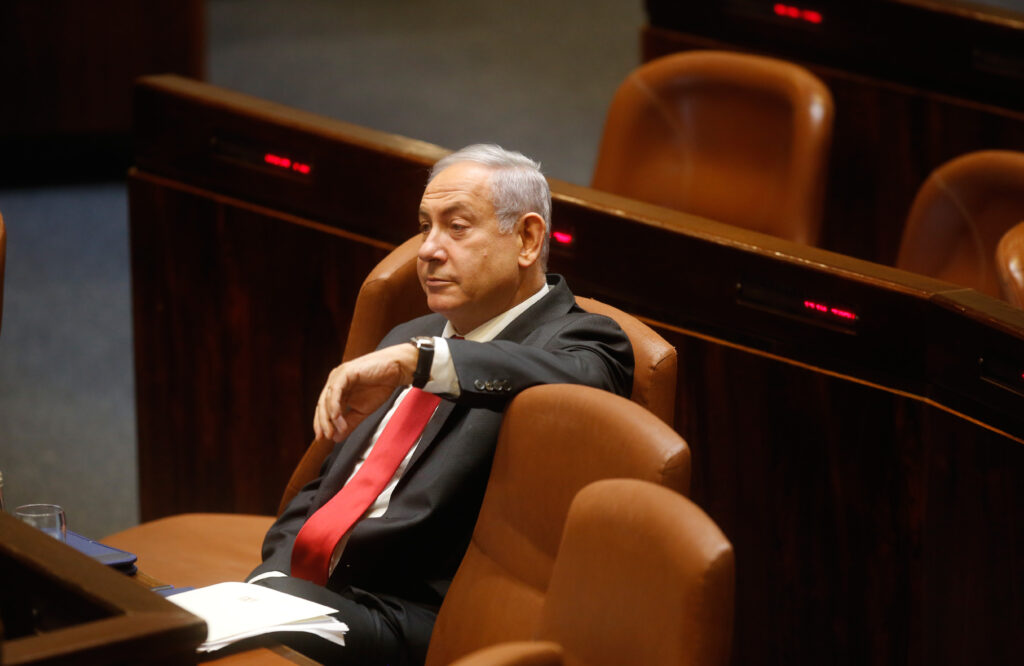
To see out the remainder of this Knesset’s term, Binyamin Netanyahu will have to navigate a budget vote, tensions over Haredi military conscription and a volatile regional environment dominated by Iran and the still unresolved Gaza situation
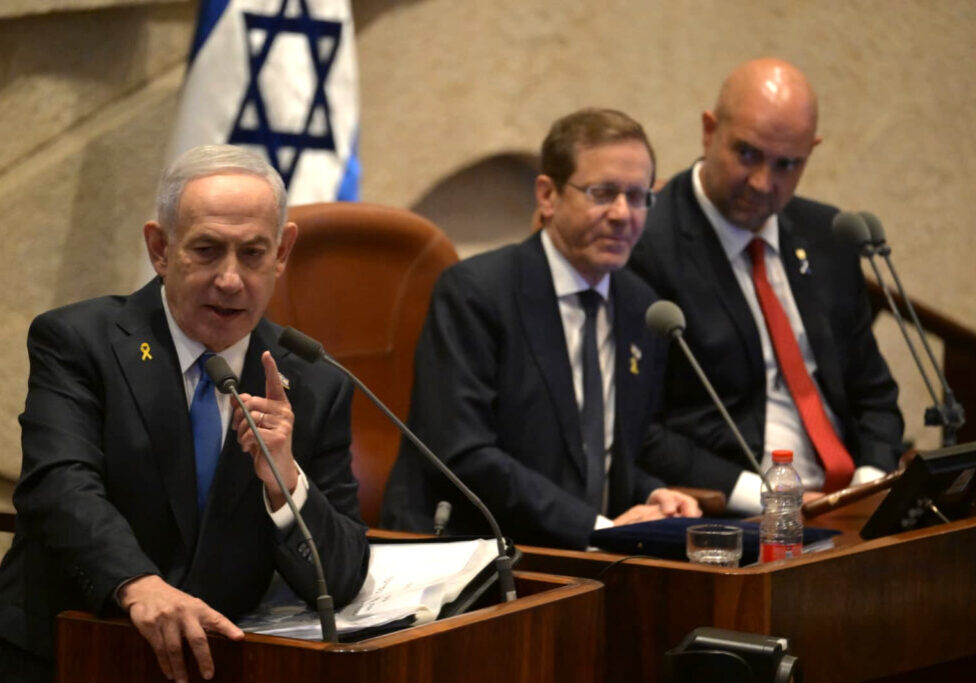
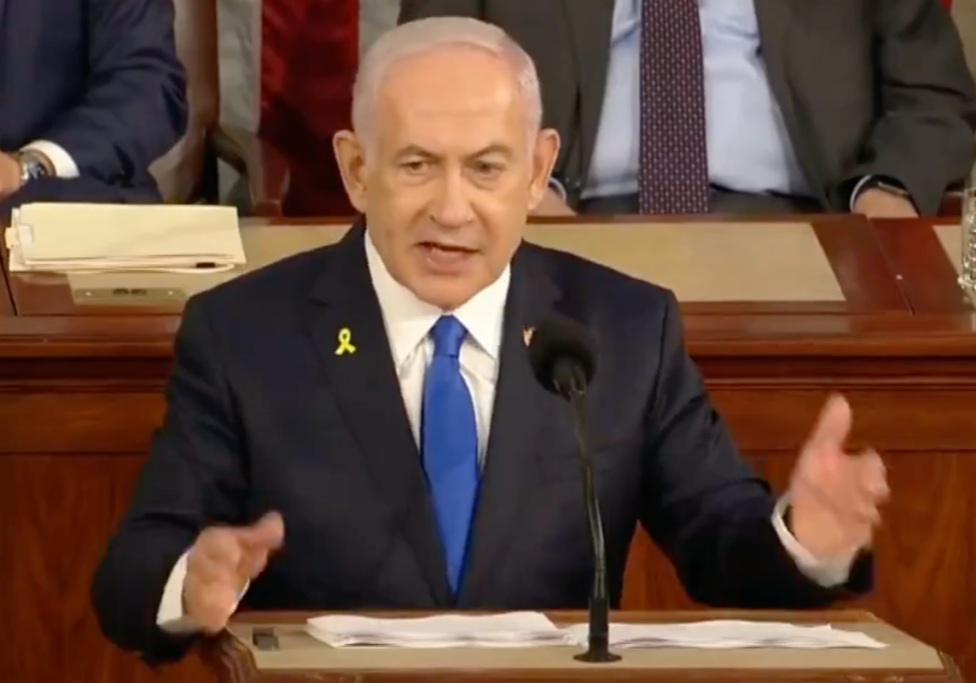
Israeli Prime Minister Binyamin Netanyahu travelled to Washington on Feb. 11 for discussions with President Donald Trump, focused primarily on the ongoing standoff with Iran.
Yet as he did so, Israeli domestic politics remained locked in an ongoing political do-or-die crisis, in which the governing coalition must pass a budget, yet is unable to do so without a breakthrough on the vexed and controversial issue of ultra-Orthodox military service.
Under Israeli law, a budget must be passed by March 31 – failure to do so would automatically dissolve the Knesset and trigger early elections. Elections have to occur by November of this year in any case.
A first reading of the budget went through by a 62-55 majority on January 29, despite threats by the two ultra-Orthodox parties – Shas and United Torah Judaism (UTJ) – not to vote in favour without securing a legislative draft exemption for their constituents.
UTJ, made up of two separate factions, Agudat Yisrael and Degel HaTorah, split over the vote, providing a possible indication of what lies ahead for the second and third readings.
Agudat Yisrael abstained from the vote, with chairman Yitzchak Goldknopf stating his dissatisfaction with enforcement measures against ultra-Orthodox draft evaders in the absence of new exemption legislation. “We cannot stand by,” he said during the Knesset debate. “This government will be remembered as the one that puts young men behind bars.”
Meanwhile, Degel HaTorah leader MK Moshe Gafni and others from his faction voted in favour of the budget but did so while stipulating that the Government’s proposed Haredi (ultra-Orthodox) draft law must be passed before subsequent budget readings to obtain their votes on it.
According to a report in Haaretz, both Shas and the Degel Hatorah faction of UTJ are willing to make far-reaching compromises to ensure that the draft law proposed by the Government passes, enabling them to vote for the budget. A source from Degel Hatorah told Haaretz that they would probably vote for the law even if it did not resolve the status of thousands of Haredim who have been declared draft dodgers since the Supreme Court decision invalidating their exemptions in 2024. Instructions from the rabbis who guide these parties are to pass the law at “any cost”, the source said.
The Agudat Yisrael faction controls just three seats, so the budget could, in theory, pass without it. This arithmetic affords Goldknopf space for grandstanding and brinkmanship without risking bringing down the Government.
Prior to the vote on the preliminary reading, the economic daily Calcalist framed the situation in explicitly fiscal terms: failure to pass the budget could significantly reduce funding for ultra-Orthodox educational institutions, a factor seen as giving the Haredi parties a clear incentive to avoid a budget crisis.
For Shas and UTJ, the stakes are both ideological and institutional. Their leadership views protection of the yeshiva system – seminaries in which most ultra-Orthodox young men study religious texts daily, while also mostly avoiding paid employment – as more than merely a core political obligation to their electorate. They see it as an existential defence of their community’s way of life, which they do not believe can survive widespread military service and the exposure to a more secular Israeli lifestyle this would entail.
At the same time, these parties must weigh that commitment against the risk of early elections, particularly given that polling presently shows the current coalition likely failing to achieve the 61 Knesset seat threshold required to secure a return to power. Any alternative governing coalition that would exclude these parties would make achieving their political aims all but impossible.
The proposed budget for fiscal year 2026 stands at NIS 811.74 billion (AU$317 billion), comprising a regular budget of approximately NIS 580.75 billion (AU$266 billion), with NIS 112 billion (AU$51 billion) earmarked for defence, and a development and capital budget totalling approximately NIS 230.99 billion (AU$106 billion).
Presenting the budget, Finance Minister Bezalel Smotrich extolled what he described as the resilience of Israel’s economy despite the ongoing war. “Our macroeconomic figures are nothing short of remarkable,” he said. “After two years of an expensive war, the State of Israel is a powerhouse of strength. We are projecting GDP growth of 5.2% in the coming year.”
The same week, a visiting IMF mission praised aspects of Israel’s economic performance but, as in previous reviews, warned of structural challenges – including low employment rates among ultra-Orthodox and Arab Israelis – and flagged the growing deficit that resulted from financing two-and-a-half years of war in Gaza.
Yet the success of the Israeli economy, with a soaring shekel and a surging Israeli stock exchange, does nothing to resolve the core political issue facing Netanyahu’s coalition: the absence of a legally viable framework governing ultra-Orthodox military service.
Since the Supreme Court’s June 2024 ruling ending blanket draft deferments for ultra-Orthodox yeshiva students, Netanyahu’s Government has struggled to formulate replacement legislation that would satisfy both judicial scrutiny and its ultra-Orthodox partners.
Indeed, it still remains unclear if the legislation currently being debated – which sets increasing targets for ultra-Orthodox conscripts over the next five years, but proposes conscripting only those ultra-Orthodox men not in full-time religious study, and offers civil but no criminal sanctions on draft dodgers, while lifting all sanctions once they turn 26 – can survive a Supreme Court challenge.
The practical problem is straightforward. The Israel Defence Forces continue to face manpower pressure following the prolonged Gaza campaign and the broader regional escalation that began with the October 7 attack.
Even with the current ceasefire in Gaza, reserve mobilisation levels remain very high in Israel, and public sensitivity to perceived inequalities in military service has increased accordingly. This has made the conscription issue even more politically charged than in the past.
Thus, Opposition Leader Yair Lapid, speaking at the preliminary hearing for the budget, described it as one of “corruption and draft evasion.”
“In order to finance the 60 billion shekels that ultra-Orthodox draft evasion costs, they are raising taxes on Israeli citizens,” he said.
While the Opposition has sharpened its rhetoric, its parliamentary leverage remains limited.
Lapid and other centrist leaders have framed the draft exemption issue as a question of equality before the law and of burden-sharing during wartime – themes that resonate among reserve families fatigued by prolonged mobilisation. By linking draft exemptions to tax increases, Lapid seeks to recast the debate as both a fiscal and national-security concern.
Yet the Opposition lacks the numbers to block the budget unless discipline within the governing coalition fractures from within. Its strategy, therefore, focuses on widening internal tensions, particularly between Likud and its ultra-Orthodox partners, and on sustaining public scrutiny around the conscription issue.
At the same time, the Opposition itself is increasingly fractured, with tensions persisting over leadership positioning, campaign priorities and whether or not to join forces with majority Arab parties to form government. These divisions have complicated efforts to present a coherent governing alternative. In that sense, the Opposition’s challenge is not only to exploit Government vulnerabilities, but to demonstrate that it can overcome its own internal strategic contradictions.
Netanyahu’s political calculus is characteristically cautious. His immediate objective is not the resolution of the political issues but coalition survival. By sequencing the draft legislation ahead of the final budget votes, he buys time and reduces the probability of having to deal with several crises at once. The strategy is a good example of Netanyahu’s long-standing political playbook: defer confrontation, maintain ambiguity in legislative drafting and rely on incremental compromises that satisfy coalition partners without fully resolving structural tensions.
The Prime Minister’s Washington visit underscored how Israel’s external environment remains volatile. Both the possibility of an American operation against Iran that would lead to Teheran retaliating against Israel and the possibility of a US-Iran deal that resolves the nuclear file but leaves Iran’s missile arsenal intact create major strategic dilemmas for Israel. Yet the clock is ticking down towards new elections amidst major domestic disputes, especially ultra-Orthodox conscription.
Meanwhile, Gaza is still a source of regular violence, and the currently halting efforts to advance “Phase II” of the Trump Administration’s Gaza plan, which calls for Hamas disarmament followed by Israeli withdrawals, will inevitably bring about additional security quandaries and international pressure over the coming months.
An election campaign would inevitably constrain strategic decision-making on Iran, Gaza and other urgent issues. Caretaker governments in Israel traditionally avoid far-reaching strategic moves unless compelled by immediate necessity. Budgetary uncertainty would also complicate long-term defence procurement and force planning. While Israel’s security establishment is capable of operating under political turbulence, sustained instability carries costs- both operational and diplomatic.
All of this converges on a single deadline: March 31. If the budget fails to pass by then, the Knesset dissolves automatically and Israel heads to elections, probably in June. That prospect looms over every negotiation between Netanyahu and his ultra-Orthodox partners.
For now, mutual self-interest favours compromise. The Haredi parties require budgetary continuity; Netanyahu requires their votes. But the margin for error is thin. The Supreme Court has altered the legal baseline. The war has altered the socio-political baseline. And the regional environment offers little tolerance for prolonged political paralysis.
Netanyahu’s balancing act, therefore, is not merely about managing coalition partners. It is about synchronising domestic stability with strategic continuity at a moment when both are under increasing pressure.
Bibi iswidely acknowledged as a master of the difficult art of maintaining a political coalition of diverse parties with often contradictory priorities. Whether he can maintain that balance and overcome the March 31 deadline will likely have significant effects not only on the lifespan of his current government, but also on wider regional developments.
Tags: Binyamin Netanyahu, Israel, Israeli politics
RELATED ARTICLES



Australia gripped by the plight of the Iranian women’s football team: Dionne Taylor on GB News
Enormous hope that Iran is being liberated: Colin Rubenstein on Sky News