FRESH AIR
India/Israel ties look promising in Modi’s second term
June 14, 2019 | Sarah Jacobs
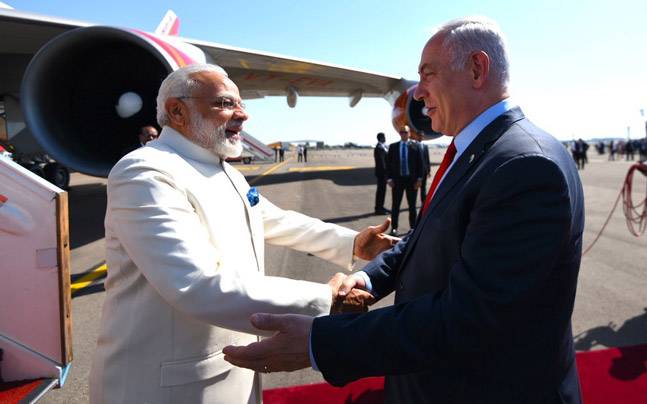
On 30 May, Narendra Modi was sworn in to his second term as India’s Prime Minister.
For Israeli PM Benjamin Netanyahu, Modi’s re-election was warmly welcomed as an opportunity to strengthen the burgeoning political, economic, geostrategic and defence ties and on a range of issues including counter-terrorism, Iran, and the United Nations that have marked relations between the two countries since Modi first took office in 2014.
Less than two weeks after Modi’s swearing in, his government voted with Israel in the United Nations to block a request by Palestinian NGO Shahed to obtain observer status, the only nation from the Asia group to do so.
Netanyahu tweeted to Modi personally thanking him for India’s support at what has been described as an unprecedented “historic vote”.
This noteworthy shift in India’s voting is all the more remarkable given New Delhi’s historical lack of support for Israel in the public international arena, particularly at the UN.
In November 1947 India opposed the UN Partition Plan of Palestine and voted against Israel’s admission to the United Nations in 1949. Although India finally recognised the State of Israel in September 1950, the Indian embassy only opened in Israel 42 years later.
The historic frostiness is still evident in India’s voting record at the United Nations where it continues to support the 20 highly one-sided anti-Israel resolutions the General Assembly rubber stamps each year (albeit with the occasional abstention). More recently, in December 2017, India voted to condemn the Trump Administration’s decision to recognise Jerusalem as Israel’s capital and move the US embassy there.
Though the wheels of change towards favouring Israel have turned slowly in international fora, Modi’s growing support for Israel is felt in India domestically as well as internationally. Shortly after Modi’s first election, the Indian Parliament voted down a resolution that would have condemned Israel’s actions in the 2014 war with Hamas, a statement of the centre-right party’s support for Israel.
Under Modi’s leadership, India’s relationship with Israel has never been better. After signing documents of cooperation, as reported by AIJAC last year, India now has agricultural training centres that teach Israeli methods of water desalination and purification, academic collaboration with Israeli universities, and even ties between Bollywood and Israel’s film industry.
The improvement in overall relations between the two countries is partly due to the development of Netanyahu and Modi’s close personal relationship, captured by their iconic walk along the shores of Haifa while discussing desalination technology. The two Prime Ministers were quick to congratulate one another over their recent re-elections via Twitter, and in a filmed phone conversation, Netanyahu said he hopes to see Modi as soon as they both form governments, and ironically joked, “but there is one difference: you don’t need a coalition, I do!”
During Modi’s historic visit to Israel in 2017, Netanyahu and Modi connected over Modi’s equation for successful advances in IT: Israeli technology plus Indian talent. Modi has certainly enlightened India to the benefits of partnering with Israel.
India is the largest buyer of Israeli weapons in the world, appreciating Jerusalem’s transparent policies free from attempts to to influence New Delhi’s foreign policy. In the recent developments of the India-Pakistan conflict, India not only used Israeli intelligence tactics to strike an alleged terrorist camp inside Pakistan, but also used Israeli made weapons, including the SPICE (Smart, Precise, Impact, and Cost-Effective) precision bomb.
One zone of contention for Indo-Israeli relations is India’s close relationship with Iran, which Sadanand Dhume of the American Enterprise Institute defined as “one of necessity” due to the geographical proximity between India and Iran.
India was the second largest buyer of Iranian oil, but ended all Iranian oil imports last month due to US sanctions.
India can also play an important role in combatting Iranian support for global Islamist terrorist groups, including those in neighbouring Pakistan.
Modi’s leadership has paved the way for a new vision of India’s foreign policy, the opposite of what Dhume describes as “the old Indian standoffishness towards Israel [that] was not in fact due to any kind of high principle; it was in fact due to cowardice and fear.”
Barring unforeseen events, with India in the role of the world’s largest democracy with the second largest population, the seventh largest economy, and relationships with Muslim and Arab countries, one can expect the strategic relationship with Israel to assume even greater significance in Modi’s second term.
Tags: Benjamin Netanyahu, Elections, India, Israel
RELATED ARTICLES




Enormous hope that Iran is being liberated: Colin Rubenstein on Sky News
He survived Bondi. Now he’s fighting back: Arsen Ostrovsky addresses AIPAC conference