IN THE MEDIA
What I learned on Bondi beach
January 7, 2026 | Arsen Ostrovsky
7 January 2026
Survival does not always come with answers. It does, however, come with responsibilities.
Not long after the Bondi Beach terror attack on December 14, which claimed the lives of 15 people and injured dozens more—including me—I was asked a question I was not quite prepared for: Since the attack, am I more a man of faith or less?
The question sounded simple, almost routine, but it stopped me cold. When you stand at the precipice between life and death, faith is no longer abstract. It becomes the lens through which every memory, breath, and decision is framed.
On that Hanukkah night, my family and I had gathered with the Jewish community at Bondi—our community—to celebrate light, life, and belonging. Instead, violence tore through what should have been a moment of joy. I was struck in the head by a bullet and collapsed, unsure if I would ever see my wife and children again. At the hospital, doctors told me that my survival came down to millimetres. By all medical accounts, they said, it was a miracle.
But miracles are not always neatly packaged. They are complicated.
I cannot explain why my life was spared while 10-year-old Matilda, full of laughter, promise, and innocence, was taken from her family and our community. Nor can I explain why I am here today, while 87-year-old Alex Kleytman, a Holocaust survivor who had already endured humanity’s darkest chapter, was murdered protecting his wife.
Lying on the ground that balmy summer night in Sydney with blood still gushing from my head, having just learned that my wife and children had reached safety, I found myself reciting the Shema, the ancient and seminal Jewish declaration of faith. I do not know what compelled me to speak those words, which came instinctively, not as a calculated act. I am not the most observant of Jews, yet in that moment I uttered them, not knowing if they would be my last.
As a human rights lawyer and activist who lived in Israel for 13 years before relocating to Australia to take up a senior leadership position within the Jewish community, I have spent much of my life telling stories of terror and resilience, advocating for victims, documenting atrocities, and fighting for survivors. I never imagined I would become one myself. But here I am.
Survival does not always come with answers. It does, however, come with responsibilities.
What I do know is this: I am alive. And being alive carries an obligation to tell the truth about what happened, to honour those who were taken, and to continue confronting the scourge of antisemitism that made such violence possible.
The attack at Bondi was not random. It was a targeted act of antisemitic terror, the deadly culmination of a sustained campaign of incitement, dehumanisation, and inaction by our political leaders. It has left many Jewish Australians afraid to openly express who they are, and it has exposed just how fragile our social fabric becomes when hatred is tolerated, excused, or mainstreamed.
I know that fear personally. What I witnessed that night was pure evil: terror, screams, and lifeless bodies, images permanently etched into my memory. Surviving Bondi sharpened my awareness of how quickly our societies fracture when prejudice is left unchecked.
But that is not the whole story.
Because even in the darkness, I witnessed something extraordinary, something profound and deeply hopeful. Ordinary Australians, Jews and non-Jews alike ran toward danger to help the wounded. With no obligation and no protection, they offered aid, comfort, and compassion, risking their own lives to shield strangers and stop the attackers.
I know this firsthand, because I was one of the recipients of their courage and generosity. With bullets still flying, one stranger tore his shirt to help stop my bleeding. Another, a nurse from across the street, ran toward the chaos and later helped administer an IV drip, while a surf lifesaver came running with water. There were countless such acts of heroism: Ahmed al-Ahmed, who tackled one of the attackers; and Boris and Sofia Gurman, a husband and wife who could have stayed under cover but instead chose to confront the terrorists, losing their lives in the struggle.
Since then, Australians from across the spectrum and every part of society have come together, calling for a royal commission into antisemitism that not only explores what happened but how we arrived at this moment, and whether we are prepared to confront the forces that made it possible and expose the root causes of a systematic and institutional assault on the Jewish community.
This is the real Australia. Not the ravenous hatred of the murderers and their enablers, but the quiet courage and honesty of decent people.
They remind us that while hatred can be loud and lethal, decency is often quiet and far more enduring. And that we shall prevail not because the forces of hate don’t exist, but because we choose to stand in defiance of them. We shall prevail because our memories will not fade, because our stories will be told, and because our communities will continue to celebrate Jewish life, culture, and faith even in the face of attempts to extinguish them.
That is a lesson worth holding on to.
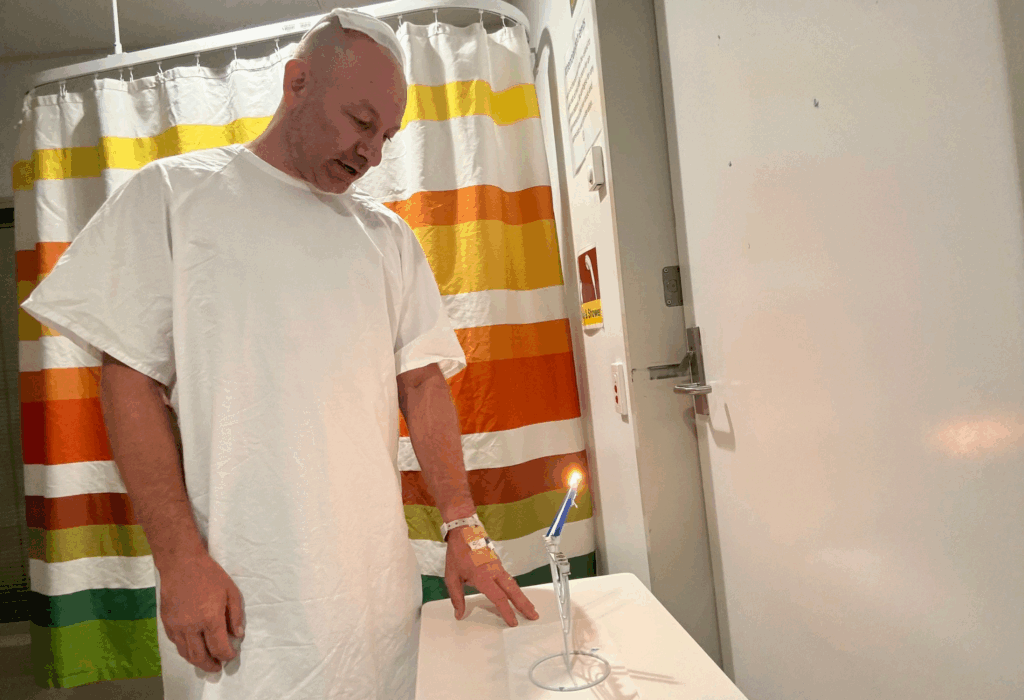
Although I was unable to light the first night of Hanukkah candles with my family and the Jewish community at Bondi, I insisted on doing so the very next day, from my hospital bed.
Ultimately, faith is not diminished by being tested. It is defined by what we choose to do after the test. Whether in Australia, the United States, or anywhere antisemitism and hatred are allowed to take root, the same fundamental truth applies: If we lack the courage to confront it, it will spread, corroding the very fabric of our societies.
As Rabbi Lord Jonathan Sacks once warned, “A world without room for Jews is one that has no room for difference, and a world that lacks space for difference lacks space for humanity itself.”
So, if I am asked again whether I am more or less a man of faith since that first Hanukkah night of December 14, my answer is this: My faith was tested, and it endured. Not because my life was spared, but because survival demands something of us. It demands that we remember those who were taken, speak for those who no longer can, and stand without apology against hatred, terror, and antisemitism.
Yes, I am a survivor. I am also a witness. And the lesson of Bondi, one I will carry with me always, is that faith is not proven by survival alone, but by the courage to confront the forces of darkness and hate.
Tags: Antisemitism, Australia, Bondi, Terrorism