IN THE MEDIA
When a platform becomes a weapon
February 23, 2026 | Justin Amler
Sky News – 23 February 2026
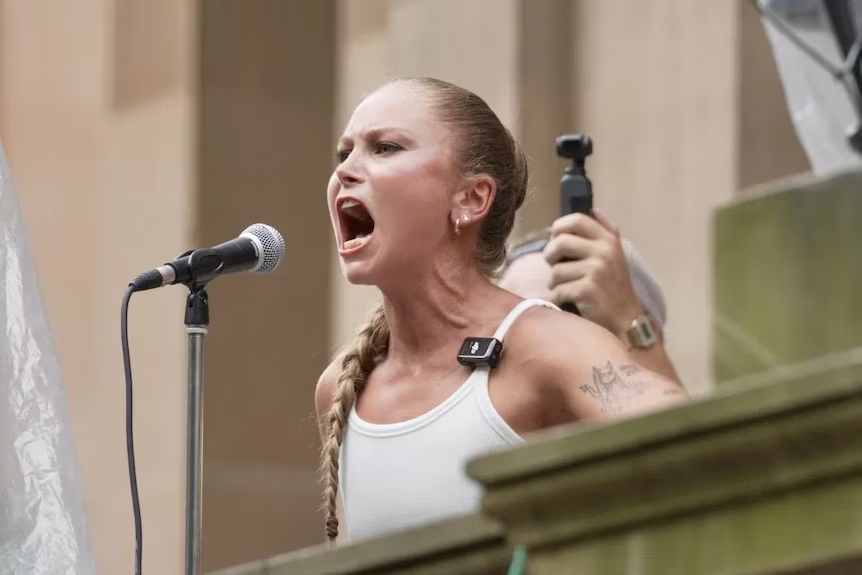
The chants of former Australian of the Year Grace Tame are still echoing in the ears of Australian Jews all over the country. To have someone who has been bestowed a great honour, one reserved for someone who embodies Australian values such as fairness, respect and compassion, use a chant widely interpreted as a call for violence against a segment of the Australian community is both troubling and distressing.
“Globalise the intifada,” the chant Grace Tame led from the steps of Sydney Town Hall, is not a neutral political slogan. It is a phrase historically intertwined with organised violence against civilians – especially Jewish civilians.
When such slogans are normalised by high-profile figures, two possibilities exist: either the historical weight of the language is understood, or it is not. If its history is understood, amplifying it is reckless. If it is not understood, it is irresponsible. Neither is harmless or acceptable.
Public platforms are powerful things. They amplify voices, shape discourse and influence culture. But when used carelessly — or recklessly — they can inflame rather than enlighten.
In recent years, we have seen a troubling trend: prominent public figures using cultural events, festivals and public platforms to demonise Israel in language that moves well beyond policy critique and into delegitimisation, often with implicit calls for violence.
Grace Tame released a social media post in which she claimed in her defence that those attacking her for her words are putting a “negative spin” on the word intifada. She trivialises it by saying simply that it means “shaking off” as if it’s some innocent animal shaking off the water after running through a sprinkler system. She makes this statement right after claiming, based on a conspiratorial and factually debunked Al-Jazeera report, that almost 3000 Palestinians were, in her words, “evaporated by Israel using illegal US weapons”.
In the context of the Israeli-Palestinian conflict, “Intifada” is not an abstract metaphor. It is the word describing the waves of suicide bombings, shootings and stabbings in buses, cafes, hotels and on the streets, from 2000-2005, which murdered over a thousand people, overwhelmingly civilians. Calling for Intifada to be “globalised” is calling for the same thing to happen in other places, such as Australia.
We have already seen how rhetoric tied to “intifada” has coincided with violence reaching diaspora communities.
We saw it in those horrific scenes at Bondi Beach on December 14 last year, where Jews were targeted at a Hanukkah event. We saw it when two Israeli embassy workers were gunned down on the street in Washington. And we saw it when a synagogue in Manchester was attacked on Yom Kippur – the holiest day in the Jewish calendar.
In her attempt to deflect responsibility, Tame says the story is not about her, but about Israel.
She’s wrong.
The story is about her – and about all those who use their high-profile public platforms to demonise the State of Israel through inflammatory and unfounded charges, based not on evidence, but on emotive rhetoric.
Hollywood actors and other celebrities use their massive platforms to spout on about social justice, wearing pins, pledging not to work with Israeli artists, as if they’re uniquely positioned to be the arbiters of truth and justice in the world. The truth is that many of those amplifying such slogans have never had to shelter their children from rockets crashing into their homes or hide from gunmen at a music festival murdering their friends.
Learning history from TikTok is not education, it’s indoctrination. And being validated by the amounts of likes on social media posts is not about arming yourself with knowledge. It’s about immersing yourself in ignorance.
And since when do feelings replace facts anyway? Since when do slogans replace reality? Since when do distortions replace the truth?
This twisting of history is typical of the modern anti-Israel movement. It constructs a fantastical moral universe in which Israel is uniquely evil and illegitimate and Jewish national identity is framed as unworthy of basic rights accorded to other peoples. It indulges simplistic narratives detached from history, while presenting them as moral clarity. It is a world in which terrorists are glorified as folk heroes while those defending their homes are vilified as aggressors.
Criticism of Israeli governments is legitimate. Protest is legitimate. Political disagreement is legitimate. But using a platform for slogans historically associated with violence against civilians is not policy critique or protest — it is an act of escalation.
To be able to reach people through a massive platform is a privilege, a real opportunity to be a meaningful voice of justice and reason and compassion in a world that desperately needs truth more than anything.
But when these powerful voices are turned into a conduit for lies, deception and incitement, it is a tragedy in which all society suffers.