IN THE MEDIA
Eurovision: A tale of courage vs cowardice
December 11, 2025 | Justin Amler
Australian Jewish News – 11 December 2025
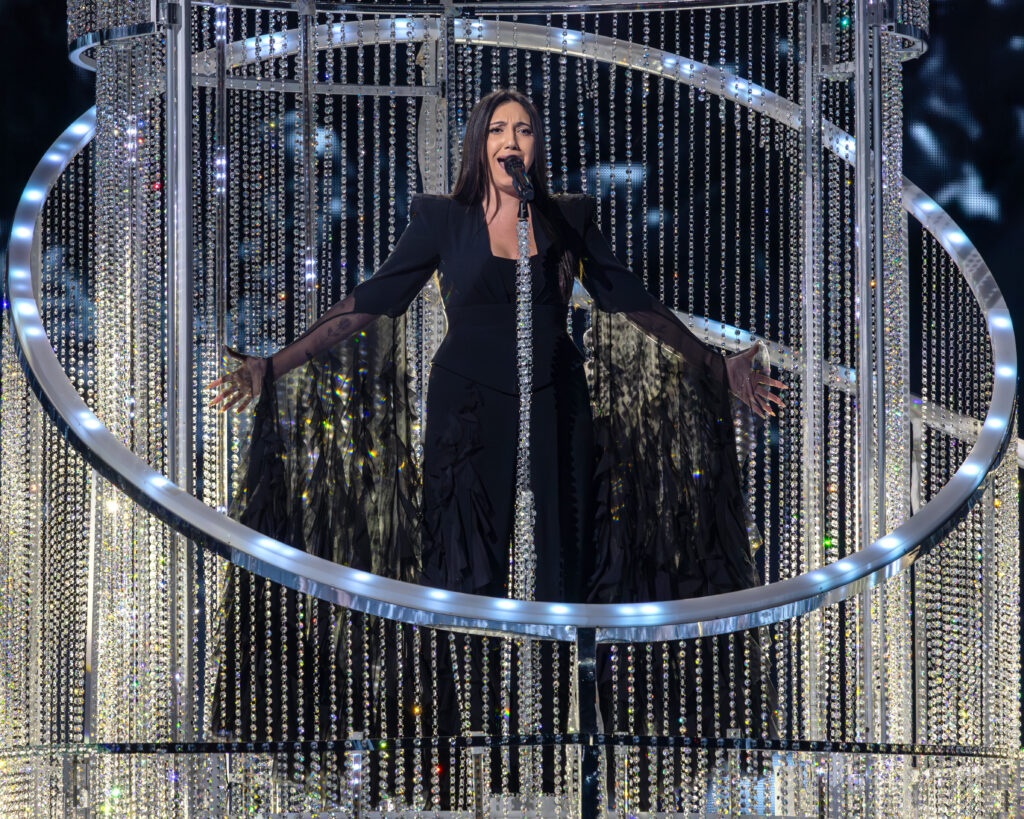
Seven months ago, Yuval Raphael stood alone on the St Jakobshalle stage in Basel, Switzerland and sang her heart out with a level of courage rarely seen. This was no ordinary performance. She was representing Israel in a hostile environment, protected around the clock from those who openly wanted to harm her. The danger was not theoretical. During the grand final, two activists attempted to storm the stage and throw red paint on her.
But Yuval sang on, powered by her people and by an uncanny bravery forged in the ashes of October 7. She had survived the massacre by hiding for eight hours in a bomb shelter, surrounded by bodies and terrorists just metres away. The slightest sound could have meant her death.
To live through that horror and then step onto a world stage is remarkable.
But last week, at a meeting in Switzerland of the European Broadcasting Union (EBU) — the body that oversees Eurovision — we witnessed the opposite of that courage: cowardice.
The broadcasters of Spain, Ireland, the Netherlands, and Slovenia led a desperate campaign to ban Israel from the 2026 contest. When they failed, they did what cowards do when they don’t get their way: they threw a hissy fit and boycotted the competition instead. Spanish Prime Minister Pedro Sánchez reacted by saying that if Russia was exiled from the competition, then Israel should be too. Irish Prime Minister Micheál Martin described the decision as an “act of solidarity.”
This sudden act of ‘principle’ means they will not participate next year — a great loss for anyone hoping to see yet another sub-par, devil-worshipping Irish performance — the kind that traumatises children for years.
No doubt, they’ll claim their boycott is grounded in moral principles. After all, their governments have taken politically hostile actions including varying degrees of boycotts or embargoes against Israel, spearheaded by what they call “principles”. This included “recognising” a non-existent Palestinian state — a symbolic gesture that has done nothing to advance peace, only push it further away by reinforcing the idea that a state can be achieved not through negotiation, but through rejection and violence.
But these arguments on principle are as farcical as Ireland’s 2008 Eurovision performance when they sent Dustin the Turkey, a puppet, as their entry.
Even as governments and broadcasters lead boycotting campaigns, reality tells a different story.
The Netherlands deploys Israeli Mobileye systems in its transport fleets, uses Netafim drip-irrigation, and relies on Given Imaging’s PillCam in its hospitals. Spain uses Israeli cybersecurity protocols in its police and security branches, and Spanish banks depend on Israeli identity-protection systems like CyberArk.
Ireland, one of Israel’s loudest critics, runs major parts of its telecom infrastructure using Amdocs, an Israeli company.
Slovenia, though small, still benefits from Israeli med-tech, irrigation systems, fleet-safety tools, and cybersecurity.
And when these same governments need advanced weapons systems or cyber-defence capabilities, as many have used before, rest assured their grand boycott will dissolve faster than a Eurovision costume change. They know, as the rest of Europe does, that in many fields Israel is a world leader in advanced technologies and defence systems.
There also exists an irony that while many leaders posture about Israel, oftentimes their own populations think differently. In the 2025 Eurovision contest, some of Israel’s highest public-vote scores came from these same countries — in stark contrast to their juries.
In many ways, Israel won a moral victory — something intolerable to the boycotting nations. So they protested. And while they failed to get Israel removed, the EBU introduced new rules widely interpreted as targeting Israeli influence – a gesture chillingly reminiscent of darker times in Europe’s treatment of Jews.
Meanwhile, these “principle-driven” governments and broadcasters remain quiet about real genocides occurring in the world — such as the horrors unfolding in Sudan, or as Hamas cold-bloodedly executes its opponents in public squares in Gaza.
This is why Eurovision has long ceased to be a song competition. It has become a virtue-signalling pageant where political grandstanding often counts for more than musical merit.
It is this moral blindness that leads over 200 cultural figures to sign a petition demanding the release of Marwan Barghouti — a convicted murderer — in the delusional belief that freeing a terrorist brings peace.
Yuval Raphael’s performance this year was a testament to strength, integrity, and courage. She represented the best of us.
Spain, Ireland, Slovenia, and the Netherlands’ performance at Eurovision 2026 — which they will boycott — is a display of cowardice, shame, and dishonour. A symbol of the worst in them.
It is, as Shakespeare wrote, a tale “full of sound and fury,” but ultimately, “signifying nothing.”
Justin Amler is a policy analyst at the Australia/Israel & Jewish Affairs Council (AIJAC).
Tags: Europe, Eurovision, Israel, October 7