IN THE MEDIA
Antizionism fuels the hatred of Jews
March 2, 2026 | Galit Jones
It’s time to name the movement fuelling Jew-hatred in Australia
Australian Financial Review – 2 March 2026
Incidents of anti-Jewish vilification and violence have become disturbingly common in Australia, yet our institutions appear paralysed when it comes to naming the movement driving it.
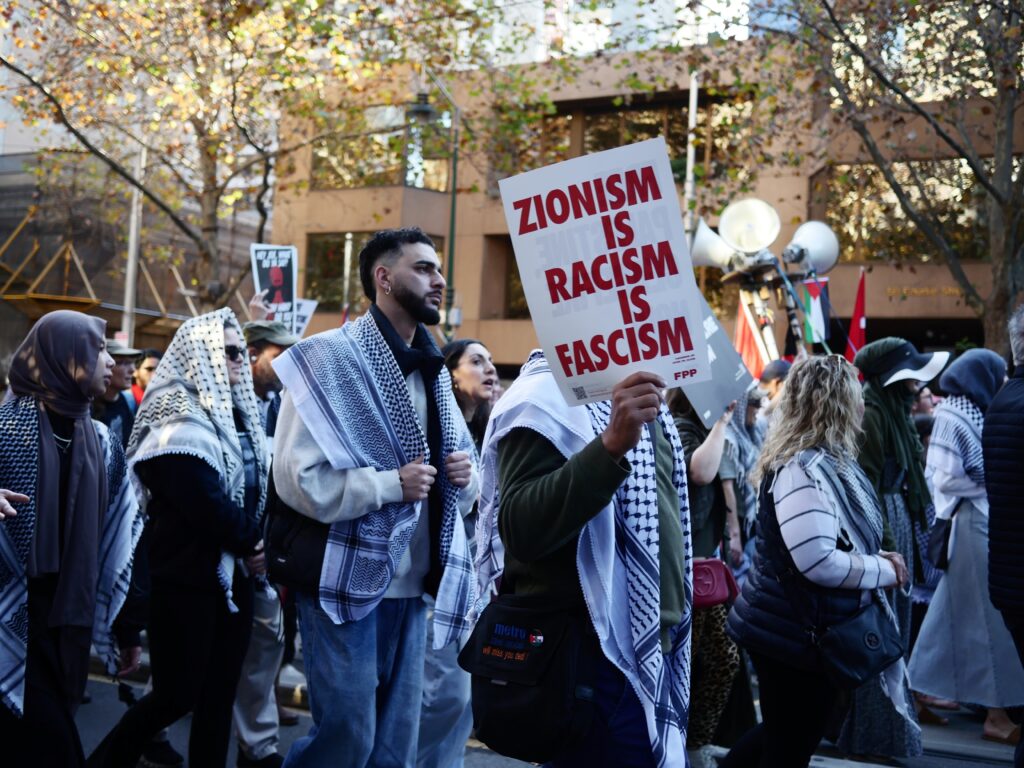
The ideology animating the hostility that is reshaping Jewish life in Australia — antizionism — simply does not fit the prevailing mental model of antisemitism. Antizionism explicitly disavows both racial hatred and religious bigotry, framing itself instead as “political critique” of an “ideology”.
This has consequences: even those who acknowledge the damage it is inflicting seem unable — or unwilling — to identify its source.
Are Australian politicians, media outlets, courts and cultural institutions capable of reckoning with the antizionist elephant in the room?
To be clear, criticism of Israel’s government does not constitute antisemitism or antizionism. Debate about any country’s policies, leaders or military actions is not only legitimate, but necessary.
But singling out Jewish national self-determination — a right affirmed for every other people — as uniquely illegitimate, immoral or incompatible with justice, is indisputably prejudiced. The antizionist conviction that the world would be vastly more just if only its one Jewish-majority state ceased to exist is antisemitism incarnate.
Apply this logic to any other nation-state and the bigotry is obvious. But Australian Jews continue to be stigmatised by a widespread, even fashionable, assertion that Jewish national existence is inherently evil.
Antizionists brand what they call “Zionists” as “white supremacists” and “settler-colonialists”, not because these labels correspond to reality, but because these words represent the ultimate moral transgressions of our era. Anyone even tangentially associated with the Jewish state becomes a legitimate target for abuse, boycotts, doxxing and sanctions. Those who object to this dynamic are dismissed as pawns or agents of the “Zionist lobby”.
To have collective responsibility imputed for the actions — real or imagined — of a foreign state; to have their pain and suffering minimised, mocked or dismissed; is a situation few Jews could ever have expected to endure.
But it is the determined refusal by so many to see what is plainly visible that has left Jewish Australians feeling a new helplessness.
Public institutions know that since October 7, Jewish Australians have faced harassment, threats and exclusion from spaces meant to protect them. Universities know Jewish students feel unsafe on campus. Courts know complaints involving anti-Jewish vilification are increasingly being brought before them. Police know Jewish schools and synagogues now require permanent security. Politicians know Jewish constituents are reporting real fear and it is often unsafe to be visibly Jewish on our city streets.
Yet when asked to explain the mechanism driving this, language suddenly softens into ambiguous references to a war on the other side of the world – “heightened tensions” and “overseas conflicts spilling over”.
Antizionism is treated as irrelevant or benign — or, at most, a political position that occasionally “crosses a line” into antisemitism. This framing allows institutions to acknowledge harm while avoiding responsibility for the ideology underpinning it. The elephant in the room continues to call for the erasure of the Jewish state while leaders condemn “antisemitism, Islamophobia, and all forms of racism.”
This failure is particularly stark given how many of our institutions have adopted the International Holocaust Remembrance Alliance working definition of antisemitism.
Denying Jews the rights afforded to all other peoples is not criticism, it is bigotry. Allowing Israel to be defined by libels rather than to be appraised along the same lines as all other states is not a political opinion, it is discrimination. And this discrimination is causing clear and present harm.
Indeed, the ideology responsible for this harm continues to not only be treated as legitimate political expression but applauded as brave dissent against a conspiratorial conception of Jewish power. This is how antizionism functions as a mask: by wrapping anti-Jewish hostility in the moral language of the day, it transforms prejudice into principle. As it has been throughout history, the targeting of Jews is repackaged as moral necessity.
For the overwhelming majority of Jews, Zionism is not a political position but an expression of peoplehood and self-determination – an indispensable and inextricable part of our Jewish identity. Targeting “Zionists” is a socially permissible way to target Jews, while offering plausible deniability.
Most institutions still refuse to make this connection.
Naming antizionism would require institutions to confront a belief system they have treated as morally legitimate, despite its discriminatory outcomes. Until they do, universities will continue to enforce anti-racism codes while tolerating antizionist “activism” that systematically marginalises Jewish students. Legal institutions will affirm equality before the law while permitting rhetoric that casts Jewish collective identity as inherently criminal. Politicians will condemn antisemitism in principle while remaining silent about Its contemporary permutation.
The upcoming Royal Commission has an opportunity to change this, and that must start with naming antizionism as the key driver of the anti-Jewish hostility now gripping Australia.
This “elephant in the room” will not disappear through silence. It must be named. And once named, it must be confronted. Otherwise, Jewish Australians will continue to hear solemn assurances that antisemitism is unacceptable — while watching the extremist and bigoted ideology that fuels it remain comfortably within the bounds of respectable debate.