IN THE MEDIA
‘Anti-Zionist’ protests just same old Soviet-style hate
February 16, 2026 | Paul Rubenstein
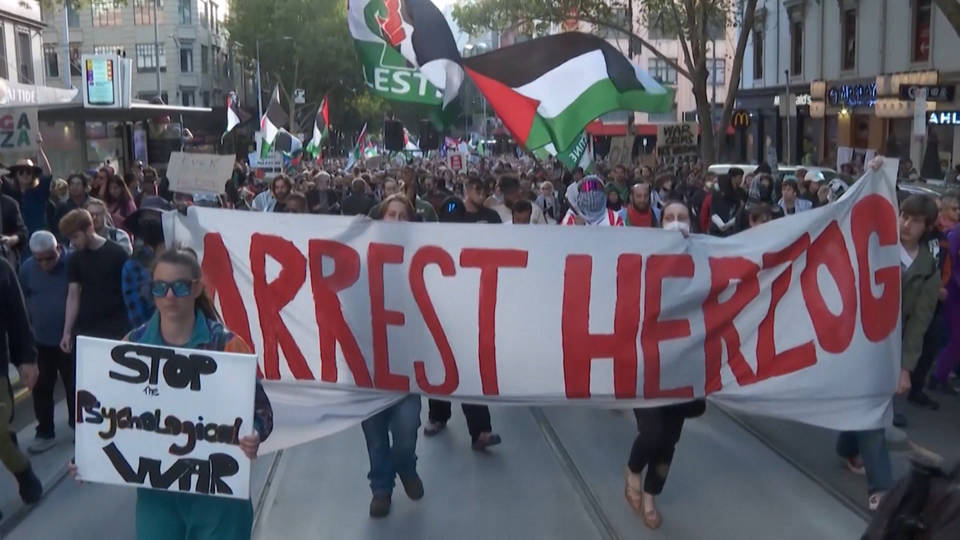
The Australian – 16 February 2026
In the old Soviet Union, the state insisted with meticulous precision that it did not hate Jews. It opposed only Zionists. Jews were welcome in Soviet society, officials said, provided they abandoned any attachment to Jewish peoplehood, national self-determination or solidarity with other Jews beyond Soviet borders.
Zionism was recast as a racist, colonial ideology – an instrument of Western imperialism – and therefore a legitimate object of political repression.
As sociologist Shaul Kelner has documented, Soviet anti-Zionism functioned as a morally sanitised antisemitism, a system that allowed the marginalisation of Jews while preserving the regime’s self-image as progressive and anti-racist. Jewish culture could be suppressed, emigration denied, activists imprisoned.
A half-century later, that same architecture has re-emerged in Western progressive politics. Nowhere is this more visible than in Sydney. The protests held this past week against the visit of Israeli President Isaac Herzog – a largely ceremonial head of state – were touted as mass mobilisation in the service of human rights and international law. In reality, they followed the same script as classic Soviet practice in which Zionism was slandered, treated as illegitimate, vilified as a symbol of global evil and Jews who associated with it were morally tainted.
Organisers of these rallies insist they are not antisemitic, only anti-Zionist. Jewish fears are dismissed as cynical or manipulative. Zionism is treated not as one national movement among many but as a uniquely malignant force. Jews who object are told the problem lies not with the organisers’ eliminationist anti-Zionist rhetoric but with their own identity.
One revealing parallel lies in how contemporary anti-Zionist movements, similar to their Soviet forebears, attempt to shield themselves from accusations of antisemitism. The Soviet Union paid and promoted a small number of professional “anti-Zionist Jews” as proof of its moral purity. Today’s protest movements prominently align themselves with a small number of left-leaning, anti-Zionist Jews – “proof” that hostility towards Zionism cannot possibly be antisemitic.
This tactic is actually ancient. Throughout history, from the Inquisition’s conversos to Enlightenment Europe’s “emancipated” Jews, movements hostile to Jews have rewarded those individual Jews willing to conform to the ideological demands of the day.
Today, those terms are ideological rather than theological. “Good Jews” disavow Zionism and validate the anti-Zionist movement’s moral framework in its entirety. “Bad Jews”, the overwhelming majority of Jewish Australians, have ties to Israel and insist that Jewish self-determination is legitimate.
Perhaps the clearest echo of Soviet propaganda lies in the movement’s moral selectivity. Soviet anti-Zionism cloaked itself in the language of international law and human rights while remaining conspicuously silent about Moscow’s own atrocities. The Soviet Union did not merely commit human rights abuses; it systematised them. Yet “Zionism” remained an obsession.
Today’s protest movement follows the same pattern. In the name of the new secular religion of human rights and international law, it is singularly fixated on Israel, advancing maximalist accusations with extraordinary intensity.
At the same moment, it is almost entirely silent about the catastrophic human rights abuses unfolding in other places – for instance, Iran.
Iran is witnessing thousands murdered, executions, mass arrests, torture and the violent suppression of women, religious minorities and dissidents. These abuses are ongoing and extreme. Yet there are no similar mass marches, no sustained outrage, no chanting crowds.
This is not accidental. This movement is not driven by universal principles but by ideological fixation on Israel as the object of an obsessive world view. Human rights are deployed selectively, hypocritically and almost exclusively as a weapon against the Jewish state – including by developing unique reinterpretations of international law designed solely to facilitate condemning Israeli policies and behaviours common across many states.
This context matters when considering the Bondi Beach massacre. In the ultimate irony, many of the victims of Bondi were Jews whose families had fled the Soviet Union, people who had lived under precisely this system. They left societies where antisemitism was denied, intellectualised and moralised. They came to Australia believing that here Jewish existence would not be contingent on ideological conformity.
That belief was shattered when the killers emerged from a cultural environment in which Jews had already been recast as political symbols rather than human beings, where Jewish identity had been divided into acceptable and unacceptable forms, and where open hostility towards the latter, the overwhelming majority, had been normalised.
Supporters of the protests will insist they oppose a state and human rights abuses, not a people. But when a movement treats Jewish self-determination as uniquely illegitimate, elevates compliant Jews to silence the majority, uses human-rights language selectively and mobilises obsessively against Israel while ignoring abuses elsewhere vastly worse than those alleged against Israel, it reproduces the moral logic of Soviet anti-Zionism with chilling precision.
The Soviet Union perfected antisemitism without antisemites. It also ended up in the dustbin of history. Let’s hope the recent visit of Herzog – as well as the upcoming royal commission – marks a turning point where out of the shadow of Bondi Beach the “anti-Zionist” movement and these hateful demonstrations are seen clearly by Australians – and firmly rejected – for what they really are.
Paul Rubenstein is the NSW chairman of the Australia/Israel & Jewish Affairs Council.
Tags: Anti-Zionism, Antisemitism, Australia, Israel