IN THE MEDIA
Herzog’s visit brought warmth to Australia’s Jews
February 18, 2026 | Justin Amler
Jerusalem Post – 17 February 2026
For the past few years, many Jews around the world have felt alone.
We watched as our brothers and sisters in Israel were slaughtered on October 7. We watched as their pain was minimised, their suffering dismissed, their ongoing anguish ignored.
We saw international bodies twist reality until victims were reframed as aggressors and terrorism blurred into “resistance.” We saw ancient libels resurface, so that Israel — still reeling from a sadistic terror attack — was suddenly accused of the very crimes committed against it.
In country after country that prides itself on fairness and human rights, moral clarity gave way to moral confusion. Democracies that speak the language of justice appeared hesitant when Jews were the targets.
Israel – the Jew among the nations – was treated with the same equivocation.
But it was not only Israel. Jewish communities across the diaspora found themselves on the frontline of an increasingly hostile ideological campaign against their identity.
Across Western democracies, antisemitism surged to levels not seen in generations. In Australia, reported incidents skyrocketed. In Canada, the UK and elsewhere, Jewish communities faced abuse, intimidation and violence.
These were not abstract statistics. Jews were assaulted. Synagogues attacked. Businesses vandalized. Streets filled with marches where hostility toward the Jewish state bled easily into hostility toward Jews.
All of it often framed as moral virtue.
All of it defended with the same refrain: “It’s not about Jews – it’s about Israel. Anti-Zionism isn’t antisemitism.”
But when calls are made to dismantle the world’s only Jewish state – the sole refuge in a long history of exile and persecution – Jews understandably hear something deeper.
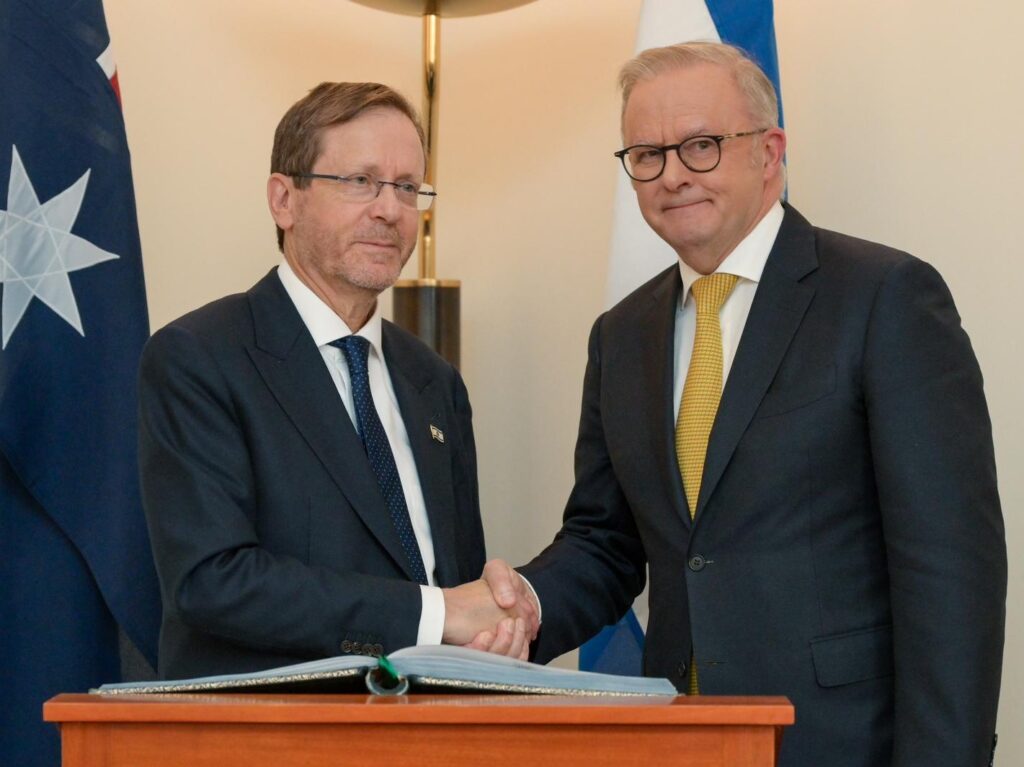
That is why Israeli President Isaac Herzog’s visit to Australia mattered.
For more than two years, Australian Jews have endured rising hostility. Synagogues firebombed. Schools defaced. Restaurants attacked. Neighbourhoods targeted. Even the “smaller” incidents – the slurs, the threats, the intimidation – accumulate like daily arrows.
Antisemitism has become so normalised that many incidents barely register beyond the community itself.
In that climate, Herzog’s visit was not simply a diplomatic engagement. It was the embrace that we needed for a community that for too long felt isolated and vulnerable.
His presence carried emotional weight. It reminded Australian Jews that the bond between Israel and the Jewish people is not political fashion – it is historical, cultural and existential.
Australian Jews love this country. They are deeply patriotic. At pro-Israel rallies, Australian flags are raised alongside Israeli ones – a visible affirmation that loyalty to Australia and support for Israel are not contradictory but complementary.
But Jews are also a people shaped by memory. History is not simply about the past; it’s a lived experience. That is why the existence of Israel is not theoretical. It is woven into Jewish identity after centuries of exile and vulnerability.
President Herzog’s visit reaffirmed that connection. He came to honour the victims of the Bondi massacre, but he also reminded Australian Jews that they are part of a small but enduring people who have traversed continents and centuries, contributing richly to the societies in which they live while maintaining an unbreakable link to their ancestral homeland.
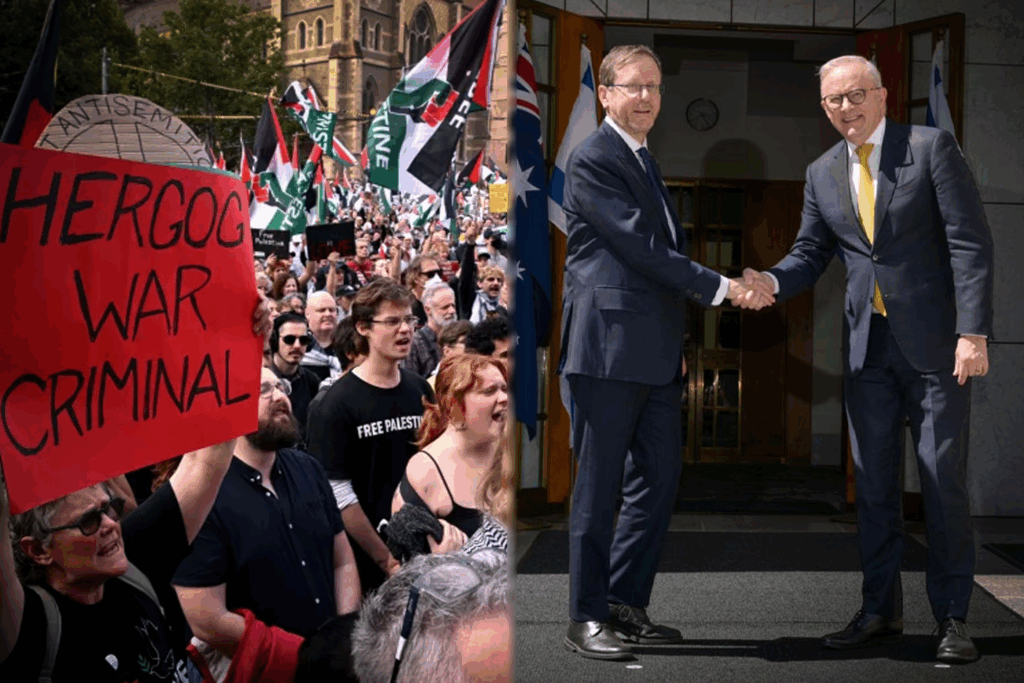
To his credit, Prime Minister Anthony Albanese was gracious in hosting the visit. Yet it cannot be denied that in recent years, under his government, actions have been taken that have strained the relationship between Australia and Israel, deeply unsettling the Australian Jewish community. This includes sustained public criticism of Israel’s wartime actions, diplomatic shifts at international forums and the recognition of a State of Palestine at a time when no meaningful Palestinian commitment to coexistence has been demonstrated. Restoring the trust that once existed requires more than ceremony; it requires moral consistency.
The visit itself illustrated the tension.
On the steps of the Sydney Town Hall, just a short distance from where President Herzog was meeting victims of the Bondi Massacre, Grace Tame, a former Australian of the Year recipient, led a crowd in chants to “Globalise the Intifada”, a call for violence against Jews worldwide.
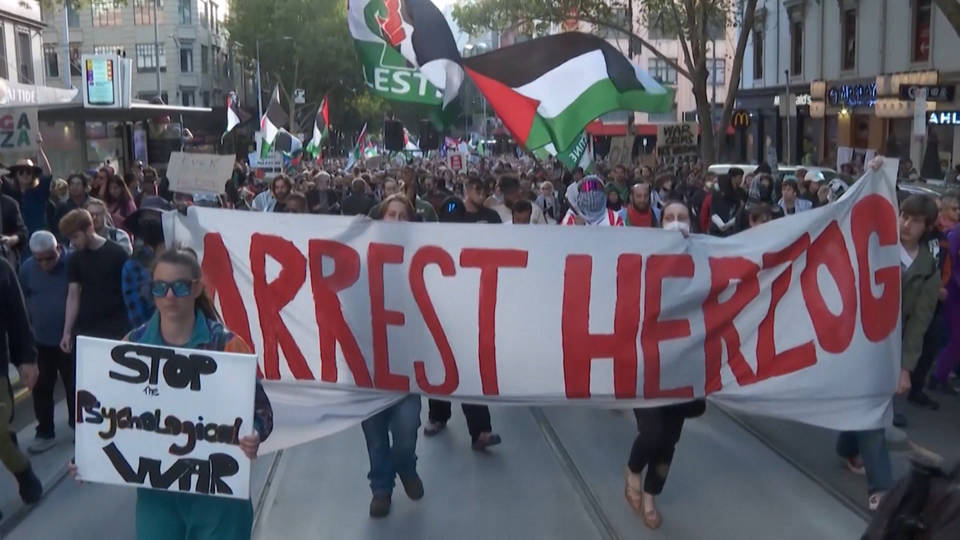
Then in Melbourne, Herzog was prevented from visiting the Adass Israel synagogue, destroyed by an arson attack, due to security concerns caused by the many thousands of protestors.
It should alarm every Australian that the President of the world’s only Jewish state could not safely visit a synagogue destroyed by arson.
At Melbourne University, graffiti was displayed on a wall calling for “Death to Herzog” along with Israel and Australia. Chillingly, the red triangle of Hamas – a symbol meant to invoke the targeting of Jews – was included in that despicable graffiti.
Clearly, in the fight against this hatred, Australia still has much work to do.
President Herzog’s visit was a moment of warmth in what has been a long, cold winter of discontent. He brought much-needed solidarity and reassurance — something we are all in need of today more than ever.