IN THE MEDIA
The Bondi massacre – one month later
January 13, 2026 | Justin Amler
The Algemeiner – 12 January 2026
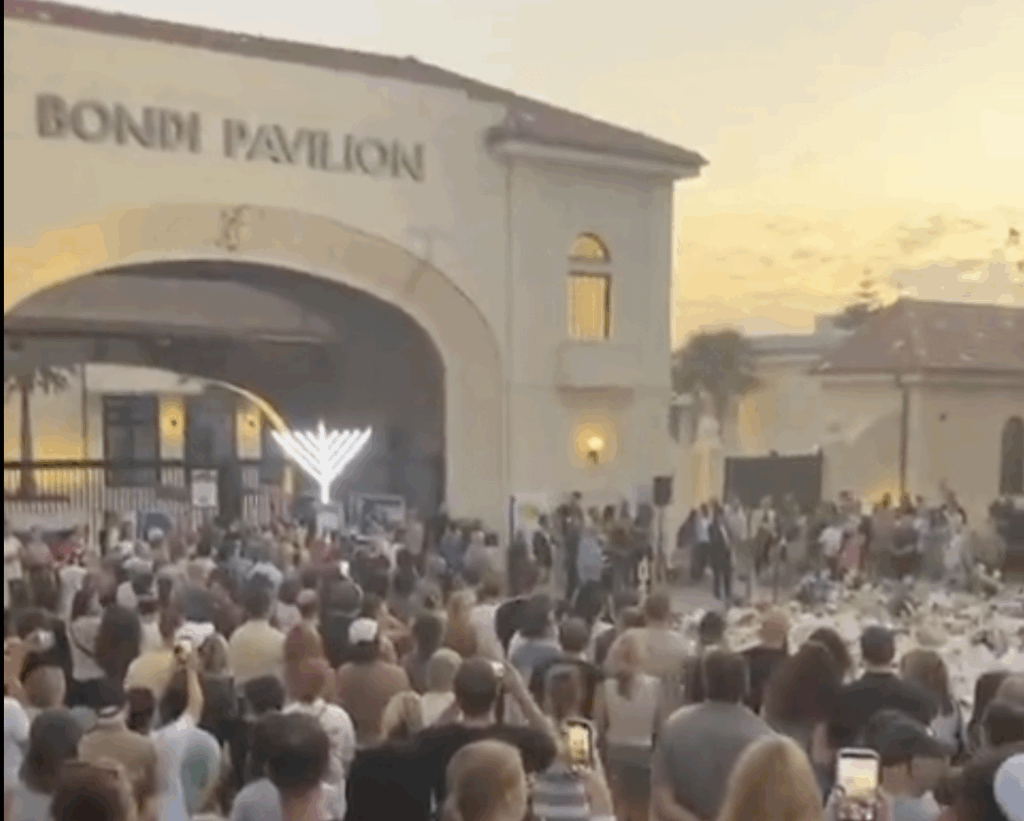
It’s been one month since the horrific events of December 14, 2025, when Australia’s Jewish community came under a direct and violent assault at a family Hanukkah event on the iconic Bondi Beachfront in Sydney. That attack left 15 people dead and dozens injured, leaving a deep scar on Australia’s Jewish community – and the nation itself.
Shortly after the attack I wrote in The Algemeiner that as shocked as the Jewish community was, it was not a surprise – not for a weary community that had endured the highest levels of Jew-hatred in Australian Jewish history.
Since the October 7 attacks, the level of antisemitic incidents is about 5.5 times higher than before, according to reports from the Executive Council of Australian Jewry (ECAJ) – the largest percentage increase of any country in the “J-7,” the seven nations outside Israel with the largest Jewish populations.
Indeed, less than two weeks after the Bondi massacre, another violent act of Jew-hatred took place, this time in Melbourne when a rabbi’s family car with Hanukkah decorations was torched in the early hours of Christmas Day, forcing the young family to evacuate their home.
Meanwhile, even Australian Prime Minister Anthony Albanese’s formal invitation to Israeli President Isaac Herzog, widely welcomed by the Jewish community, came under fire, with Labor figures urging him to withdraw the invitation, warning it could cause “social unrest.”
Labor Friends of Palestine also urged the Prime Minister to rescind the invitation while also insisting that if Herzog does enter the country, he should be investigated for “alleged incitement of genocide, and complicity in war crimes and crimes against humanity.”
The attacks on Jewish institutions or symbols, including the State of Israel, have been relentless these past few years, and Jewish organizations have been increasingly frustrated as we watched parts of our once-tolerant and peaceful society descend further into radicalization before our very eyes. And still, it felt as if we were screaming into a void, our voices ignored and our concerns largely dismissed.
Bondi proved those concerns tragically justified – the deadliest terror attack in Australian history and the greatest loss of Jewish life since October 7.
As a result, the government was forced to act. It initially agreed to establish two reviews, the Gonski Review to look at antisemitism in Australian educational institutions and the Richardson Review to look at Australia’s federal law enforcement and intelligence agencies, and whether they could have done more to prevent Bondi.
However, these reviews were limited in scope – not being able to tackle our society’s antisemitism crisis as a whole – and also lacked coercive powers or the ability to subpoena witnesses. They were thus widely regarded as inadequate – and not just by the Jewish community – given the scale and deadly nature of the antisemitism now confronting the country.
Consequently, there was a strong national push – led especially by the families of the victims and survivors of Bondi – for a national Royal Commission to investigate the link between Bondi and Australia’s antisemitism surge over recent years. A Royal Commission is Australia’s most powerful form of public inquiry, roughly equivalent to a US Congressional investigation combined with a federal prosecutor’s fact-finding powers. It is established by government but operates independently, with sweeping legal powers to subpoena documents and compel witnesses to testify under oath.
When Australia convenes such a commission — judge-led and non-partisan — it signals national recognition that something went deeply wrong and the truth must not be buried.
Yet the government initially strongly resisted such an inquiry for three weeks. Critics suggested it was perhaps uncomfortable with the kind of questions that would be asked – including how antisemitic incitement became so normalized, why repeated warnings were ignored, how education, media and political rhetoric contributed to it, and perhaps, most importantly, why Jewish Australians were left feeling unprotected in their own country, despite repeated pleas?
On January 9th, twenty-five days after the massacre, Prime Minister Albanese finally relented and called for a national Royal Commission to be set up, a decision Jewish leaders welcomed.
But it shouldn’t have been that hard. It took open letters signed by thousands — victims’ families, rabbis, sporting leaders, business leaders, politicians, security, academic and legal experts — and editorials across the national press to reach this point. Indeed, the amount of support that the Jewish community received from across all walks of Australia has been a ray of light amidst the darkness of our post-Bondi reality.
One month after that terrible day, Australian Jews remain devastated. But that devastation has now hardened into anger, frustration, and a new determination.
Simply put, we want answers.
This Royal Commission will not solve the world’s oldest hatred. But it may finally help answer the major questions Australia’s Jewish community has asked for years. And hopefully, with that clarity, this country can now begin the long and difficult work of reclaiming the values of tolerance, diversity, and warmth it has long claimed as its own.
Justin Amler is a policy analyst at the Australia/Israel & Jewish Affairs Council (AIJAC).
Tags: Antisemitism, Australia, Australian Government, Bondi, Terrorism