IN THE MEDIA
“I’m not religious but I started praying”: Arsen Ostrovsky in the Jerusalem Post
December 26, 2025
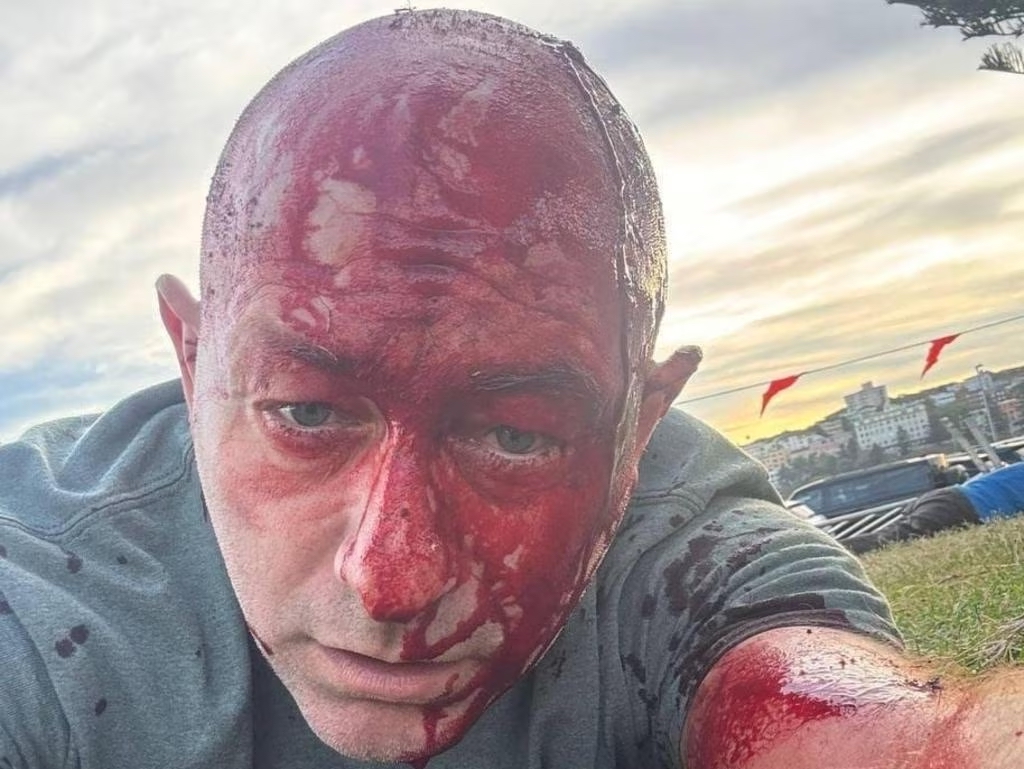
Arsen Ostrovsky spoke about surviving the Bondi Beach terrorist attack with Jerusalem Post Editor-in-Chief Zvika Klein on the Jpost Sits Down With podcast.
Jerusalem Post – 26 December 2025
He had stepped away for food, the kind of mundane errand that is supposed to be safe on a holiday night, even more so on a beach that sells itself as paradise. Arsen Ostrovsky was at Bondi for a Hanukkah celebration. Minutes later, he was injured in a terror attack, and Australia was forced to look at its Jewish community through the harshest possible lens.
When I called him afterward, I expected anger. Instead, he offered something quieter, and maybe more explosive: “I feel alive.”
Anyone who follows Ostrovsky knows there is usually a rhythm to his week. Every Friday, like clockwork, he would post a photo of himself with yet another scrumptious Israeli breakfast, a spread that somehow managed to look both excessive and deeply normal. He would add a quick line about what was unique this time, the ingredient, the local twist, the small detail that turns food into identity. It was his shorthand for belonging, for routine, for the stubborn insistence that Jewish life is not only a headline, it is also a table.
That is part of what made hearing him now feel so disorienting. For years, readers of this paper have known Ostrovsky as a sharp, relentless pro-Israel advocate, a lawyer by training, and a familiar voice in the public fight against antisemitism. Even before Bondi, he lived in a world of argument and urgency, the kind of person whose phone never really stops buzzing.
Now, the buzz had turned into something else.
‘This is my beach’
Ostrovsky grew up in Bondi. “This is my area. This is my beach. These are my people,” he told me, describing it not as a tourist landmark but as a personal geography. He had lived in Israel for 13 years, he said, and moved back to Australia only weeks ago.
The return was not a retreat from being openly Jewish, or from fighting for Israel. It was a choice to fight from a different front and to give his family a little peace. He had been recruited into a senior leadership role at AIJAC, the Australian Israel and Jewish Affairs Council, one of the central Jewish communal organizations in the country, with a mission that includes combating antisemitism and strengthening the Australia-Israel relationship.
He told me about the moment he broke the news to his children. His oldest, eight years old, looked at him with what he called “puppy eyes” and asked a question that, in its innocence, carried an entire Israeli childhood inside it.
“Does that mean no more boomies?” the child asked, meaning no more rockets, sirens, and running to the bomb shelter. Ostrovsky promised Australia would mean normal.
“It pains me that I was wrong,” he said later.
The moment the night turned
Ostrovsky described a scene that was supposed to be simple: families, children, a candle lighting, the kind of public Jewish joy that feels more fragile than it should, even in the best of times. His wife and two daughters had sat down as the ceremony was about to begin. He stepped away to get food, planning to rejoin them.
Then came noises that, for a few seconds, his brain tried to file under normal: balloons, fireworks, kids’ activities.
And then the realization that it was neither.
What he stressed most was not his own fear, but the minutes when he did not know if his wife and children were alive. He called. He could not reach them. That gap, he said, was the longest stretch of time he has ever experienced.
In the middle of that, he sent his wife a photo with two words, “love you,” because when you do not know what comes next, you reach for the most basic thing you can still say.
When the message finally came back that they were safe, something in him shifted, and not in the way a political speech would predict.
“I’m not the most religious person,” Ostrovsky told me, and he sounded almost surprised by what he said next.
After he heard his wife and children were alive, he began reciting the Shema (a central Jewish prayer), because he did not know if those would be his last words.
He could not fully explain why. He only knew it happened, instinctively, as if something older than ideology took over.
I have interviewed many public figures who can narrate trauma with the polish of experience. This was not that. This was a human being trying to make sense of his own reflexes.
Ostrovsky said he realized almost instantly that the injury was serious, not because of pain, but because of how fast he was losing blood. “It wasn’t even just dripping,” he told me, “the blood just started gushing out.” In the chaos, he said a stranger next to him tore off his own shirt so Ostrovsky could press it to his head and slow the bleeding. He added that adrenaline can be deceptively reassuring in a moment like that, and only later did he grasp how much blood he had lost.
‘I’m just Kelly’
Ostrovsky kept returning to a decision he has made about memory: he refuses to let the attackers be the only thing he carries out of the night.
He spoke about ordinary Australians who ran toward danger, surfers, first responders, and bystanders who did not debate whether to help. He described the presence of a politician, Kelly Sloan, head of the New South Wales opposition, who, in his telling, showed up not as a brand but as a person.
He had never met her. She sat next to him and held his hand, and he asked, “Are you Kelly Sloan?”
“I’m just Kelly. How can I help you?” she replied.
Ostrovsky described her arriving with a first responder from Hatzalah (a volunteer emergency response organization), and then moving from person to person, comforting, helping, not stopping long enough to be photographed into a convenient narrative.
He wanted me, and frankly he wanted Australia, to understand that this is part of the story too.
When the second attack is digital
Then came a modern twist that still sounds surreal even when you hear it directly from the person it happened to.
As Ostrovsky’s image spread online, with a bloody face, so did the accusations that it was fake. People claimed he was using “makeup,” and the mockery turned into a trend.
He told me he saw the comments just before being wheeled into surgery.
“A part of me doesn’t even want to dignify the sick… hate and lies with a response,” he said, but he framed it as part of an organized campaign of disinformation.
Then he uttered a statement that should make every platform executive uncomfortable.
“Words have very real consequences,” he told me, and when words are left unchecked, they lead to incitement and violence.
Ostrovsky’s argument was not abstract. It was lived.
This is a wholesale failure of leadership
As the conversation widened, he stopped sounding like a survivor describing a terrible night, and started sounding like the advocate many readers already know, focused, precise, impatient with empty rituals.
He described the surge in antisemitism in Australia since October 7, and what he called the predictable cycle that followed each incident: statements of concern, promises of review, assurances of action, and then, too often, nothing.
“This is not a failure of awareness,” he said. “This is a wholesale failure of leadership.”
He pushed for what he called “urgent, decisive action now,” not another round of condolences. He called for a royal commission, arguing that the failure was not only intelligence, it was the political will to act on warnings.
And he offered a line that sounds obvious until you remember how often leaders pretend otherwise.
“You can have all the laws of the world,” he told me, “but they are entirely meaningless in the absence of political willpower to enforce them.”
The Israel calls, and the Hanukkah donut
For all his frustration with official complacency, Ostrovsky was moved by the response he received from Israel.
He told me that President Isaac Herzog called, and Prime Minister Benjamin Netanyahu called. He said Diaspora Affairs Minister Amichai Chikli came to visit him in the hospital, along with Israel’s ambassador, and that the delegation arrived with enough security cars to confuse the hospital staff.
They also brought sufganiyah (a jelly doughnut traditionally eaten on Hanukkah), because Israelis, for better or worse, do comfort through food.
It was a small detail, but it mattered. The attack was on Jewish life. The reply, in its own way, was Jewish life refusing to shrink.
Near the end of our conversation, I asked the question that sits under so many private conversations in Jewish communities now, especially after a public attack. Do you leave? Do you hide? Do you move somewhere “safer,” as if that word still has a stable meaning?
Ostrovsky’s answer was not complicated.
“Hamas, Hezbollah, Iran, they were not going to push me around,” he said. “And these antisemites and terrorists, they’re not going to push me around either.”
Then he said it plainly, as a vow more than a slogan.
“There’s no terrorist in the world… going to tell me how or where to live my life.”
When we wrapped up, he offered a line that felt like the most honest aspiration in the aftermath of trauma.
“We’ll settle for a bit of mundane,” he said, and then added something that, as a journalist, I did not take lightly: he thanked “everything you and The Jerusalem Post” have done “to help share our stories.”
The story, in other words, is not only what happened at Bondi. It is what happens after, who gets to define it, and whether a society chooses to treat antisemitism as a public emergency or as a regrettable inconvenience.
And somewhere in the middle of all that, there is still the Friday breakfast photo, the Israeli spread, the small caption about what makes this one special. A reminder that the goal is not to live forever in crisis mode, but to fight hard enough to earn back the right to be boring.
Or, as Ostrovsky put it, in the sentence that started our call and has not left me since: “I feel alive.”
Tags: Antisemitism, Arsen Ostrovsky, Bondi Beach, ISIS, Terrorism