IN THE MEDIA
The attack that changed Australia — or did it?
February 3, 2026 | Justin Amler
The Algemeiner – 2 February 2026
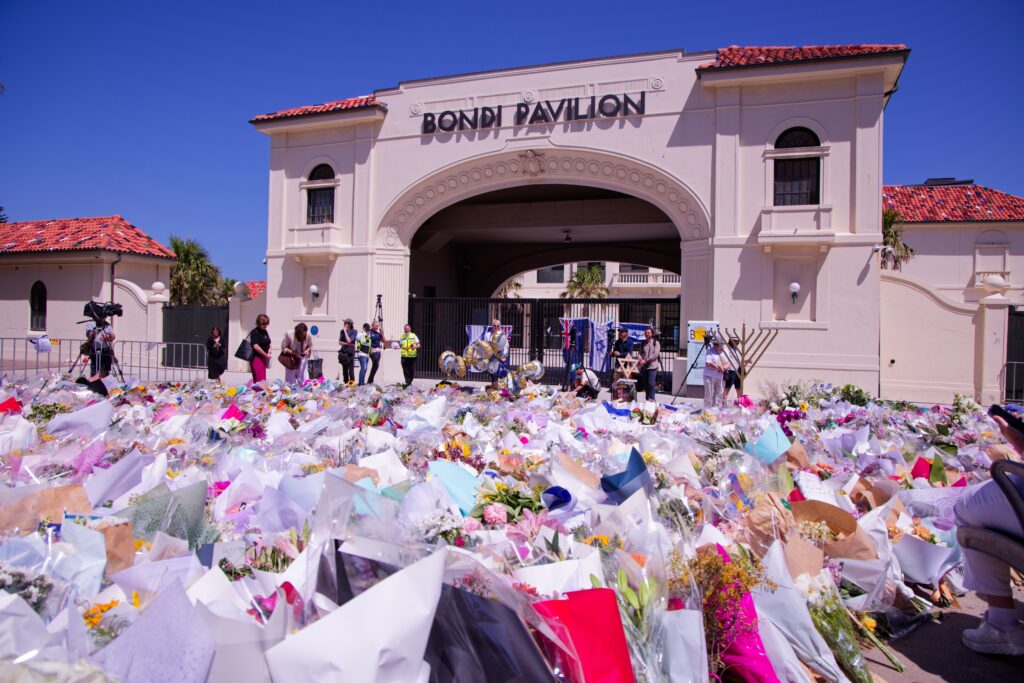
The Bondi terrorist attack on December 14, 2025 changed Australia.
But in many ways, it also didn’t.
The shock of watching a murderous rampage unfold at one of our most iconic sites, in what Australians long believed was a safe, peaceful country, shook the nation to its core. Fifteen innocent people murdered at a peaceful Hanukkah event is something so foreign to the experience of Australians that it shattered the country’s sense of security overnight. Most Australians believed this kind of hatred was something that occurred elsewhere, not here.
Such trauma can prompt genuine reflection — which in turn may lead to genuine change.
In the aftermath, Prime Minister Anthony Albanese struck a markedly different tone, showing an empathy with Australia’s Jewish community that many in our community felt was often sorely missed in the months following October 7. On January 22, he initiated a National Day of Mourning, observed across the country. Fifteen sites were illuminated to commemorate the 15 victims, Australians were encouraged to light candles in their windows, and — strikingly — the government even urged citizens to perform a mitzvah – yes, it used that word – in the victims’ memory, publishing a list of 15 suggested acts of kindness.
In a nationally televised address at the Sydney Opera House — the very site where, on October 9, 2023, crowds had gathered to celebrate the Hamas massacre in Israel — the Prime Minister offered a direct apology to the Jewish community, acknowledging that “we could not protect your loved ones from this evil.”
Five days later, on International Holocaust Remembrance Day, Albanese released a statement commemorating the six million Jews murdered in the Holocaust, describing “the immense multitudes of Jewish lives and futures stolen with a pitiless cruelty that remains scarcely fathomable in its evil.” To be fair, he issued a similar statement for the same day last year.
This moral clarity contrasted with BBC news readers and US Vice-President JD Vance, who both failed to even mention the word “Jew” in their statements marking the day.
The apology was a sharp departure from what had often been a strained and acrimonious relationship between the government and the Jewish community, driven by persistent and often disproportionate criticism of Israel during its war against Hamas and other terrorist groups, alongside a series of concrete policy decisions widely perceived as hostile toward a longstanding democratic ally.
In the weeks following Bondi, the government moved swiftly to legislate, recalling parliament early in order to pass a package of new federal hate and extremism laws, including the Combatting Antisemitism, Hate and Extremism Bill. The measures criminalise participation in designated hate groups, impose penalties of up to 15 years’ imprisonment for directing such organisations, expand visa-cancellation powers for individuals promoting hate, and tighten controls on extremist symbols and propaganda. A provision to criminalize extreme racial vilification was dropped in the face of the Opposition’s objections to it.
New South Wales, where the attack occurred, also introduced state-level laws granting police broader powers around protests linked to declared terrorist events.
A Royal Commission has also been commissioned to investigate antisemitism in Australia in the lead-up to the Bondi attack, following pressure from broad sections of the community after Albanese was initially opposed to holding one.
These steps were welcomed by the Jewish community, yet it remains far too early to declare them transformative. After all, hate-speech laws already existed across Australian jurisdictions but were only rarely used.
History therefore suggests that legislation alone is rarely enough; the true test is whether authorities are willing to enforce the laws consistently, especially when in doing so, it becomes politically uncomfortable.
And that discomfort may arrive very soon.
The upcoming visit of Israeli President Isaac Herzog in early February, at Prime Minister Albanese’s invitation, will serve as a critical test of whether the empathy shown after Bondi represents a lasting shift or a fleeting political moment. Already, Labor Friends of Palestine have called for President Herzog to be blocked from coming and investigated for alleged incitement and complicity in war crimes. Multiculturalism Minister Dr Anne Aly initially declined to confirm whether she would welcome the Israeli President on his state visit, before later offering a notably lukewarm endorsement. There are also mass planned protests against his visit by anti-Israel groups. How the government deals with this will be telling.
Because these are the same kind of groups that appeared on Australia Day, the national celebration of identity and unity, with calls for “intifada”.
Australia is currently at a crossroads in its relationship with Israel and by extension the Jewish community here. How it navigates that relationship with its once strong ally could well determine the future of Jewish life in Australia. Hopefully, the solidarity now being shown will be maintained and enhanced. But if it proves to be temporary, and the hostility being drummed up by the local anti-Zionist movement resurges, then the long-term sense of belonging and security that underpin Australia’s long thriving Jewish community will likely erode further.
That, tragically, could echo the same sad and tragic path of many Jewish communities throughout history.