
FRESH AIR
New UN reports confirm Gaza has ample food, was never in a famine
February 9, 2026 | Alana Schetzer
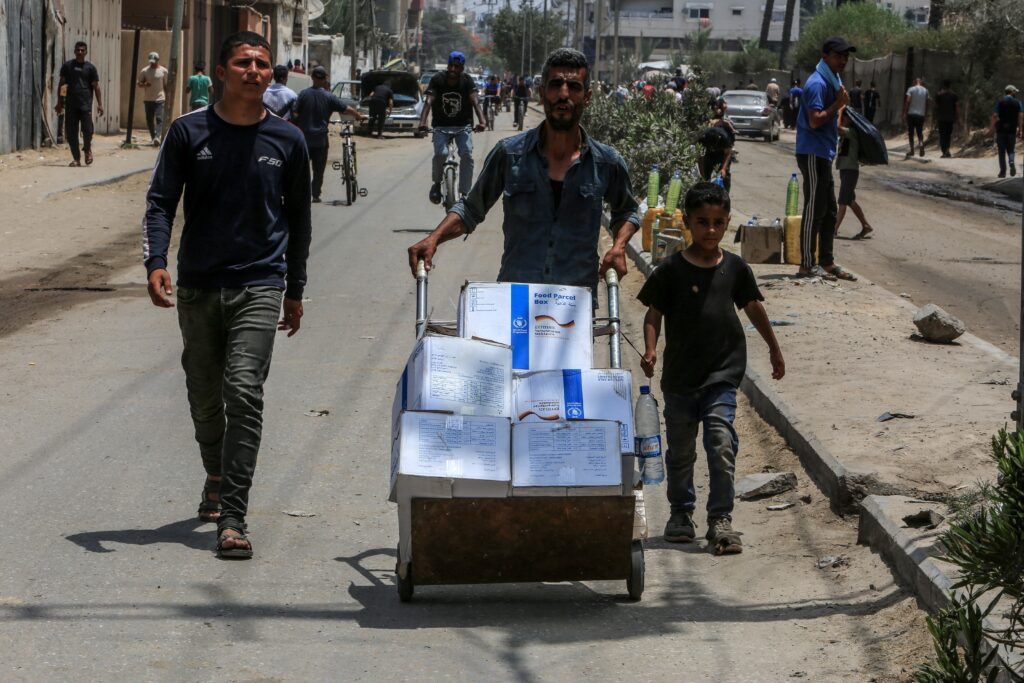
On January 5, the United Nations put out a media release acknowledging that “100 per cent of basic food needs” in Gaza were being met, though this was not reported widely. Indeed, there are still frequent media claims that not enough aid is entering Gaza, despite this UN acknowledgement.
Yet even this UN acknowledgement was actually a gross understatement.
The World Food Program estimated in July 2025 that Gaza’s minimum monthly food needs were 62,000 tons. Other UN sources say as much as 80,000 tons per months are necessary. That would be 3,200 food trucks – around 120 per day – per month, calculated at 25 tons per truck. Yet according to IDF data, 425 food trucks, out of more than 600 trucks, have been entering daily on average since the beginning of the year. That’s 318,000 tons of food on average monthly. This is around 400% of the minimum need as defined by the UN. Israeli security sources also say the excess is almost certainly benefitting Hamas’ efforts to re-assert control over Gaza.
This is the latest example of the UN playing games with aid figures in Gaza.
Also not widely reported is that data released by a leading global malnutrition institution has confirmed that Gaza should never have been classified as being in famine last year, a claim widely covered in the media. This was fairly obvious at the time, as explained in this article published in the Australia/Israel Review last year.
The Global Nutrition Cluster (GNC) is supported by UNICEF and tracks and collects data across the world on malnutrition and food insecurity. It is one of 21 global partners that plays a crucial role in providing support in gathering data used by the Integrated Food Security Phase Classification (IPC), the UN-backed body that declared part of Gaza was in famine last August.
In October, GNC published never-before-seen data that was collected during July and August and which was selectively used by the IPC to declare famine in Gaza City, where about 500,000 Palestinians live. However, the data was misused by the IPC in its August report, as the AIR article showed last September.
Essential background: The IPC’s August report
In late August, the IPC released a report that declared Gaza City was officially in famine. The report garnered worldwide attention and increased the already intense backlash against Israel.
Importantly, an official classification that part of Gaza was in famine will likely be used as part of the legal argument against the State of Israel in international courts; South Africa has taken Israel to the International Court of Justice, accusing it of genocide against Palestinians in Gaza, with part of its argument being that the Israeli Government has a policy of deliberate starvation.
Thresholds for declaring famine
The IPC has three essential criteria for a famine declaration:
- 30% of children under five suffer from acute malnutrition (or 15% measured with MUAC, a controversial upper arm measurement, see below);
- 20% of households experience extreme food insecurity; and
- A daily mortality rate of two adults or four children per 10,000 people, due to malnutrition.
In September, AIJAC’s analysis of the IPC report revealed the IPC manipulated its reporting methodology, including:
- selective use of data;
- breaching its own rules (such as by conducting MUAC checks at hospitals and medical centres rather than among the general public);
- deliberately excluding vital evidence;
- ignoring mortality data that showed malnutrition-related deaths were much,much lower than what is required as a minimum for a famine classification; and
- using averages rather than medians, which is a flawed system to use with unweighted data or data that contains outliers, because it often produces misleading results.
It should also be noted that several authors of the IPC report are openly anti-Israel.
About MUAC
MUAC is an upper-arm measurement used to help determine a person’s nutritional status. Under IPC rules, MUAC can only be used as a metric in very limited circumstances due to it being less accurate than the IPC’s usual metric method, weight-for-height Z-score.
The IPC report relied on unweighted – or raw – data, which contained numerous biases, including the disproportionate percentage of MUAC from younger children. This is problematic because younger children are naturally smaller than older children and so will have smaller upper arm circumferences. Disproportionately using younger children and/or not weighting the data produces inflated malnutrition results.
The IPC requires its data must be age-weighted so it can avoid this very partiality, but the IPC broke its own rules, and it was not.
Many experts published their own analyses of the IPC report, revealing that the IPC appeared to have made retroactive changes to some of the data in order to justify its findings.
What the new data says
The new data, from the GNC’s State of Palestine nutrition cluster meeting on September 17 last year, proves that the IPC report was based on deceptive data.
Data from the GNC meeting notes revealed:
- A vital threshold for famine to be declared – that MUAC reach at least 15% – was never met
- The IPC August report claimed that MUAC was 16.2% but the original GNC data shows that MUAC peaked at 14.8% (in mid-July)
- MUAC began to decline significantly from early August, recording MUAC results between 10.5% to 11%
Overall, the GNC’s data is 23% lower than what the IPC chose to publish for its August report.
The GNC data confirms that malnutrition rates peaked in the second half of July 2025 and then started to decline. Gaza City never crossed the 15% threshold, regardless of whether one examines biweekly or monthly data.
Crucially, the GNC data revealed both weighed and unweighted data, plus the results of the full sample of 15,749 children. One of the greatest deficiencies of the IPC August report was the fact that it used data from only half of that sample, of about 7,500 children, which seemingly deliberately skewed the results. Not only that, the IPC used just a two-week sample of data on which to base its findings, rather than the usual month-long data, which was yet another breach of its own rules.
Mortality data proves IPC prediction wrong
Further disproving the IPC’s famine declaration was the release of more recent mortality data by the Gaza Ministry of Health (MoH), which is controlled by the terrorist organisation Hamas. Based on the IPC’s own predictions that famine was expected to grow from August onwards, that would have meant that approximately 10,144 malnutrition-relations deaths would have occurred between August 22 and October 10, when the ceasefire came into effect.
But the MoH’s own figures reveal that only a fraction of that number actually occurred during that time period – 192 such deaths (and most of them were due to pre-existing conditions).
Food prices also prove IPC prediction wrong
The IPC also predicted that food prices would dramatically increase.
But food prices had already significantly fallen in August – by between 20% and 98% – according to both the World Food Programme Market Monitor and Israel’s Coordination of Government Activities in the Territories (COGAT).
For example, by the end of August, a kilo of sugar was selling for about US$4 (or 13 shekels); this is a significant reduction from its cost a month earlier, when a kilo of sugar could sell for almost US$200 (or 600 shekels). Since prices started to tumble in August, prices for staple food items such as oil, rice, flour and salt have been stable.
Additionally, UNRWA Commissioner-General Philippe Lazzarini tweeted on Oct. 9, the day before the Hamas–Israel ceasefire went into effect that, “We have enough to provide food for the entire population for the coming three months.”
Claim that global groups wanted to use ‘famine’ accusation early in war
While the GNC data confirms without doubt that the IPC August 2025 report was based on deceptive data, it has also been revealed that leading global institutions had pushed for Gaza, or part of it, to be classified as being in famine as early as the first three months of the Hamas–Israel war.
In late October, the World Health Organisation (WHO) representative to Israel, Dr Michel Thieren, revealed that these types of discussions were being held in December 2023 in order to pressure the Israeli Government.
“At the very end of the meeting – I won’t say exactly where, and it wasn’t necessarily at the WHO, rest assured – there was a gathering of experts who asked the question quite forcefully. I was there, and I was absolutely stunned. What they were saying, essentially, was that one should try to find a term that could be used to exert pressure. So yes, I was very shocked by that,” he said during an interview on the Mosaïque podcast.
The publication of the GNC’s meeting notes, as well as other recent evidence, including Hamas’ Ministry of Health mortality figures, conclusively proves that the IPC’s decision to declare Gaza City as being in famine was one not based on facts, but was a politically-driven predetermined finding.
The IPC and the United Nations have serious questions to answer about the multiple defects in the August report. But given the UN’s decades-long history of politically-motivated bias against Israel, it’s highly unlikely the institution will back away from a declaration it appears its officials badly wanted to make, regardless of what the evidence said.
Likewise, do not expect them to publicise or even acknowledge, that Gaza is now receiving many times more food than the UN’s own estimates say it needs.
Tags: Gaza, NGOs, United Nations
RELATED ARTICLES




Herzog visit an important expression of solidarity with our traumatised community: Joel Burnie on Sky News


Security concerns over Herzog visit a terrible indictment: Joel Burnie on Sky News