UPDATES
Iran arms Syria as UN shifts into low gear
August 4, 2011 | Daniel Meyerowitz-Katz
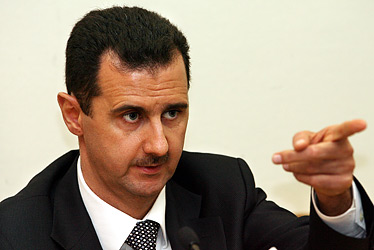
The forces of Syrian President Bashar al-Assad stepped-up their assault on the opposition stronghold of Hama yesterday. As reported by Nada Bakri for The New York Times:
Ignoring mounting condemnations, the Syrian military sent tanks, armored vehicles and snipers on Wednesday into the symbolic center of Hama, a rebellious city that has emerged as a linchpin of the nearly five-month uprising, in what appeared a decisive step by President Bashar al-Assad to crush opposition to his rule.
The military’s assault on Assi Square, the scene of some of the biggest demonstrations against Mr. Assad’s leadership, was an event that many activists and residents had thought impossible, evidence of the government’s determination to retake by force a city that suffered one of the most brutal crackdowns in Syrian history in 1982.
This blog has been closely following the situation in Syria, posting repeatedly about the reluctance of the international community to take any effective action. It is welcome news, therefore, that after five months of ongoing turmoil and mounting civilian casualties, the UN Security Council has finally issued a condemnation of the Assad regime. As Neil MacFarquhar reports in The New York Times, this was made possible when Russia finally permitted the statement to be released, albeit as a statement and not a resolution.
The council’s action, which took the form of what is known as a presidential statement, condemned “widespread violations of human rights and the use of force against civilians by the Syrian authorities.
Western nations had sought a resolution, the strongest council action. But Russia, a permanent Security Council member with veto power, which had led the opposition to any action for months on the basis of not interfering in internal affairs, had made clear from the outset that it considered a resolution excessive.
In an odd voting twist, Lebanon joined the 15-member consensus required to pass a presidential statement, but then “disassociated” itself from the result. The statement “does not help in addressing the current situation,” said Caroline Ziade, Lebanon’s deputy permanent representative, in a widely anticipated move given that Syria has held sway over the Lebanese government for decades.
As Foreign Policy’s UN correspondent Colum Lynch has explained, the Western bloc that had been pushing for a condemnation of Syria had met with resistance from non-Western countries claiming to be wary of a repeat of the NATO operation in Libya.
Western governments have faced stiff resistance from other council members, including China, Russia, Lebanon, Brazil, India, and South Africa. Diplomats from those countries have cited concern that a resolution would be used as a pretext to impose sanctions or military force on Syria in the future.
In a press briefing Tuesday, India’s U.N. ambassador Hardeep Singh Puri, suggested that many council diplomats believe that the Western military coalition operating in Libya has exceeded its Security Council mandate to protect civilians there, and has effectively sided with one party in a civil war.
That the Council was only able to issue a President’s statement and not even a resolution of condemnation is a poor reflection on the state of the organisation charged with protecting the world’s security. Even resolutions – which, in theory, are binding under international law – are seldom followed by rogue regimes such as the Syrian Government. Furthermore, a resolution condemning the violence but not necessarily calling for intervention would not have been a particularly powerful move by the Council anyway.
Meanwhile, breaking news has emerged this morning of an Iranian arms shipment to Syria having been intercepted by Turkey. The AFP report speculated that the weapons were intended for Hezbollah, however the details of the interception have yet to emerge. What this does demonstrate is that international condemnation and even sanctions are having little or no effect on the operations of the Syrian regime – they are still receiving arms and supporting Hezbollah in Lebanon, despite all of their concerns at home.
Tags: Iran