Australia/Israel Review
Media Matters: Trial by media
Mar 18, 2026 | Allon Lee
Few allegations are freighted with more moral, legal, political, public and diplomatic consequences than a charge of genocide. The term describes the gravest crime recognised in international law – the deliberate attempt to destroy a people.
Little wonder then that anti-Israel activists working at the UN and other NGOs have been eager to brand the Jewish state with this modern mark of Cain. Even before Israel responded militarily to Hamas’ October 7 massacre, the accusation that it was carrying out genocide in Gaza was being bandied about more freely than rice at a wedding.
Israeli President Isaac Herzog’s recent visit to Australia is a case study of the media’s role in the dissemination of the genocide calumny.
At the invitation of Prime Minister Anthony Albanese and Governor-General Sam Mostyn AC, Herzog travelled to Australia to comfort and grieve with the Australian Jewish community following the terror attack by two Islamists that left 15 people dead at a Chanukah gathering on Bondi Beach on December 14 last year.
In this instance, Australian human rights lawyer Chris Sidoti was front and centre of a media campaign to smear Herzog in the week before he arrived on Feb. 9.
Sidoti was not merely critical of the trip. He insisted it be cancelled on the basis that Herzog, in a media conference five days after October 7, had supposedly incited Israelis to carry out genocide against Palestinians in Gaza (AIJAC’s comprehensive dissection of the baseless allegation against Herzog is here).
To most people, genocide means the deliberate attempt to annihilate a people. Yet Israel’s conduct during the war shows the exact opposite of an intention to carry out genocide. The IDF dropped millions of leaflets and made millions of calls warning Gazans of impending military operations, established designated safe zones, permitted large quantities of humanitarian aid to enter Gaza and implemented humanitarian pauses. These actions fly in the face of any claim that the Israeli military entered Gaza with the intention of annihilating the Palestinian population there.
Yet journalists rarely raised such considerations or provided even the most basic alternate perspective in the overwhelming majority of Sidoti’s media appearances.
Acts of Commission
Since 2021, Sidoti has served on the United Nations Human Rights Council’s “Independent International Commission of Inquiry on the Occupied Palestinian Territory, including East Jerusalem, and Israel.”
Last September, this Commission released a tendentious report that claimed it had “found” Israeli officials, including Herzog, were responsible for genocide in Gaza.
It’s important to understand that the Commission’s report broke no new ground and simply recycled the claims of NGOs with long records of seeking to delegitimise Israel and its defensive war against Hamas – which has promised to repeat October 7 “again and again” until the Jewish state’s elimination.
The Commission itself has been controversial since its creation. Unlike all other UN investigative bodies, which are established to examine specific incidents or defined periods of conflict, this Commission was given a mandate with no fixed end date and was tasked with investigating not only alleged violations of international law, but also the “root causes” of the Israeli-Palestinian conflict. The original Commissioners, including Sidoti, have long records of extreme anti-Israel commentary. (A factsheet by NGO Monitor on the founding members of the Commission can be read here).
On Feb. 4, a media release appeared in Australia under a headline quoting Sidoti directly: “Israel’s President Herzog should be arrested on arrival for the crime of incitement to genocide.”
The release noted Sidoti was available for interviews. The result was predictable.
Trading on the halo effect surrounding the United Nations, Sidoti became the media’s man of the moment – appearing mostly without serious scrutiny or pushback.
Sidoti’s past media fails
Spruiking the Commission’s report in the Australian media in September/October 2025, Sidoti’s commentary had been marked by what one could generously call “schoolboy errors”.
Writing in the Age and Sydney Morning Herald on Sept. 18, Sidoti asserted that the International Court of Justice had put states “on notice that there was an existing plausible risk of genocide in Gaza.”
As AIJAC has pointed out repeatedly, this claim is just wrong.
Nowhere in the ICJ’s January 2024 interim finding, did it state that “there was an existing plausible risk of genocide in Gaza” or anything close to this.
Indeed, no less an authority than the ICJ’s own President at the time, Joan Donoghue, explained very directly on the BBC in April 2024 that the Court did not find there was a plausible genocide in Gaza.
As Judge Donoghue said:
“You know, I’m glad I have a chance to address that because the court’s test for deciding whether to impose measures uses the idea of plausibility, but the test is the plausibility of the rights that are asserted by the applicant, in this case South Africa. So, the court decided that the Palestinians had a plausible right to be protected from genocide and that South Africa had the right to present that claim in the court… it didn’t decide that the claim of genocide was plausible… the shorthand that often appears, which is that there’s a plausible case of genocide, isn’t what the court decided.”
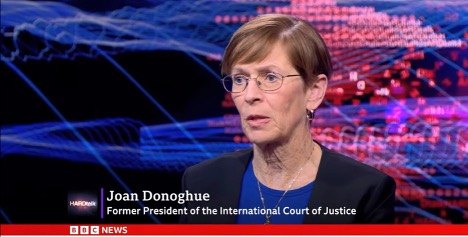
Former ICJ president Joan Donoghue (Image: Screenshot)
Yet, Judge Donoghue’s intervention barely made a ripple – UN officials (like Sidoti) and media professionals have repeatedly claimed the opposite.
Sidoti was also deceptive in his February 2026 interviews by repeatedly implying that the question of Israeli culpability for genocide had already been decided by courts of law, rather than just his commission, which has no legal authority. On Feb. 9, Sidoti told Channel 7 that Israel is a “state that has been found by courts already, by the Commission of Inquiry, the UN Commission of which I’m a member, and by many others, as having been responsible for war crimes, crimes against humanity and genocide.”
Yet, with a few exceptions, the media reports featuring Sidoti smearing Herzog failed to probe the accusation itself or include opposing views.
Most failed to note that the Commission of Inquiry is not a judicial body, that its findings do not constitute legal verdicts or reflect any criminal law standards.
No journalists asked Sidoti about the evidentiary standards underlying the Commission’s conclusions.
Caught out by the facts
Another area where Sidoti was sloppy related to the International Criminal Court (ICC).
In November 2024, the Court issued arrest warrants against Israeli Prime Minister Binyamin Netanyahu and former Defence Minister Yoav Gallant for war crimes and crimes against humanity.
The charge sheet did not include genocide and no charges have ever been sought against Herzog. More than a year later, there is no indication whatsoever that Herzog is even being investigated.
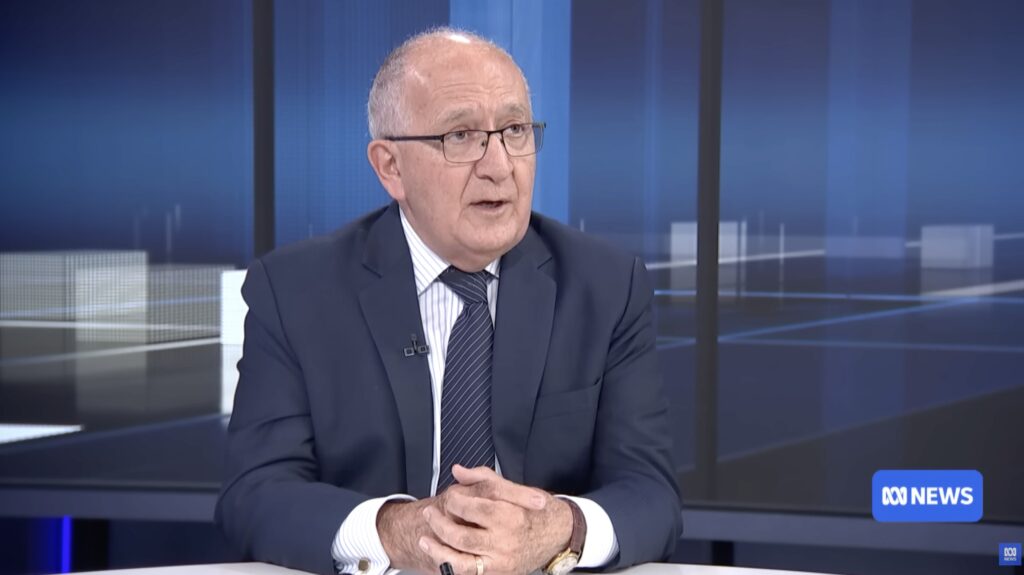
On ABC TV “News” (Feb. 5), host Joe O’Brien challenged Sidoti, pointing out that the ICC had issued arrest warrants for Netanyahu and Gallant but not for Herzog. Sidoti ignored the question.
O’Brien also pointed out that “in that same media conference [Herzog] also said Israel always operates according to international law and that there are many innocent Palestinians.”
O’Brien played footage of Herzog from the media conference angrily denying he was calling for collective punishment of all civilians in Gaza and then asked Sidoti “why did you conclude in your investigation that he was?”
Sidoti responded:
It was only when he was challenged about that that he started to qualify it or back away from it. But his meaning was clear.
The entire nation, were the words he used, is responsible, meaning clearly all Palestinians in Gaza were responsible for the actions of Hamas. Those words were so clear that they were picked up by Israeli soldiers in the field. We have seen videos of soldiers chanting, they are all responsible.
We have seen that phrase used as graffiti by soldiers on Palestinian buildings in Gaza. So, his meaning was clear to the soldiers, as it was to us, as it was to the journalist who asked the question.
Sidoti was referring to the supposed ‘evidence’ in the Commission of Inquiry’s report relating to Herzog – which is flimsy to the point of absurdity.
The evidence that his words incited Israeli soldiers is found in two footnotes with links to three social media reports.
One of the videos is to a short from the YouTube account of Middle East Eye – a pro-Palestinian news service – which features a social media reel of a stray dog in Gaza and an Israel soldier saying the dog is the “only uninvolved civilian” there.
The description with the video offers context for the phrase and attributes it to a far-right Israeli MK. Herzog is not mentioned.
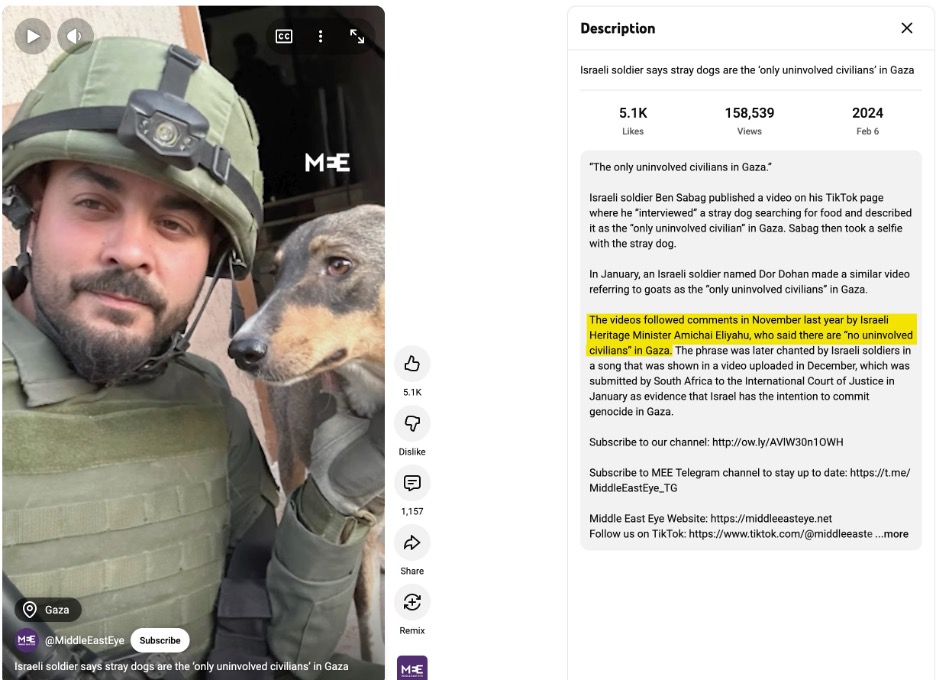
An example of Sidoti’s so-called “evidence” against Herzog (Image: YouTubeScreenshot)
Contrary to Sidoti’s claim that there was graffiti repeating the “no uninvolved civilians” claim on “Palestinian buildings in Gaza,” the footnote in the Commission of Inquiry report takes you to a 2024 Amnesty International report which actually shows an Israeli military watchtower in the West Bank.
The Amnesty report is significant because it unintentionally debunks the claim Herzog’s comments can be linked to the “evidence” cited by the Commission. Ridiculously, it accuses Herzog of inciting genocide even though it concedes:
Amnesty International recognizes that the general assertion that there are no ‘uninvolved’ or ‘innocent civilians’ predates this current conflict. It is therefore unable to conclude with certainty whether Israeli soldiers echoed statements by President Herzog and other senior officials or merely repeated a widely held belief.
In fact, a footnote to this paragraph provides evidence that the phrase was used by IDF soldiers during the 2014 war Hamas fought with Israel.
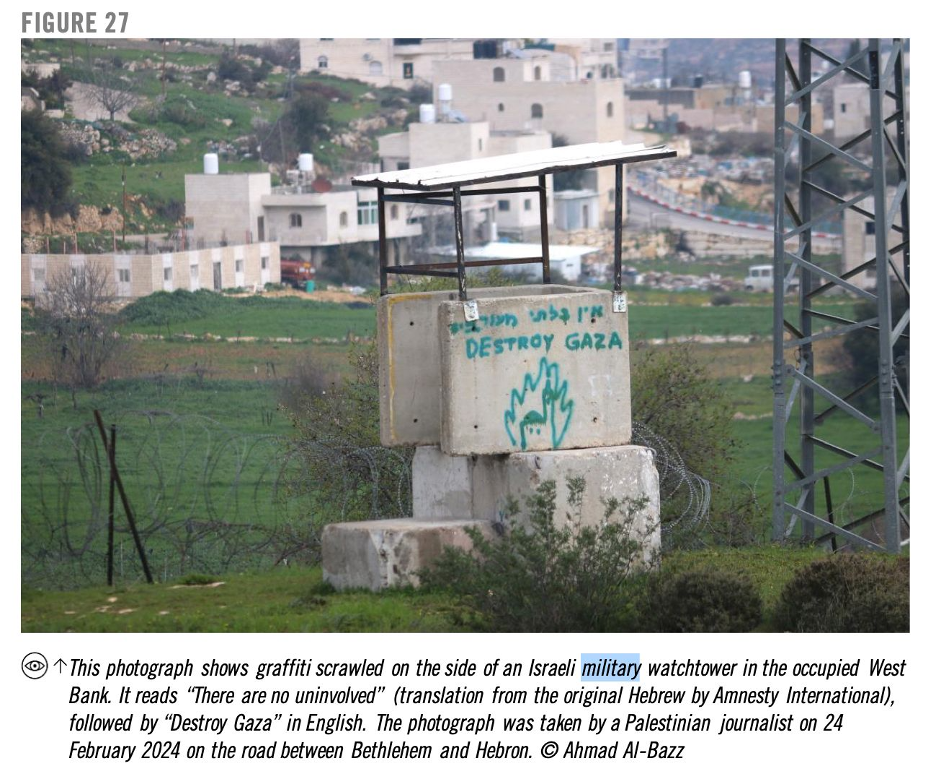
Image from an Amnesty report that was misrepresented by Sidoti
Another absurdity in the Commission of Inquiry’s September 2025 report which accuses Herzog of inciting genocide is this section:
While the direct and public incitement to commit genocide is a crime in itself, whether anyone acts on it or not, the Commission nevertheless refers to the actions of the Israeli security forces personnel on the ground in Gaza who could be seen celebrating their conduct in demolishing Palestinian properties.
Again, most people would not accept “demolishing Palestinian properties” as evidence of genocide.
Sidoti’s procedural ploy
Central to Sidoti’s campaign was a demand that the Australian Federal Police arrest Herzog upon arrival.
Yet Sidoti must have known such an outcome was extremely unlikely given heads of state enjoy diplomatic immunity – particularly if they have not been charged with a crime by any court!
But that didn’t prevent Sidoti repeatedly suggesting, as he did in his Guardian Australia op-ed (Feb. 5) that:
There is now strong legal argument that this immunity does not apply in relation to atrocity crimes, namely war crimes, crimes against humanity and genocide. Australia should not apply immunity in relation to these crimes.
One of the few media reports that bothered exploring the immunity issue was from acting ABC Middle East correspondent Nick Dole (Feb. 6).
Buried in Dole’s report was a quote from Australian National University professor of international law Donald Rothwell stating his belief that a prosecution would ultimately fail, noting that “an incitement charge probably wouldn’t meet [the] threshold” to override Herzog’s immunity.
Short, but not sweet
Aside from those two ABC items, most media coverage, especially short news reports, were characterised by serious factual errors and omissions.
SBS TV “World News” (Feb. 5) reporter Rayane Tamer incorrectly claimed the ICJ “found in 2024 it’s plausible Israel is committing genocide in Gaza.”
Nine’s national affairs editor Andrew Probyn (Feb. 5) said Herzog had “infamously signed an Israeli missile to be deployed during the Gaza war that’s killed up to 70,000 Palestinians.” In fact it was an artillery shell used by the IDF to create a smokescreen – not a “missile”.
On the ABC podcast “News Daily” (Feb. 10), Global Affairs Editor Laura Tingle’s attempt to address the issue of Herzog’s alleged incitement to genocide was unprofessional. Instead of playing the full exchange from the October 2023 press conference, in which Herzog clearly said Israel should obey international law and no one should ever target civilians, the program broadcast only a short excerpt that reinforced the accusations.
On Feb. 11, ABC Radio’s AM program host Sara Tomevska told listeners the ICJ had found it “plausible” Israel’s actions could violate the genocide convention – despite an ABC Ombudsman ruling in July 2024 confirming that such an interpretation was factually incorrect.
Media commentary questioning Sidoti’s allegations did appear in outlets such as Sky News Australia and News Corp papers, and ABC presenter Joe O’Brien also interviewed AIJAC’s Colin Rubenstein.
But in interviews where Sidoti himself appeared, the media failed to do the basic legwork required to examine his claims, even as his flimsy allegations of incitement to genocide received near saturation coverage.
Among the most basic questions journalists should have asked Sidoti:
- If the International Criminal Court is already investigating Israeli officials, why not leave the matter to that court?
- If the ICC did not seek an arrest warrant for Herzog, why should Australia arrest him?
It is ironic that Sidoti demanded the cancellation of President Herzog’s immunity as a head of state, because, during the media storm surrounding Herzog’s visit, it was Sidoti himself who appeared to enjoy near-total immunity from serious media cross-examination.
RELATED ARTICLES