Australia/Israel Review
Essay: Transformed by war
Dec 19, 2025 | Eran Lerman
Assessing what has changed in the Middle East since October 7
“It ain’t over till it’s over – and it’s never over” was legendary baseball player Yogi Berra’s most famous contribution to American folklore. Nowhere is it as true as in the war-torn region of West Asia and North Africa, still referred to by the name the British gave it, the Middle East. It ain’t over, even if US President Donald Trump proudly claims to have brought to an end a 3,000-year-old conflict.
It ain’t over, because the forces that started the war – on October 7, 2023, not three millennia ago – are still holding on to their guns in Gaza and in Lebanon, regardless of what the Americans and others ardently want to see happening. It ain’t over, because Iran has yet to abandon the costly and disastrous quest for the bomb.
But with UNSCR 2803 successfully adopted on November 17, 2025, the two-year war has formally come to an end – of sorts, for now. Or, at least, entered a pause long enough and stable enough to bring one of its most painful aspects, the hostage saga, to a close and to enable some form of stocktaking as to the astounding consequences of the fighting so far.
As 2025 draws to a close, the region is a very different place to what it was merely 26 months ago – the strategic balance between the forces contending for dominance in it has changed, with a potential impact well beyond the region’s borders. To understand the nature of this change, it is necessary to review the struggle for power between rival camps, which has unfolded since the early years of the previous decade, amidst violent upheavals in several key countries.
Mapping the camps, then and now
When the region went into the violent convulsion known, somewhat hopefully, as “the Arab Spring”, early in 2011, it soon became evident that the old mental map of states with their geopolitical interests and interactions was no longer relevant. Leaders who were there for decades, and had become almost synonymous with the countries they led, were brought down overnight. Countries fell apart amidst partisan warfare. New links were forged based on ideological affiliation – in line with what the theoreticians would call the constructionist frame of analysis (“ideas matter”).
Indeed, a good way to navigate the new landscape would have been then – and remains now – to categorise regional players by their ideological affiliation. Of six such “camps”, only three are still (in 2025) in active contention for hegemony in the region, as detailed below. As for the other three:
The socialist pan-Arab nationalists (some of whom, like Saddam Hussein in his day, probably deserved to be thought of as “National Socialists”): For years, in the days of Nasser in Egypt and the Ba’ath in Syria and Iraq, this was the predominant school of thought about the region’s future. Its leaders seemed to tower over all others. Yet under Sadat, Egypt left that fold in the early 1970s; and those who remained became strongly associated, one and all, with the Soviets within the Cold War system. When the latter’s quick collapse in 1989-1991 left them adrift, some – like Saddam – tried to gain regional power on their own (which ended disastrously for him). Others, like Syria’s Hafez al-Assad (Bashar’s father), found another camp to join. Only relics (such as the now depleted the Popular Front for the Liberation of Palestine – PFLP) remain of the forces that had once dominated the region like a colossus. The war launched on October 7, 2023, fought under Islamist rather than nationalist banners, did little to revive these forces.
The true liberal democrats, to some extent encouraged by US President George W. Bush’s “agenda of liberty”, thought they saw a dawn of freedom in the spring of 2011, and played a major role in the drama of Tahrir Square in Egypt and elsewhere in the region. However, they soon proved to be unprepared to take power, and their influence faded (in Tunisia they did share power for a while, but it too is now under authoritarian rule). Again, the war with its inflamed passions did little to give strength to the remnants of this camp in the region or even among Muslims abroad.
At the other end of the spectrum, the Salafi Jihadists, such as al-Qaeda and Islamic State (Daesh in its Arab acronym), left their mark on the world on 9/11 and again with their rapid conquests in northern Syria and Iraq in 2014. But they were largely rendered marginal by the defeats they suffered at the hands of American-led coalition forces, in Afghanistan in 2001 and in Iraq and Syria in 2015 onwards. True, the US effort in Afghanistan collapsed and the Taliban have regained power: the sorry manner in which the Americans left may have added to the self-assurance of Hamas and its likes as to the capacity of Western liberal societies to withstand losses. But Afghanistan today (recently embraced by India for its own geopolitical reasons) is careful not to be perceived again as exporting terror, and the Salafi-Jihadists, even if they do live through the social networks and have a presence in the minds of radical Islamists in the West, no longer have a territorial base that would keep them in contention for regional hegemony.
The Iranian Camp and the Impact of the War
Thus, a mapping of the war’s effect on the regional balance requires only glancing attention to the old nationalist radicals or the liberals, who largely remained silent in the face of Hamas’ atrocities.
As to the Salafi Jihadists, they did play a major role in the ranks of the opposition forces who swept away the regime of Bashar al-Assad in Syria in December 2024, and were thus key beneficiaries of the impact of the war, but they did not join the fighting. Indeed, in his new persona as a leader, still bearded but in a suit and friendly face towards the West, President Ahmed al-Sharaa seeks to put his Jihadi past behind him. His level of engagement with the Israeli Government is unprecedented (even if it has yet to produce a security agreement). Only time will tell whether this transformation is profound or merely suit-deep.
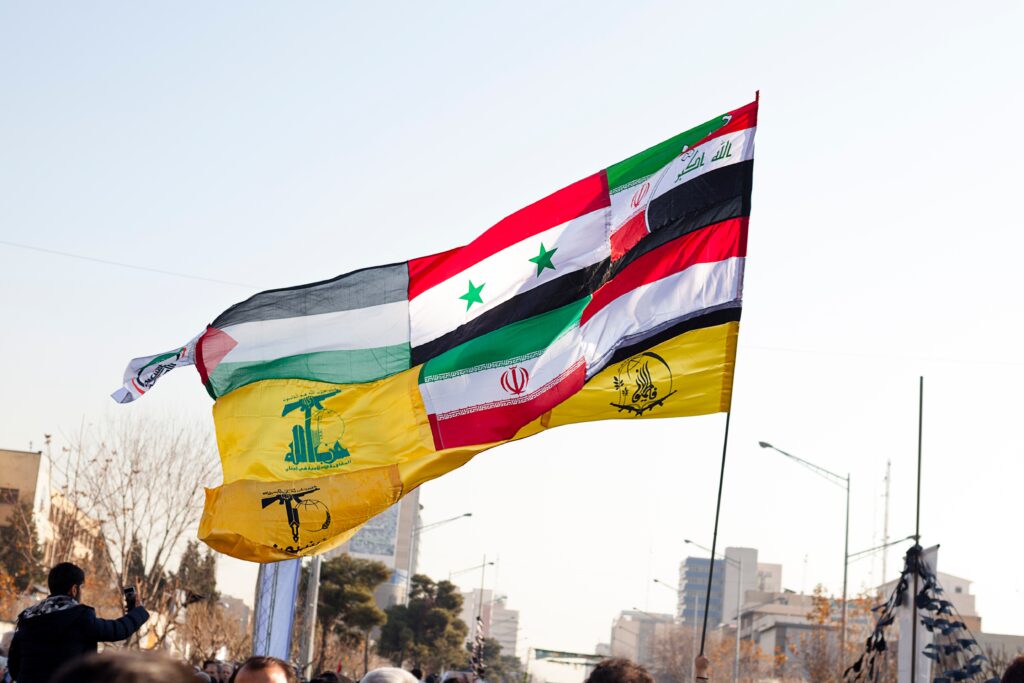
Far more consequential, indeed central to the understanding of what the war has wrought, is the position of Iran and its “camp” of proxies. To understand why the present Islamic revolutionary regime was a central player in creating the conditions for this war (even if it was not apparently a party to the specifics of Hamas’ plans), it is necessary to delve into its ideological imperatives – since no real geo-political or economic interests are behind its eliminationist position towards Israel.
For regime founder Supreme Leader Ruhollah Khomeini in his day, and for his successor Ali Khamenei and his regime today, “being in the business of destroying Israel” is rooted in their innermost creed. In their version (or perversion) of the Shi’ite faith, a violent bid to turn it into a modern totalitarian template, Iran and its camp will be able to carry forward the elimination of the Jewish state (which they define as a cancer brought into the region by the “global arrogance” of the West) – a task that the existing Sunni regimes gave up on. It is not for nothing that for years, a major thoroughfare in Teheran was named after Khaled al-Islambuli, the assassin of President Sadat of Egypt, whose sin was to make peace with Israel. In other words, the quest for Israel’s destruction was not the result of any specific point of contention with the Jewish state: it was, and remains, a core aspect of the Islamic Revolution as such.
In order to pursue this existential mission, the Iranian regime pursued three channels of action – all of which ended up by being severely challenged, but not yet completely overturned, by the events of the war:
Active pursuit of a nuclear military capability: The Iranian insistence on an active enrichment program, which over time had brought them closer and closer to having enough fissile material for a bomb, cannot be explained by any coherent civilian need. Modelled after the Pakistani project (whose designs were shared with them by the father of the Pakistani atomic bomb A. Q. Khan), it never made any sense in terms of its size and its nature other than as a bid for the bomb, even if the text of the 2015 nuclear deal, the Joint Comprehensive Plan of Action (JCPOA), boldly asserted otherwise. True, Iran may well have other reasons to seek a nuclear capability: It has suffered at the hands of Iraq, had occasional rifts with Pakistan, has reasons to fear Russian power, and seeks to dominate its Arab Gulf neighbours. And yet a central purpose of the project, all along, has been to undo Israel’s perceived regional superiority so as to open up the avenues that would lead to its decline and destruction.
Forced, under the terms of the JCPOA, to abandon the plutonium track to a bomb, Iran was nevertheless adamant that it would keep the capacity to enrich uranium (i.e. using centrifuges to separate fissile U-235 from U-238). And once the Trump Administration turned its back on the JCPOA in 2018, the regime cast off, step by step, all restraints on enrichment. By late 2024 there were also signs that it was activating the long-dormant weapons group, setting in motion the Israeli plans to stop it by force if necessary – and ultimately, Operation Rising Lion, known also as the “12-Day War” this past June.
The results were far-reaching, both in terms of the physical destruction wrought upon Iran’s nuclear facilities and as regards the fate of key scientists and engineers involved in the project. What was left of Iran’s existing stockpile is buried under rubble, and any serious attempts to retrieve it are bound to be detected and undone.
Notably, the Trump Administration joined the fray with a final assault on facilities Israel did not have the means to penetrate by bombing. What drove Operation “Midnight Hammer” was the realisation by the US that Iran has positioned itself as an ally, and indeed a weapons supplier, to Russia, in close coordination with other enemies of America. This “axis”, sometime referred to as the CRINK (China, Russia, Iran and North Korea) has emerged as an active challenger, and the US decision to move against it – based on years of planning by the US Central Command (CENTCOM) – struck effectively at its weakest point.
In the aftermath, Iran refused to accept a negotiated end to its nuclear venture – in return for the removal of sanctions, a deal that Trump quite clearly put on the table, having stopped Israel from pursuing its attacks any further. As a result, the three European partners to the JCPOA – after years of reluctance to follow America’s lead in putting “maximum pressure” on Iran – finally activated the so-called “snap-back” clause and re-instated sanctions (China and Russia, obviously, did not follow suit). It now remains to be seen whether the mounting pressure will bring Iran back to the negotiating table (possibly the outcome favoured by President Pezeshkian), or instead, in line with the Supreme Leader’s ideological obsession, Teheran will dig in its heels or even take the drastic step of leaving the Non-Proliferation Treaty (NPT).
Iran’s other tool designed to bring about Israel’s decline and fall was the proxy system – or, to use a term coined by Major General (res.) Yaakov Amidror, Israeli former National Security Advisor – the “ring of fire” built around Israel. Its most significant component was in Lebanon, held in the firm grip of a terror group fully subservient to Iran – Hezbollah, the “Party of God”, which combined political representation of the country’s underprivileged Shi’ites with the building of a massive military capacity, stronger than that of many states. To call it a “militia” when it held some 150,000 rockets and missiles was a serious understatement.
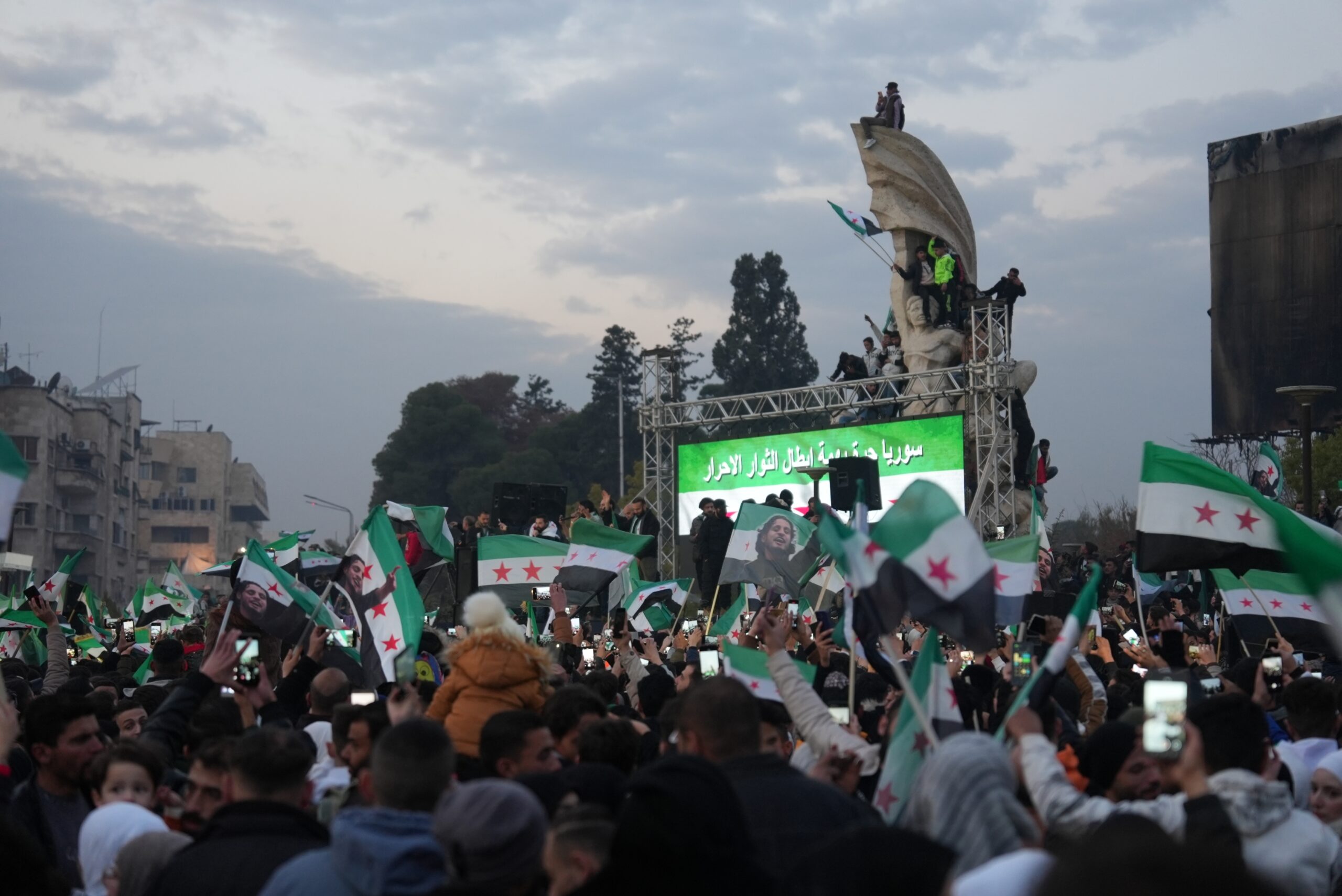
Syrians celebrate the liberation of their country from the Assad regime (Image: Mohammed Bash/ Shutterstock)
Neighbouring Syria – or rather, most of it – was held by a murderous regime beholden to Iran for its help against its own people. Even if the Assad clan was in fact secularist, and belonged to the Alawite sect that has long left the realm of Islam, it has been allied with Iran for decades because of their common enmity toward Saddam’s regime in Iraq, and served Iran as a conduit to Lebanon – and to Israel. Since 2013, the latter, in retaliation, had conducted a long series of air attacks on Iranian targets and convoys in Syria, which came to be known as the “Campaign Between the Wars.”
To the south of Syria, Iran sought, but failed, to destabilise Jordan so as to gain direct access to the Palestinians in the West Bank. Much further south, in Yemen, the radical Houthi Shi’a group which took over large parts of the country, was also, in many ways, an Iranian proxy, albeit with a will of its own. Its capacity to strike at far-away targets, both in Israel and in the Gulf monarchies, was clearly based on Iranian-supplied missile and drone technologies. Finally, in Gaza (not Shi’ite but radicalised), Iran has a fully-owned proxy – Palestinian Islamic Jihad – as well as working relationship with Hamas, even if in ideological terms that organisation is closer to the Muslim Brotherhood than to Iran’s version of Islamism.
All this was meant to erupt upon Israel at the appropriate moment and hasten its demise, with Iran staying safely behind the scenes. Yet something went wrong: Hamas’ leader, Yahya Sinwar, while sharing with Iran his general intentions, chose to keep both Teheran and Hezbollah’s leaders in the dark as to precisely when he was going to strike. There may well have been some solid logic behind this decision – and not just the vanity of being the standard bearer. Given the intensity of Israel’s intelligence effort in the north (which we now know came at the expense of taking the Hamas challenge seriously), he may have assumed – with good reason – that informing Hassan Nasrallah risked informing Israel’s sources.
Thus, by the time the war was underway, Hezbollah was caught unprepared – and when it had to make a choice as to its mode of action, a significant segment of the IDF reserves was already deployed in the north (and the Biden Administration issued a stern warning aimed at Hezbollah and Iran: “Don’t”).
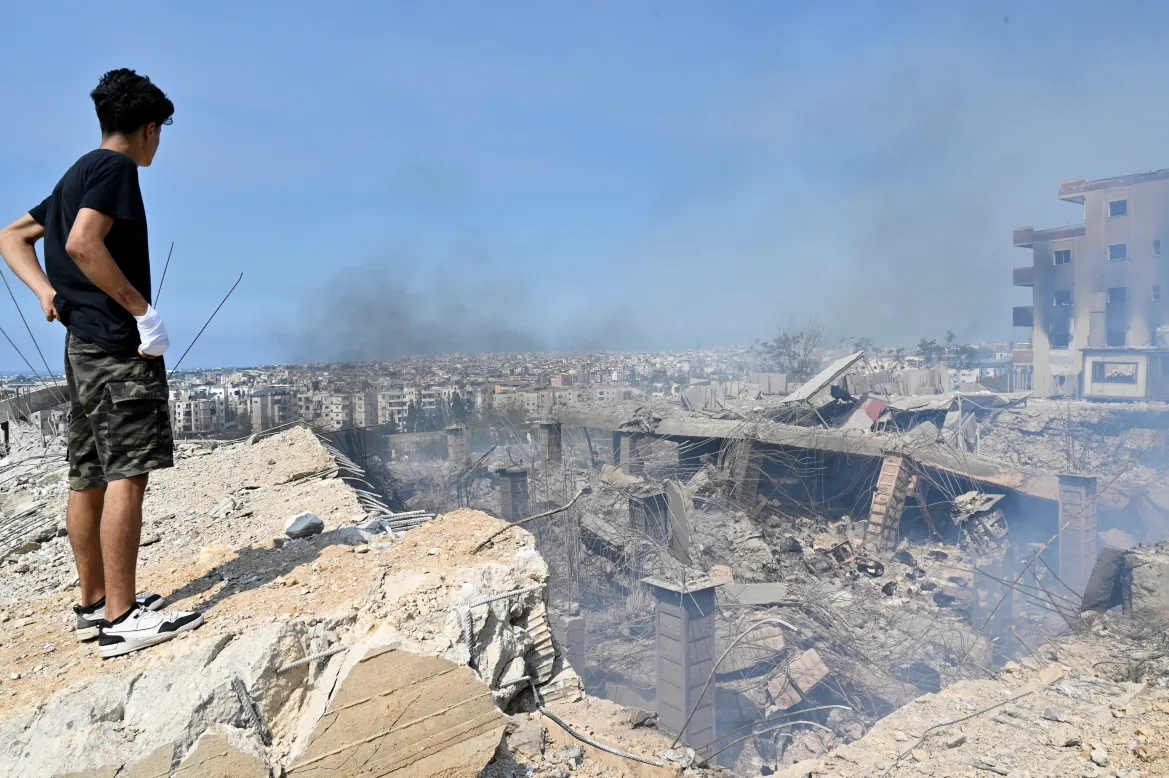
The site of the attack that killed Hezbollah leader Hassan Nasrallah (Image: Mohamad Safa/ X)
Hezbollah chief Hassan Nasrallah thus chose a low-to-mid-intensity option and it was only in September 2024 that Israel chose to escalate, not least because of the horrifying death of 12 Druze children in a rocket attack on a town in the Golan. Once this happened, the results followed fast and furious, with devastating effects for the Iranian axis of proxies. Israel unleashed its pager attack, followed by the decapitation of Hezbollah’s leadership, the destruction of much of its infrastructure and a limited ground incursion that pushed it away from the border.
The dramatic reduction of its power – and reputation – made Hezbollah ineffectual in its other task in recent years; namely, helping Assad survive in Syria. When the opposition forces broke out of the Idlib enclave in the northwest in early December 2024, the regime simply disintegrated, driving an immense wedge into the heart of Iran’s proxy system. Israel moved in as well, to destroy remnants of Assad’s military power and take some commanding border areas: the new regime, despite its Jihadi antecedents, opted for talks, and Iran’s key position was undone.
While a ceasefire came into effect in November 2024 in Lebanon, the Israeli Air Force continues to strike at will, with no effective response, at Hezbollah targets, with more than 300 killed in Hezbollah’s ranks within a year. Before 2023, Israel had cautiously avoided any action in Lebanon (while taking out targets in Syria), but now it no longer fears to strike there – even in Beirut itself, where the Hezbollah Chief of Staff was killed on Nov. 23 – or the Hezbollah strongholds of the Beqaa Valley. All of this is being done on the strength of a side letter by the US, authorising Israel to take preventive measures until such time as the Lebanese succeed at disarming Hezbollah. All this demonstrates clearly how much things have changed.
As for the Houthis, they too joined in with missile and drone attacks, which inflicted minor losses and frayed nerves in Israel, and with an anti-shipping campaign that in effect closed down Israel’s Port of Eilat. An American air campaign against them was cut short before bringing about an end to the attacks. Yet Israel, gradually rising to the challenge of effective operational intelligence in such a distant and alien landscape, struck the Houthis’ leadership during a cabinet meeting, and while they remain in power, their activism seems to have been modified, with the ceasefire nominally in place.
For Iran, it was also important to build up an image of Israel as a weak and withering entity, internally divided and destined to collapse. This led Teheran to cross a threshold previously avoided and launch direct action against Israel, in April and October 2024 (and obviously once Israel launched its own attacks in June 2025). Yet the results were far from what Iran may have expected: the missile and drone salvoes in 2024 were largely foiled, with regional and international players actually assisting Israel. And while significant damage was done by the missile attacks on Israel in June (including hits on the Weizmann Institute of Science and the Soroka Hospital in Beer Sheva), the loss of life, painful as it was, did not exceed 33 dead civilians. In Iran, this outcome – as compared to the devastating effect of Israel’s strikes, which led to massive exodus of citizens from Teheran – is apparently so disappointing that an elaborate fake campaign has been put in motion to inflate the casualty numbers from the Iranian strikes ten-fold and more. This in itself is a sign that the regime is aware that the events of the war shattered the myth of Israel’s helplessness and Iran’s impending rise.
In terms of the game of camps, there can be little doubt that the Iranian regime and its offshoots and affiliates have seen both their power and their prestige greatly reduced.
The Muslim Brotherhood and their Friends
In parallel, having recovered from the immense shock of October 7, Israel systematically reduced Hamas to a shadow of what it had been as a military force in in Gaza – even if it can terrorise the local population in areas still under its control. It was, almost inevitably, a brutal war, fought with much destruction in a densely populated area. As often happens in a prolonged conflict, attitudes hardened, and Israel mismanaged the complex task of providing humanitarian aid to people still under enemy rule (even if the accusations of deliberate starvation or “genocide” are baseless – rarely during wartime has such an effort been made to feed enemy areas). The intense attachment of the majority of Israelis to the cause of releasing the hostages held by Hamas was a limiting factor, and ultimately led to an American-induced ceasefire taking hold and the living hostages being released, with the IDF in control of more than half the Gaza Strip – but Hamas still holding the rest.
This is in turn a test of the legitimacy, durability, strength and reputation of the forces in the region which are, like Hamas, offshoots, affiliates or supporters of the Muslim Brotherhood and its ideology. On the face of it, UNSCR 2803 and the Trump 20-point plan that it endorsed mandate a “phase two” – once the last hostage bodies are retrieved – in which Hamas will step down as a governing power, disarm and accept the dismantlement of its military infrastructure. But will it? There is, as these lines are being written, little cause for hope.
Part of the problem is that two key regional players, long associated with support for a version of Islamism across the region, and for Hamas in particular, actually enjoy a sympathetic attitude on the part of President Trump and his team. Qatar has certainly gone to some lengths to impress Trump as a dedicated friend (and moreover, it hosts the largest US airbase in the region), and during the war, did play a major role in negotiating the hostage releases. As for President Recep Tayyip Erdogan in Turkey, Trump says he has a “great” relationship with him and likes him, and has been quite willing to see Turkey take a leading role both in post-Assad Syria and in Gaza.
This is worrisome from an Israeli perspective for a range of reasons: Erdogan does not mince words when it comes to denouncing Israel and offering justifications for Hamas and its actions. Above all, this raises the prospect that the relative void created by the trouncing of Iran’s camp will be filled by forces, led by Erdogan and by the Qatari ruling family, who seek to promote a Sunni Islamist agenda – not only in the Palestinian context but also elsewhere. Both were involved more than a decade ago in the struggle for hegemony in Egypt, supporting the Muslim Brotherhood and President Muhammad Morsi until he was overthrown by a combination of popular protest and military intervention on July 3, 2013 (His ouster was supported, in turn, by the United Arab Emirates and Saudi Arabia).
Since then, Erdogan’s attitudes have become more sophisticated, and he effectively courts the Saudis and Emiratis and even President Abd al-Fattah al-Sisi in Egypt, who he once called a usurper. Yet the basic faultline is still there, and Israel’s clear preference is to dissuade the Americans from doing anything that would further empower Ankara and Doha at the expense of others in the region who genuinely share Israel’s quest for stability and for the weakening of both Shi’ite and Sunni Islamist elements.
The “Camp of Stability” – and its Problems
Among the eight Arab and Muslim countries that endorsed the Trump plan and pushed for adoption of UNSCR 2803, five indeed belong to what can be called the “Camp of Stability”, alongside Israel and other interested parties (including the Eastern Mediterranean players, Greece and Cyprus, who fear Erdogan’s ambitions). These are Egypt, Jordan and the UAE (who signed peace treaties with Israel in 1979, 1994 and 2020 respectively – all of which held up despite the images generated by the war), as well as Saudi Arabia (with a solid relationship “under the table”, and persistent rumours about a pending breakthrough) and Indonesia, led by moderate Muslims and with a history of fighting radicals and of Israeli military assistance. Indonesian President Prabowo’s statement at the UNGA, calling for respect towards Israel’s security needs, is an interesting indication as to what may be coming.
Others in the region, including two more Abraham Accords signatories, Morocco and Bahrain, and in the Muslim world beyond it, may be troubled domestically by public responses to the plight of people in Gaza, but also do understand the need to defeat Hamas in a manner that will serve notice to the Islamists in general. Whether this commonality of interests – easily evident in the case of action against Iran, but less so when it comes to facing Hamas, Turkey and Qatar – can be translated into common action (and specifically contributing to the creation of alternative governance in Gaza) remains to be seen. Equally uncertain at this point is the fate of the American effort to bring about normalisation between Israel and Saudi Arabia.
A significant stumbling block, in this respect, is the question of a “credible path” (as suggested by UNSCR 2803) to an Israeli-Palestinian two-state solution. After all, in the taxonomy of forces suggested above, the Palestinian Authority (PA) under Mahmoud Abbas, “Abu Mazen”, is in effect on the side of the forces of stability. But in addition to the constraints of Israeli politics, and of the seething anger that many Israelis still feel two years later towards all who had shown sympathy towards the butchers of October 7, there are two practical problems that still stand in the way and make it difficult to find that “path”: 1. The Palestinian refusal, still adamant after all these years, to accept Israel as the embodiment of the right of the Jewish People to self-determination; and 2.The sheer corruption and incompetence of the PA as a government, which means that any attempt to burden it with governance in Gaza is bound to be disastrous.
The key to the future thus lies with the international players, especially from the Camp of Stability, willing to offer a transitional authority in Gaza – perhaps coming into the areas held by the IDF first – and creating from amidst the ruins a promise for a better life for those who wish for it. This could create a better template for others in the region and beyond – thus opening that elusive “credible path” to two-states.
Colonel (res.) Dr Eran Lerman is Vice President of the Jerusalem Institute for Strategy and Security. Previously, he served as Deputy Director for Foreign Policy and International Affairs at Israel’s National Security Council, and held several senior posts in IDF Military Intelligence.
Tags: Hamas, Hezbollah, Iran, Israel, Middle East, Muslim Brotherhood, Syria
RELATED ARTICLES