Australia/Israel Review
Waiting on Gaza
Dec 19, 2025 | Ilan Evyatar
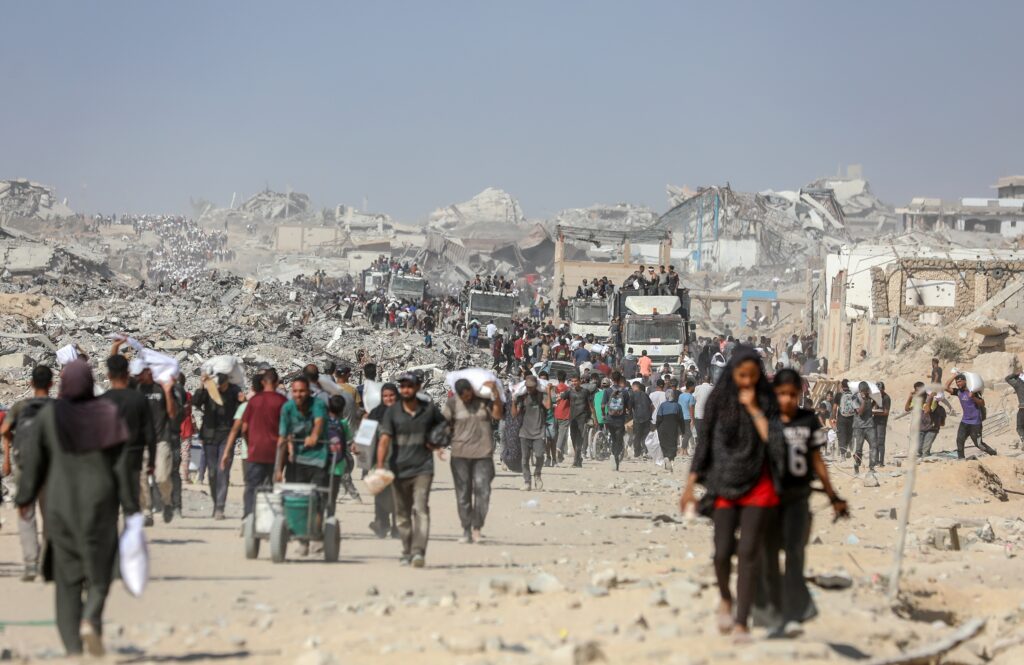
Optimists see the chance for a new regional architecture, while pessimists expect further conflict. Both agree on one point: much now depends upon Washington’s resolve.
As the dust settles over the rubble of Gaza, the Middle East finds itself suspended between two possible futures.
Optimists still believe President Trump can push through a new regional architecture, beginning with Gaza and culminating in an expansion of the Abraham Accords to incorporate Saudi Arabia and then other Arab and Muslim states. Across the region, however, a darker interpretation dominates: that the post-war landscape points not toward renewal but a relapse, with further rounds of conflict looming over Gaza, Jerusalem, Beirut and Teheran. Nearly two months after the ceasefire, an initial balance sheet is emerging, which reveals a fragile equilibrium that could collapse at any moment.
Under Phase Two of the 20-point Trump plan announced on September 29, an International Stabilisation Force (ISF) is supposed to gradually move into the Strip – making it possible for the IDF to withdraw from the areas it currently controls – and facilitate rebuilding.
But any sustainable “day after” depends entirely on Hamas’ disarmament – something the organisation has no intention of granting. In fact, Hamas has stated clearly that if the ISF attempts to disarm it, it will be treated as a “foreign occupier”. Every regional actor that might play a stabilising role, from the UAE to Morocco to Indonesia, has privately admitted what they refuse to say publicly: none of their forces will enter Gaza while Hamas retains its military infrastructure. The only states that have expressed willingness to deploy troops, Qatar and Turkey, are unacceptable to Israel because of their entrenched political alignment with Hamas and the Muslim Brotherhood. From Jerusalem’s perspective, the presence of either state would be a continuation or even amplification of the problem, not a solution.
This reality leaves Israel facing two grim prospects. It could watch Hamas remain in power in the half of Gaza beyond the “yellow line” to which Israeli forces withdrew under the Trump plan. Or else it could decide that the time has come to finish the job militarily, now unrestrained by the concern over the fate of the hostages that shaped the pace of the war up until the ceasefire implemented on Oct. 10.
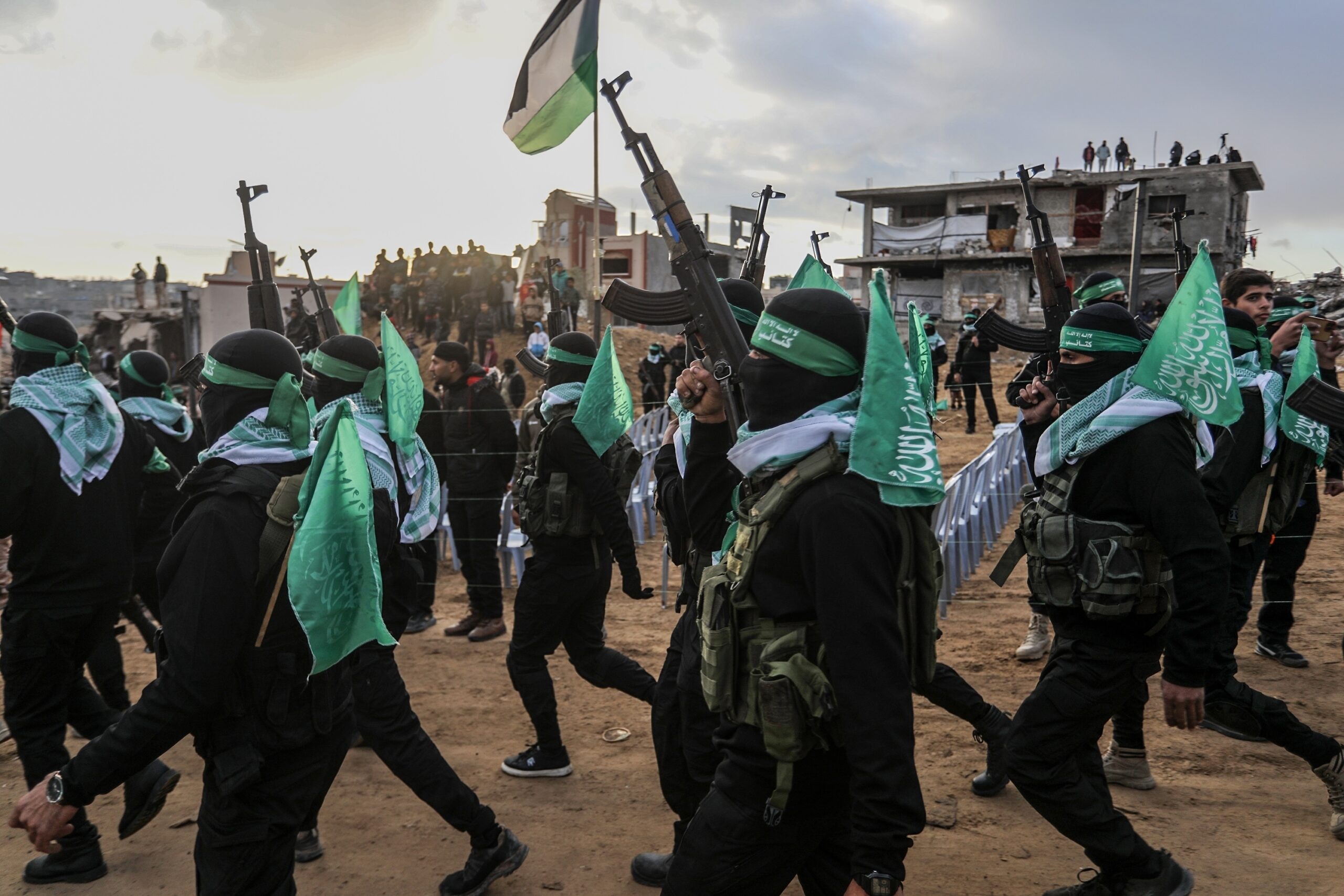
A show of force as Hamas seeks to reassert its authority in the portion of Gaza outside Israeli control (Image: Anas Mohammed/ Shutterstock)
The United States, however, remains determined to push its plan through. Washington invested political capital and diplomatic muscle into pushing through UN Security Council Resolution 2803, passed on Nov. 17. This resolution endorses the Trump Administration’s “Comprehensive Plan to End the Gaza Conflict” and authorises the establishment of the ISF and a “Board of Peace” to oversee Gaza’s future.
The US has also invested operational resources, setting up the Civil-Military Coordination Centre in Kiryat Gat in southern Israel to prepare for the next phase in Gaza.
Indeed, the increased US involvement on the ground over recent months led Israel’s opposition leader Yair Lapid to accuse PM Binyamin Netanyahu of turning Israel “into a vassal state that received dictates regarding its security” from Washington. Netanyahu dismissed the accusation as “hogwash”.
There is reason to believe that Washington today increasingly understands that its plan may only become implementable if the current equilibrium breaks. A renewal of hostilities – whether because of a deliberate decision by Israel or a Hamas miscalculation – may inadvertently create the conditions the US plan requires: a Gaza in which Hamas’ military infrastructure is degraded to the point where an international force can safely deploy, reconstruction can begin and governance can shift. It is a paradoxical but increasingly acknowledged reality in both Washington and Jerusalem: the US “peace plan” may need the war to resume in order to succeed.
Given the current suspended state, Saudi Arabia’s diplomacy offers a revealing indicator. Crown Prince Mohammed bin Salman returned from his Nov. 18-19 visit to Washington with a significant weapons package, including an agreement on the sale of F-35 fighter jets that could challenge Israel’s military superiority, without offering any movement toward normalisation with Israel. (Though the US has subsequently made it clear delivery of F-35s will only be possible after normalisation, and for practical reason would take at least five years.)
The message from the Saudis could not be clearer. Despite Trump pushing strongly for Riyadh to join the Abraham Accords, without a credible roadmap on the Palestinian issue, the Saudis will not take the next step for the time being. They cannot do so with Gaza still aflame in the public opinion of both Saudi Arabia and other Arab states.
Inside Israel, the political reality is equally well-defined. An overwhelming majority of Israelis oppose any form of Palestinian statehood without wholesale changes in Palestinian political culture and leadership, changes no one believes are likely soon, despite Palestinian Authority Chairman Mahmoud Abbas’ promises of reform. Yet beneath the surface, relations between Israel and key Arab capitals remain far more resilient than public statements suggest. Intelligence channels remain active. Military dialogue continues. Respect for Israeli military capabilities has grown. But no one is prepared to unlock a new regional architecture based on these realities while Gaza’s political future remains uncertain.
Meanwhile, if Gaza remains frozen, Lebanon is heating up. Israel’s assassination of Hezbollah’s Chief of Staff, Haytham Ali Tabatabai, on Nov. 24 sent shockwaves through Beirut’s political and military establishment. Within Israel’s security establishment, the consensus is blunt: the Lebanese state cannot and will not dismantle Hezbollah’s military infrastructure. A new round of conflict is therefore widely expected, sooner rather than later.
Talk of Lebanon entering the circle of normalisation seems premature for the moment, although here again, further Israeli erosion of Hezbollah’s capabilities could perhaps create conditions for progress.
Meanwhile, despite the possibility of a resumption of war with Hezbollah, Israeli and Lebanese government representatives met in the coastal town of Naqoura near the Israeli border on Dec. 3, the first direct meeting between the sides in over 30 years. They agreed to hold further talks by the end of the month.
There has also been talk of a possible security agreement between Israel and Syria, but this too seems detached from current realities, despite Syrian President Ahmed Al-Sharaa – a former jihadist – being warmly received in Washington. On Nov. 27, Israeli forces conducted an arrest operation in Beit Jinn, in the buffer zone on the Syrian side of Mount Hermon, and clashed with dozens of gunmen believed to be from the Hamas-Muslim Brotherhood-affiliated Jamaa al-Islamiya. Several Israeli soldiers were injured, some seriously, and as many as 20 of the gunmen were wounded. Israeli military sources said the group had been planning attacks on Israeli outposts and possibly even a cross-border attack.
Iran, too, is regrouping rather than retreating. Since the June 2025 war with Israel and the American strike known as Operation Midnight Hammer – which together destroyed much of its nuclear infrastructure – Teheran has shown little interest in returning to negotiations. Instead, it is accelerating efforts to rebuild its ballistic missile arsenal and air defences and its rhetoric is becoming increasingly bellicose.
Taken together, the regional picture defies easy categorisation. Israel has altered the strategic landscape. Hamas is weakened. Hezbollah’s leadership has suffered major blows. Iranian militias abroad and military forces at home have absorbed real damage. Israel’s deterrence, shattered on October 7, has been partially restored.
And yet the foundations of any “new Middle East” appear elusive. Gaza’s future is unresolved. Lebanon is edging toward conflict. Syria is broken. Iran is rebuilding.
However, for all the noise elsewhere – Lebanon, Syria, Iran’s rearmament – the strategic hinge remains Gaza. As long as Hamas retains guns, tunnels and territorial control, no Arab state will normalise, no international force will deploy and no new regional architecture can materialise. Gaza will continue to influence what comes next for the region. How that unfolds – through negotiation or a return to fighting – remains unclear. Much will depend on Washington’s resolve to see its plan through, and willingness to credibly threaten, and if necessary, then support a return to Israeli military operations in Gaza if that is what is required to see the plan implemented.
Tags: Gaza, Hamas, Hezbollah, Iran, Israel, Middle East, Syria, United Nations
RELATED ARTICLES