Australia/Israel Review
Split screen vision
Mar 18, 2026 | Alana Schetzer
The highs and lows of Israeli President Isaac Herzog’s visit to Australia
Prime Minister Anthony Albanese issued an invitation to Israeli President Isaac Herzog to visit Australia just days after two ISIS-affiliated Islamists targeted a gathering of Jews celebrating Chanukah at Bondi Beach on December 14. The two shot dead 15 innocent people and injured some 40 others in the worst terror attack and the second-worst mass shooting in Australian history.
As Israel’s President – the equivalent to our Governor-General – Herzog’s role is almost exclusively ceremonial, his visit was billed as one that was intended to bring comfort, support and solidarity to the survivors, victims’ families and the broader Australian Jewish community. The community has been reeling from years of growing antisemitism. This included numerous violent attacks before Bondi, some now known to have been sponsored by Iran’s Islamic Revolutionary Guard Corps, such as the firebombing of Melbourne’s Adass Israel Synagogue and a Sydney kosher deli in late 2024.
Herzog’s trip to Australia was the fourth such official visit by an Israeli head of state, following his father Chaim Herzog’s groundbreaking visit in 1986, a visit by then-President Moshe Katsav in 2005, and one by then-President Reuven Rivlin in February 2020.
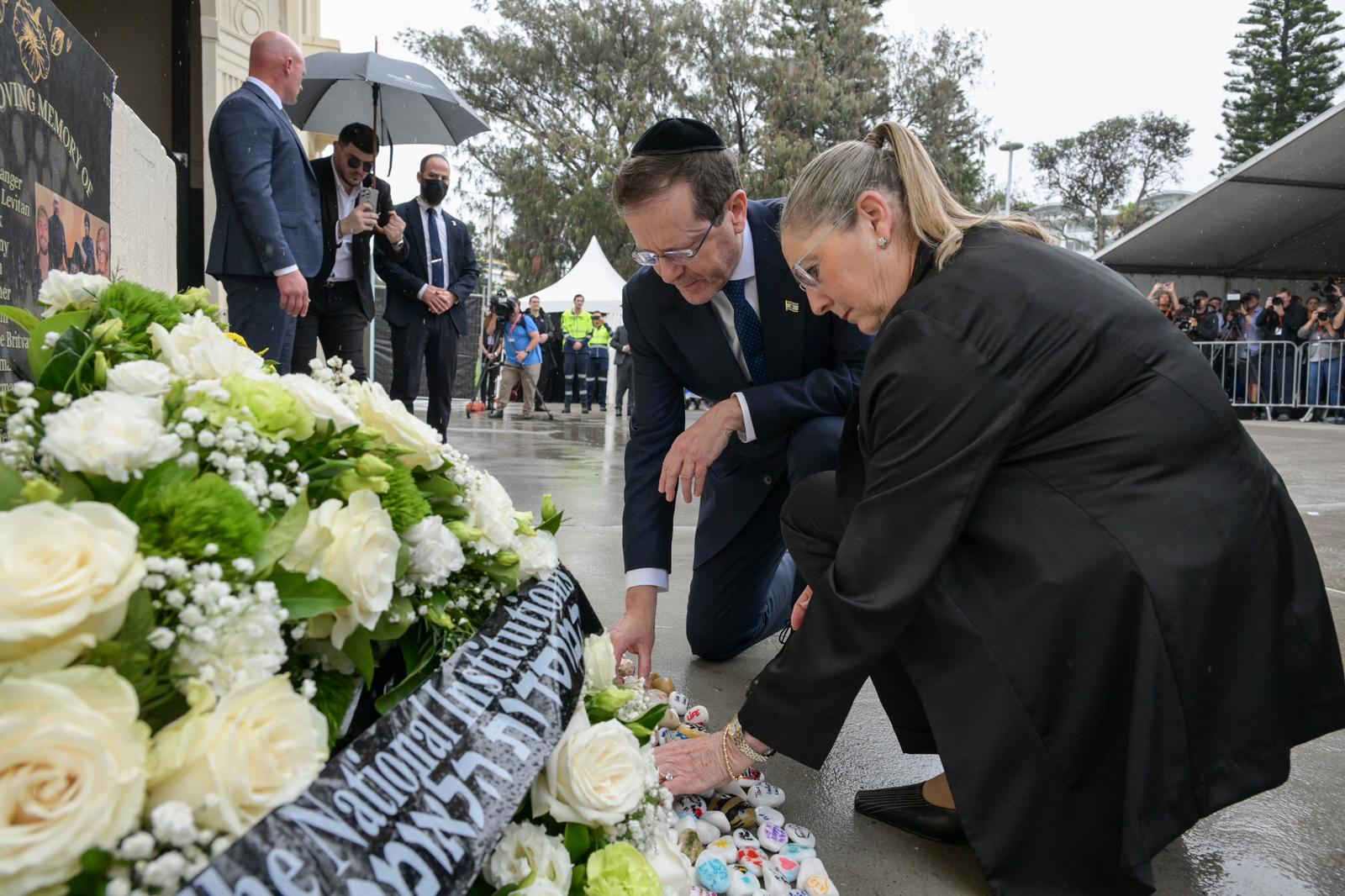
Israeli President Herzog pays tribute to the Bondi victims (Image: Ma’ayan Toaf/ GPO)
A whirlwind tour
Herzog’s official visit began on Feb. 9 in Sydney, where he was welcomed by local dignitaries. His schedule for the four days included privately meeting with survivors of the Bondi massacre, dinner with Jewish community leaders, a wreath-laying ceremony at the Australian War Memorial, a visit to the Melbourne Holocaust Museum, plus various meetings with the community and state and federal political leaders.
The day he arrived, he visited the site of the massacre and the Bondi Pavilion, laying down a wreath and some stones brought from Jerusalem.
“The stones… will remain here at Bondi for eternity, a sacred memory of the victims and as a reminder that between good people of all faiths and all nations, we will continue to hold strong in the face of terror, violence and hatred, and that we shall overcome this evil together,” he said.
Herzog spoke out against the extraordinary wave of antisemitism and violent rhetoric that has risen across the world since the October 7 terror attacks in southern Israel.
“These frustrations were shared by many, many of us, including myself. I have seen this wave surge all over the world, and I have seen it in many countries, including Canada, Great Britain, the United States and Australia – all English-speaking countries,” he said.
“Antisemitism here in Australia is not a Jewish problem. It is an Australian problem and a global problem over the generations.”
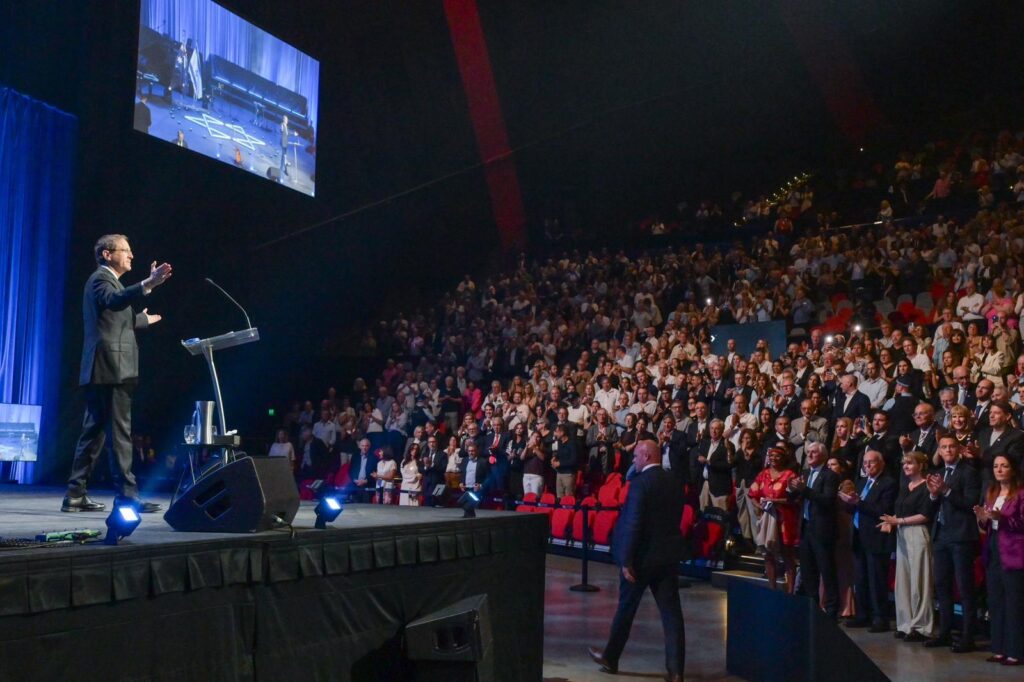
That night, he addressed a large crowd at a Jewish community event at the Sydney Convention Centre, also attended by NSW Premier Chris Minns and former Australian Prime Minister Scott Morrison among other dignitaries.
The following day, he attended a memorial service at the Bondi Chabad Synagogue together with Albanese, before a dinner at Kirribilli House, the Prime Minister’s official Sydney residence.
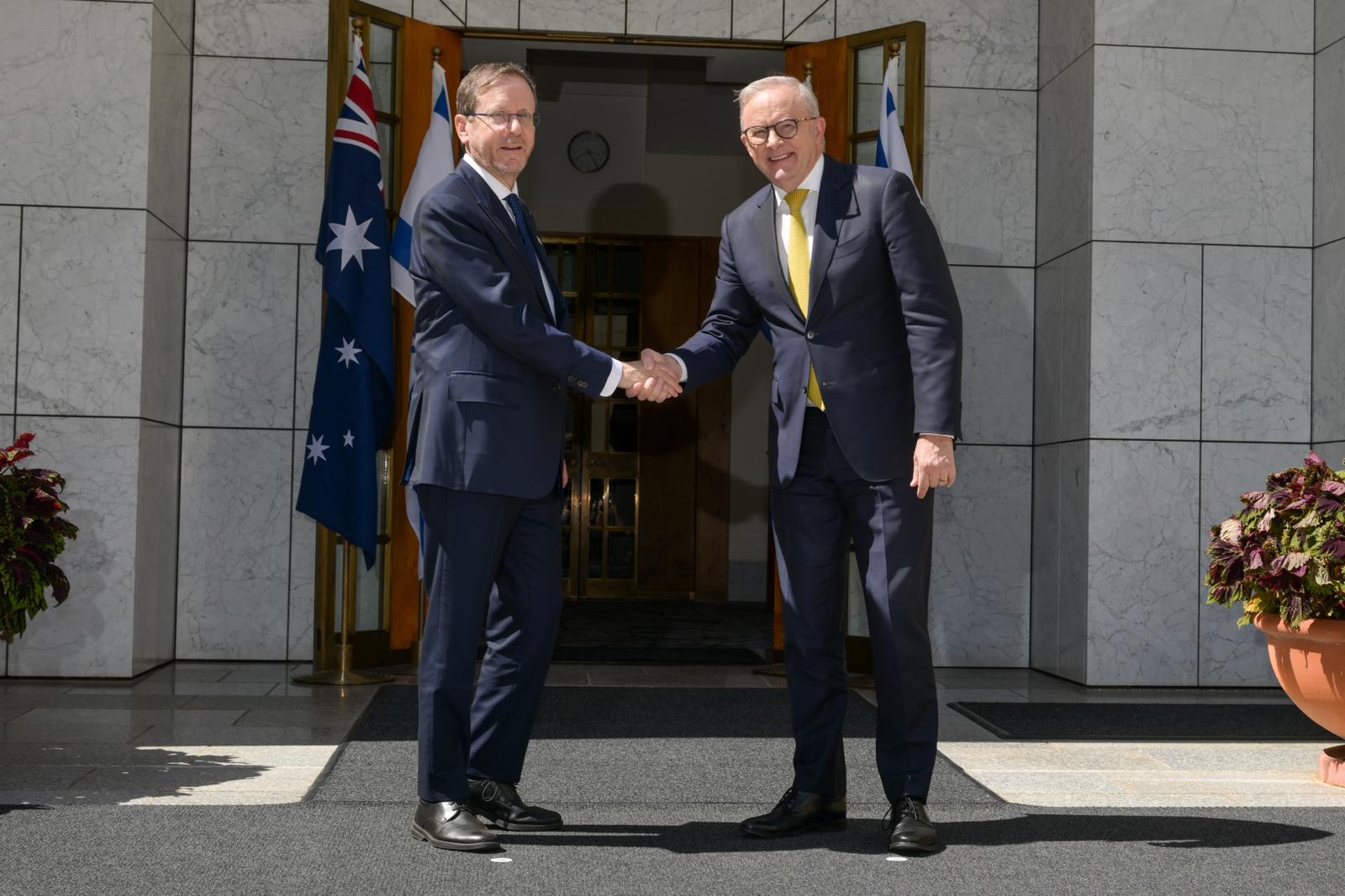
Israeli President Herzog with PM Albanese in Canberra (Image: Ma’ayan Toaf/ GPO)
On Feb. 11, Herzog was in Canberra where he was officially welcomed to Government House in a ceremony attended by Governor-General Sam Mostyn and Albanese. Mostyn said she was “very, very pleased” to welcome Herzog to Australia before speaking of the importance of his state visit following the Bondi attack. “I think it is terribly important that your visit is one that stands with those who [are] still grieving, those that want to know that they are safe,” Mostyn said.
Herzog said, “I’ve come here to express our condolences and bereavement and pain and love to the Jewish community of Australia.”
For the final day of his trip, he met with Victorian Premier Jacinta Allan at Victoria’s Government House before attending a Jewish community event in Melbourne.
Herzog adressed the extraordinary security required for his visit and the constant presence of protesters at the Jewish community event. “To me, it’s obscure and odd that we need to have so many incredible police officers protecting us for the inherent right for us to gather here as proud Jews… to host the president of the only Jewish state on Earth, without any harassment,” he said.
Herzog wrapped up his Australian visit saying to the crowd “We came to remind you that you are not alone here in the diaspora, and we leave understanding more than ever before that we have each other… The resolve and solidarity of this community are key to the future that we all share in Melbourne and in Jerusalem.”
Security
Security for Herzog’s visit was extraordinarily tight and reflected ongoing high levels of antisemitism and threats towards the Australian Jewish community.
On Feb. 5, 19-year-old Sydney man Darcy Tinning was charged with threating to kill Herzog. NSW Police Commissioner Mal Lanyon revealed days earlier that police were aware of ten antisemitic incidents in NSW over the previous fortnight, including threats to Jewish leaders.
The NSW Minns Government declared the visit a ‘major event’ under state law, meaning that police had additional powers to ensure Herzog’s safety and that of the Jewish community attending events. In a press release issued the day before Herzog’s visit began, the Minns Government stated, “The Government is asking everyone to approach the coming days with patience and respect for others.”
Minns said NSW Police would “ensure the community’s safety as well as the President’s safety” during the visit. He added, “We cannot allow a situation where mourners and protesters come into close contact on city streets without strong police presence.”
“This is about keeping people safe, lowering the temperature and ensuring Sydney remains calm and orderly.”
In addition, Lanyon extended the state’s protest restrictions, in place since Bondi, for a further 14 days with respect to certain parts of Sydney due to “significant risk to community safety by public assemblies.” These restrictions, known as Public Assembly Restriction Declaration (PARD), limited protests and rallies in parts of the CBD and eastern suburbs.
ACT Police stated that “a highly visible and significant police presence would be in place in Canberra… ahead of expected protests to coincide with the visit of the President of Israel.” That police presence would include the AFP Protection and Specialist Operations.
In preparation for Herzog’s Melbourne visit on Feb. 12, the Supreme Court granted Victoria Police additional powers for specific areas, allowing them to search people and vehicles, cordon-off areas, and seek the identities of people passing through the areas covered by the court order.
In Sydney on Feb. 12, a 45-year-old man was charged with stalking/intimidation/intention to cause fear/physical harm, after he allegedly sought to approach and harass Herzog in defiance of police orders.
During Herzog’s travel and appearances, he was escorted by a heavy police presence, with snipers positioned on rooftops during some appearances and helicopters flying overhead.
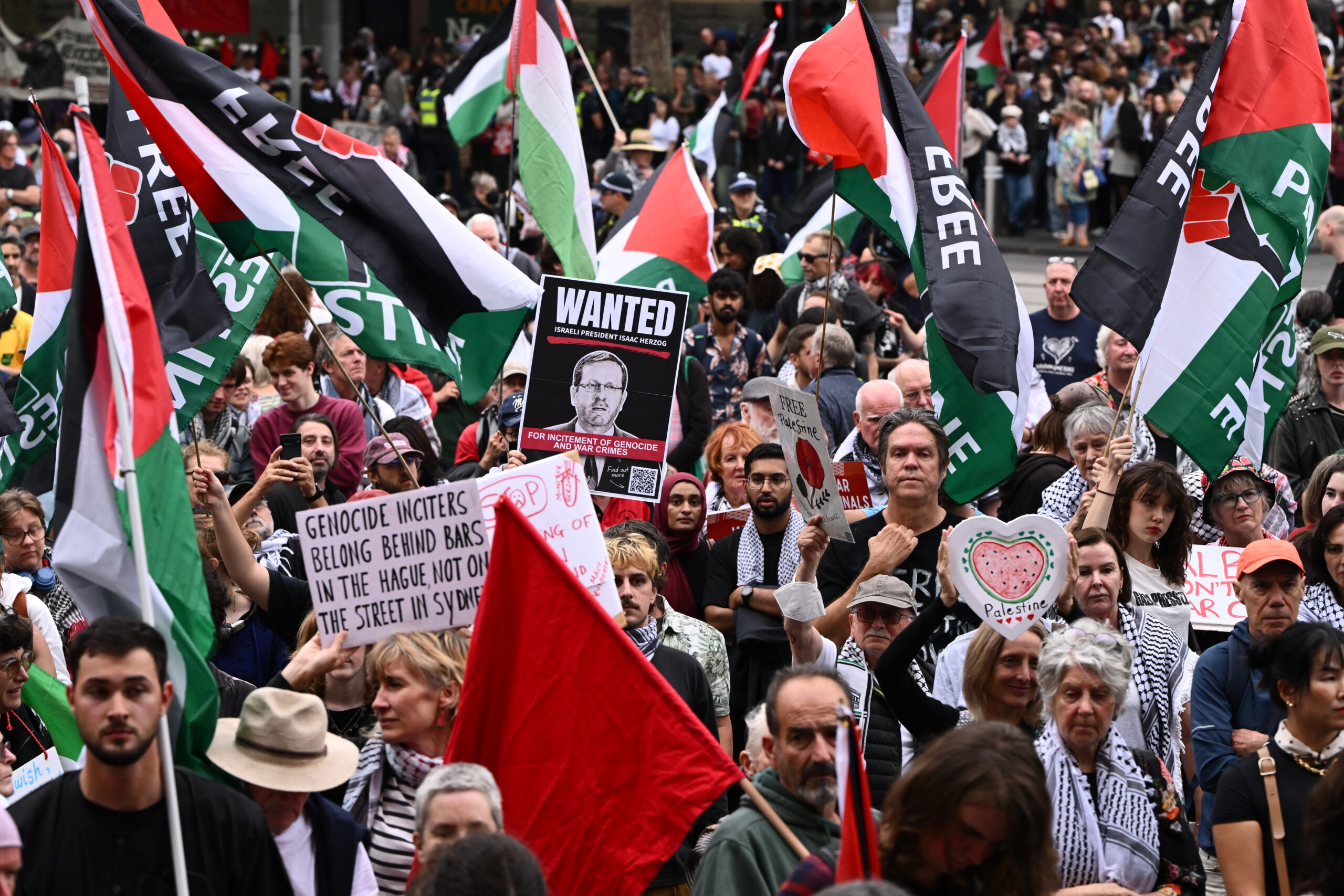
Protesters against Israeli President Isaac Herzog’s visit at Flinders Street Station in Melbourne, February 9, 2026. (Image: AAP Image/ Joel Carrett)
Protests and violence
The anti-Zionist movement, led by the Palestine Action Group (PAG), organised multiple protests across Australia opposing the visit, both before and during Herzog’s trip, with both Sydney and Melbourne CBDs and several suburbs heavily vandalised with flyers and posters promoting the protests.
PAG launched an urgent legal challenge in the NSW Supreme Court on Feb. 8 against the Minns Government decision to classify Herzog’s visit a ‘major event’, arguing that the law is usually used for commercial events. It also said that it sought to peacefully protest. However, Justice Robertson Wright found in favour of the Government, saying that its chief motivation was not to suppress protests but to protect public safety.
The PAG immediately announced it would ignore the Court’s ruling and go ahead with its planned protest. After delivering speeches outside Town Hall – which included former Australian of the Year Grace Tame leading chants of “globalise the intifada” – and despite police issuing move-on orders under PARD restrictions, protesters repeatedly attempted to march and breach police lines. Violence broke out.
Videos of the violent chaos show protesters being pepper-sprayed (as well as police being overwhelmed by the substance), people being punched and police being assaulted.
One journalist present reported that “Protesters yelled ‘F**k the police’, often going right up into officers faces, one protester in the midst of a brawl laid down directly in front of the police line, I heard another encourage protesters ‘We have the numbers to march, we just need to get past these c***s’.”
He also said that protesters singled out and attacked individual officers based on their appearance.
The PAG claimed that protesters acted peacefully and that police used excessive violence; in a social media post, the group condemned “the brutal attack by the NSW Police.”
The NSW Police watchdog has opened an investigation into allegations of police misconduct after receiving a “significant number of complaints.”
Albanese – who described the events as “confronting” – said in Parliament that protesters actively chose to breach the PARD.
“There were systems put in place to make sure, sensible, frankly, to separate where President Herzog was and where the demonstrations were and people sought to break that separation, and therefore, to create a circumstance that was not going to be peaceful,” he said.
NSW Police stated that ten officers were injured during the violent brawl and that 27 people were arrested, with nine charged with a range of assault and public order offences. One protester allegedly bit an officer.
Minns, calling the situation “incredibly combustible”, defended the police, saying, “I know that some of the scenes on media are short clips, but people have to understand the circumstances where protesters breached police lines and ran amok in Sydney would have been devastating.”
Police Association of NSW President Kevin Morton said officers were forced to stop protesters from physically coming into contact with Jewish mourners.
He said that larger groups of protesters ignored warnings and charged at police lines.
“Some sections of this protest left our members with no choice. They were people just hellbent on causing a reaction and creating chaos,” Morton said. “This was an outcome police did not want and did what they could to avoid. But when the actions of people in that crowd made it impossible, our members took the necessary action to maintain order and safety.”
He added that police had “urged protesters to take a different route. To identify an option that allowed action to go ahead and maintain safety. But this was refused.”
During Herzog’s brief stay in Canberra, several hundred protesters descended upon Parliament House chanting the slogan “From the river to the sea,” which calls for Israel’s destruction.
On the day that Herzog arrived in Melbourne, Feb. 12, “Death to Herzog” was graffitied on a building at the University of Melbourne, along with an inverted triangle, the symbol used by Hamas to designate a target for attack. The Australasian Union of Jewish students said, “Calls for violence against any individual or nation are not legitimate criticism of government policy.”
Victorian Premier Jacinta Allan called the graffiti “absolutely contemptible”.
“We all want peace to come and causing hurt and grief – and indeed violence as we’ve seen as a result in Sydney – that does not cause peace,” she said.
Herzog’s Melbourne trip was to begin with a visit to the site of the Adass Israel Synagogue, which was destroyed in a terror attack in December 2024, but this visit was cancelled due to security concerns.
Thousands of anti-Israel protesters gathered around Flinders Street Station in the early evening, blocking traffic. Protesters claimed that 30,000 people attended but Victoria Police said the number was closer to 10,000. The media reported that multiple slogans were heard , including “All Zionists are terrorists” – subsequently found to be a violation of racial vilification laws by a Victorian tribunal – and “death to the IDF.” However, unlike Sydney, and despite the inflammatory slogans, the protest was not physically aggressive.
During that afternoon’s event, Herzog said protesters should instead “go protest in front of the Iranian embassy,” referring to Iran’s regime’s massacre of as many as 36,500 Iranian civilians since Dec. 28.
Political theatre
Political tensions remained high throughout the week of Herzog’s visit, spurred by repeated accusations by the Greens that Herzog was complicit in genocide and should not be allowed into the country.
The Australian Federal Police declared that Herzog, as a visiting head of state, had full immunity during his Australian visit, after a group of pro-Palestinian lawyers had announced they would seek to have him arrested.
Albanese himself was highly supportive of the visit. “President Herzog is coming in the context of the devastating antisemitic terrorist attack that occurred at Bondi on 14 December,” he told reporters in Perth on Feb. 7.
“I hope that people are respectful of the fact that this is a difficult time for families, particularly in the Bondi community, from the Chabad community there.”
However, the ruling ALP was publicly split over the visit; Labor Friends of Palestine wrote an open letter to Home Affairs Minister Tony Burke urging him to block Herzog’s visit on the grounds that he failed the ‘character test’ for a visa.
“The presence of this Israeli leader will distress and anger millions of Australians, including Labor members and Labor voters,” Peter Moss of Labor Friends of Palestine later added.
In late January, Multicultural Affairs Minister Anne Aly initially refused to say whether she welcomed the visit, only acknowledging that, “Well, President Herzog was invited in the aftermath of the Bondi attacks, as is protocol and as is something that is usually done.” She later partially backtracked, saying “I welcome anything” that assists in the healing process after Bondi.
NSW state ALP backbenchers Sarah Kaine, Stephen Lawrence, Anthony D’Adam and Cameron Murphy joined Sydney’s anti-Herzog protests.
In their own open letter, Jewish Labor urged their colleagues to support the four-day visit, saying it came “at a moment of deep trauma for Australian Jewry.”
“It is about solidarity, reassurance, and the simple human need to be seen and heard in a time of fear. We therefore ask, respectfully but firmly: why would anyone seek to deny that?”
The letter noted that Herzog is not “a symbol of extremism” and is a former leader of the Israeli Labor Party.
The Coalition was supportive of Herzog visiting Australia. Then-Opposition Leader Sussan Ley said the visit “provides a constructive platform to rebuild trust and deepen engagement.” She also denounced the protest movement for disturbing mourners.
“It is deeply disappointing to see protests surrounding this visit in the aftermath of a national tragedy. While peaceful protest is a democratic right, the timing and tone of these demonstrations risk compounding division at a moment that calls for unity and reflection.”
During the actual visit, divisive political discourse remained prevalent. In Parliament on Feb. 10, Albanese denounced the Greens – who had demanded that he condemn “police violence” and send Herzog back to Israel – saying that Herzog was in Australia to offer “sympathy and solidarity to people who are mourning and offer his support to Australia’s Jewish community.”
“I will not, as a number of the crossbenchers have suggested, walk away from my support for his presence,” he insisted.
For coverage of the media controversies surrounding the Herzog trip, see Allon Lee’s piece here.
RELATED ARTICLES