Australia/Israel Review, Featured
Essay: Educating against antisemitism
Mar 18, 2026 | Dave Rich
How to turn off the tap of extremism
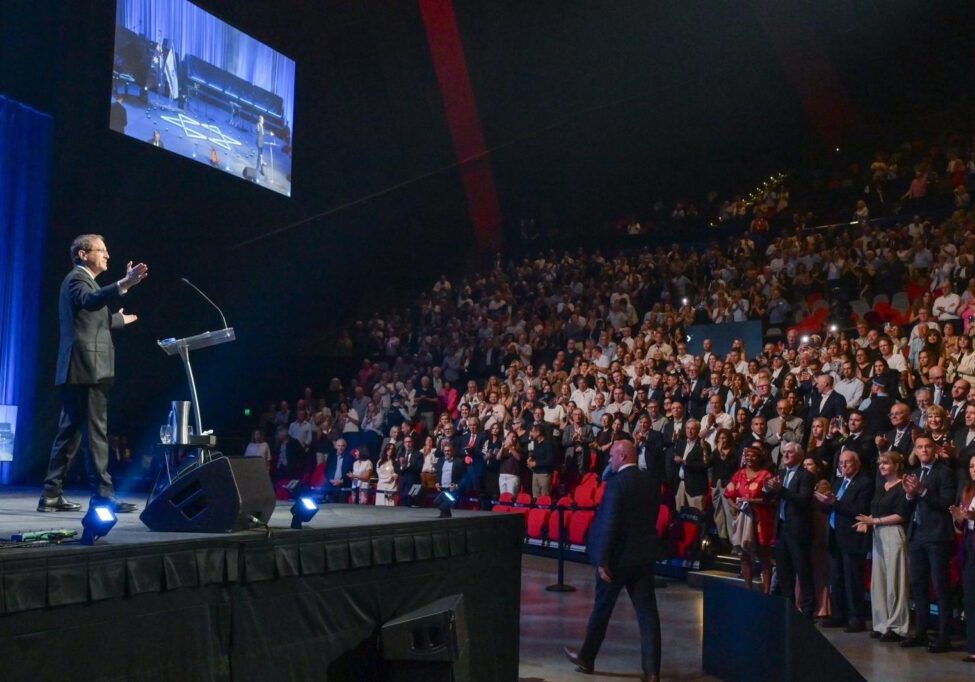
The following is based on the keynote address given in Sydney on March 17, 2026 at the “Dialogue with UNESCO on the National Approach to Combating Antisemitism in Australian Schools”, a conference for educators organised by Australia’s Special Envoy to Combat Antisemitism and hosted by the NSW Department of Education.
I last visited Sydney in November 2023, at a time when the Jewish community here, like the community in the UK, and others around the world, were reeling from the shock of October 7. And now we are reeling once again, from the horror on Bondi Beach on the first day of Chanukah, and the attack on a synagogue in Manchester, the city where I was born and grew up, on Yom Kippur. Many people, in the Jewish community and beyond, draw a connection between those events. Not a direct line perhaps, but in the idea that there is an unavoidable link between the hatreds unleashed on 7 October 2023, and the murderous terrorism that landed on our communities, in Australia and in Great Britain, at the end of 2025.
A shift in the atmosphere
In many ways, October 7 is the day that things changed for Jewish communities around the world. There was a shift in the atmosphere for Jews, a darkening of the skies. Anti-Jewish hatreds that had been largely marginal in our societies became open and proudly declared, by people unashamed of their prejudice. Hate crimes against Jews soared around the world. And there was a sense, a foreboding, that this explosion of antisemitism – seemingly unprecedented yet chillingly familiar – would lead to an atrocity like that suffered on the first day of Chanukah here in Sydney, and on Yom Kippur in Manchester. When I was last here, in November 2023, I addressed the Kristallnacht commemoration that year, and I said at the time that “it feels like we are entering a new phase.” Well, here we are.
Jewish festivals are supposed to be days of happiness, occasions to enjoy and to embrace. Whether they are festive and celebratory, like Chanukah, or days of contemplation and solemn prayer, like Yom Kippur – they share a sense of community, of coming together, a day for Jewish people to connect with each other, not just locally, but globally too. Jews around the world celebrate Chanukah in just the same way, lighting menorahs and eating donuts, wherever we are – but now, these festivals are becoming days of mourning. October 7, Manchester, Bondi, the Halle synagogue attack in Germany: all terror attacks on Jews that took place on Jewish festivals. It’s a reminder that antisemitism is not limited to the taking of Jewish lives. It is an attempt to stop the Jewish way of life, to inhibit Jewish identity and destroy Jewish dignity.
I’m talking a lot about the Jewish community and the Jewish way of life. But of course, most of the people murdered at Bondi were Australians. Those killed in Manchester were British. These are not only attacks on Jews, but on all of us, Jewish or not, and on our societies as a whole. If Bondi Beach is not safe, then our entire way of life is in question. If Jews cannot pray safely in synagogue – then the fundamental basis of our shared society is in doubt. If hatred and extremism become the norm, then we are all in danger. Public safety, equality for all, the rule of law – these are the pillars of liberal democracy. If we cannot all count on that, then society is failing.
We are not alone in this, whether in Australia or in Britain. Nor is it new, no matter how immediate it feels. Jews have been murdered in recent years in Washington DC and Boulder, Colorado; in Pittsburgh and Halle, Germany; and before that, in Paris, Copenhagen, Toulouse, Brussels, Istanbul, Mumbai, Buenos Aires – and many other places too. This is where antisemitism leads. We know it, but still, it never loses the capacity to shock us when it happens in our own homes, in the places we are so familiar with, the places where we have walked and prayed and lived ourselves.
Since October 7, 2023, there have been over 150 terrorist attacks, foiled plots, and acts of extreme violence targeting Jews and Israelis in over 40 countries around the world – not including in Israel itself. Synagogues have been burnt on five different continents since that date. The world is a small place when it comes to antisemitism: no corner of the Earth is immune. This is a global movement, and a global problem.
It’s been a difficult lesson for many people to absorb. In the UK, back in the early 2000s, we watched as terrorism and antisemitic murders took Jewish lives in France, just across the English Channel, and thought “What if it happens here?” – meaning in the UK. And I know, from talking to my Australian Jewish friends, that for a long time it was assumed that Australia was a haven from the kind of hatreds that washed over European and American Jewish communities. Meanwhile, Jews in the United States thought they were permanently shielded from the antisemitism their families had left behind.
No longer.
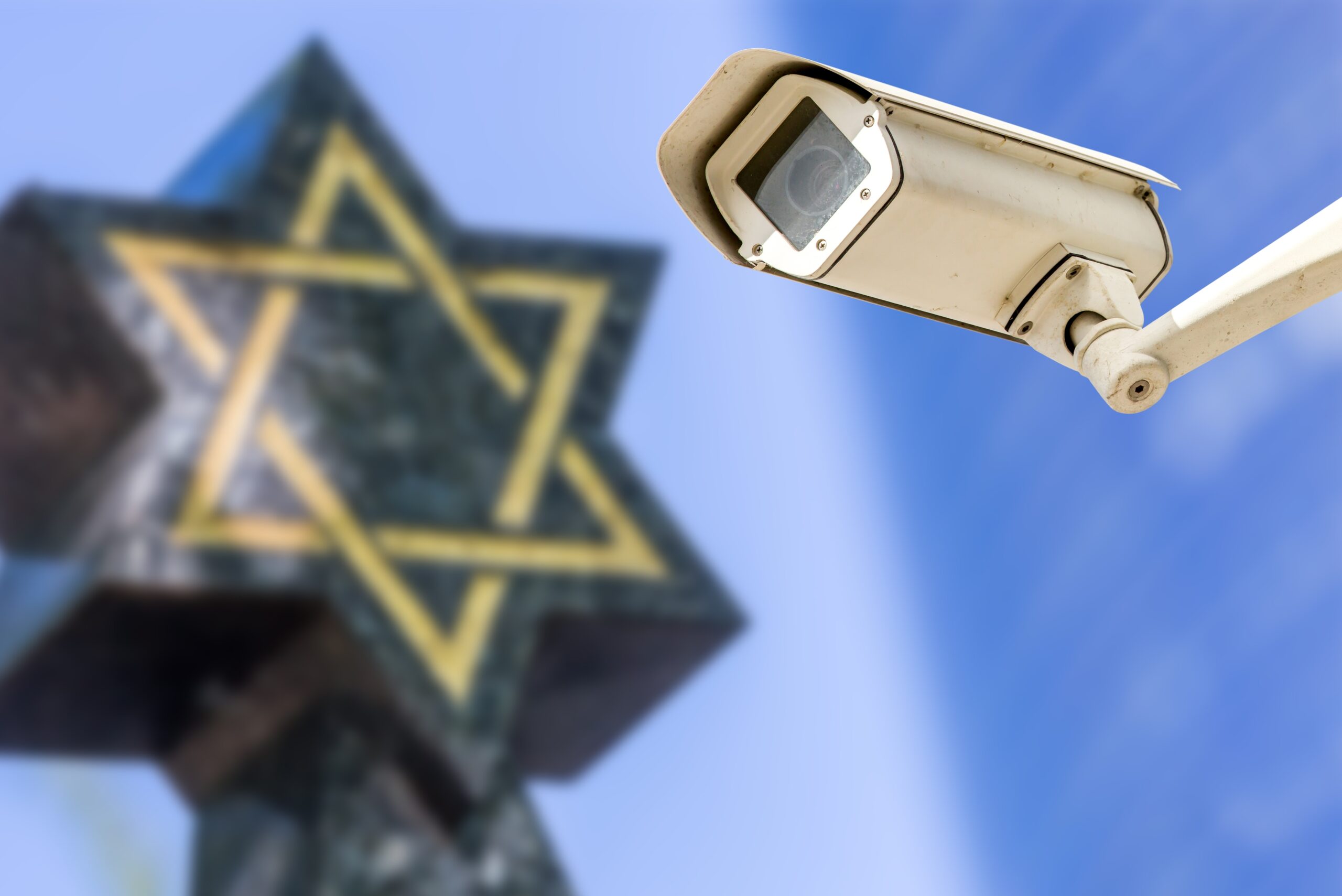
Tightened security at Jewish institutions is essential, but walls, cameras and guards are no kind of genuine answer to the explosion of antisemtism (Image: Shutterstock)
Questioning our Future
Every Jewish community, everywhere in the world, is questioning its future right now. The question of whether our home will still be safe for our children when they grow up, is staggeringly common around Jewish family dinner tables. But when murderous antisemitism can take Jewish lives in Manchester and in Bondi within weeks of each other, in the name of the same extremist ideology, then there is no escaping this danger by moving from one country to another. This hatred can reach all of us, wherever we are, and we need to work together to find an answer. We cannot face this problem alone, but nor can we leave it to others. We all have to take responsibility for dealing with it within our own countries, while cooperating with each other to find what works.
The immediate answer is to build higher walls and fences, to install ever-more intrusive security measures, to make it as difficult as possible for terrorists to reach our children. When people visit Jewish schools, they are often shocked at the amount of security – even as we Jews are so used to it that we barely notice. But this is no kind of answer, really. Not in the long term. We need to find a way to turn off the tap of extremism, to reduce the hateful ideas and harmful stereotypes that fuel this terrorism and hate crime in the first place. That’s the only long-term answer, and it must have education at its heart.
We also have to face up to some difficult truths about where this comes from. As I said, the wave of antisemitism shaking Jews around the world began on October 7, when Hamas attacked Israel and killed 1,200 people, mostly civilians, and took over 250 hostages. The war in Gaza since then has been devastating, and has kept the fires of anti-Jewish incitement burning fiercely. Most of the antisemitism we have seen since then has either been stirred up in response to that conflict or is expressed in a way that uses the language of anti-Israel hatred to target Jews.
Now we are dealing with the latest wave, with the latest war in Iran and the wider Middle East. Earlier this month, four Iranians were arrested in the UK for allegedly spying on the Jewish community in London on behalf of Iranian intelligence. Why would Iranian intelligence want to spy on my community? The answer lies in the long record of Iranian terrorism, attacking Jews and Israelis around the world, including arson attacks targeting the Jewish community here in Australia. The pressure on Jewish communities ever since October 7 has felt relentless, and there’s no sign of it stopping. So we need to take action ourselves.
Tackling this violent rhetoric, not allowing it to become normalised – that has to be our first challenge. Anti-Jewish terrorism does not occur in a vacuum. It is not like a natural disaster, terrible and sad but impossible to predict or explain. Rather, it is the most violent expression of a much wider body of prejudice and bigotry, of myths and libels about Jews, of dehumanising stereotypes and wild conspiracy theories that create an atmosphere in which attacks like this happen.
“The Foothills of Terrorism”
We have a saying at the organisation I work for in the UK, the Community Security Trust, that came from one of our mentors in the 1990s – a truly great man named John Grieve. He was a senior police officer in London’s Metropolitan Police who pioneered new ways to tackle hate crimes and build community confidence, after the Metropolitan Police had hit rock bottom in their policing of black communities. And he had a saying: “Hate crimes are the foothills of terrorism.” Find ways to address hate crimes and you go some of the way to preventing terrorist attacks. The antisemitism that is shouted in the street or paraded on a protest placard, or posted on social media, often goes unchallenged: too trivial and commonplace to justify the effort involved in tackling it. But if you ignore it, then you allow a mindset of hatred and dehumanisation to build that provides the foundation for more violent, harmful acts. And it starts young.
The evidence is all there, if you look for it. The annual reports from the Executive Council of Australian Jewry lay it out in stark terms, with the number of incidents going up and up – more than three times as many antisemitic incidents last year as there were in 2023, just two years before. And a lot of this involves young people. There was the group of Jewish school students at an aquatic centre here in Sydney, told “F*** the Jews”, “We hate the Jews,” and “We hate Israel” by students from a different school. The Jewish primary school students who were on a school trip in Melbourne, called “dirty Jews” by students from a local secondary college, along with chants of “Free Palestine” and “Free Hezbollah”. Or the Jewish Year 9 student, told by a classmate to “F*** off and die in a gas chamber” at a state high school in Brisbane.
Sure – nobody was hurt in these particular incidents. A lot of the time, it’s just words. But if you let them pass, let this become normal, then what comes next? What do these children think and do as they grow older, if there is no intervention now?
Racism happens to people of many backgrounds. All forms of prejudice and bigotry, sadly, remain all too common today. But nothing is quite like this, where a conflict thousands of miles away can trigger a wave of racist hatred on our streets and in our schools, that ranges from playground insults to murderous terrorism, and that happens all over the world in such synchronised fashion. This isn’t normal. This wave of hatred within our own societies doesn’t happen for any other foreign conflict, however awful, however many innocent people are killed or displaced, their homes damaged or destroyed. The war in Ukraine did not unleash a wave of violent terrorism and hate crime against Russians around the world. There have not been any arson attacks on Russian Orthodox churches here in Australia – but synagogues and other Jewish buildings have been burnt, as we know.
It is a simple, observable fact that the way that some people react to war involving Israel, on our streets, online, and, yes, in our schools, is fundamentally different to the way people respond to any other country, no matter what those other countries do. Not just worse, more accentuated or extreme – but fundamentally different. And it happens too often for us to treat each incident as isolated, the product of a disturbed individual or a random anomaly. Terrorism and hate crimes don’t drop out of a clear blue sky. Antisemitic violence and harassment, like all racism, is the product of a much broader way of thinking, a set of ideas and attitudes that creates a permissive environment in which hatred can take root and spread.
Sounding the Alarm
This is why, after October 7, the Jewish community here in Australia, just like my community in the UK and others around the world, sounded the alarm about the hate speech we were hearing and seeing, and pleaded for action to be taken. Violent language, full of venom for Jews, Israelis, or “Zionists”, leads to violent action, if nothing is done. What passes for acceptable discourse on protests and online quickly transfers into all those minor racist interactions that never make the news but spread through community networks like wildfire. Jewish people sounded that alarm, not because we wanted to supress free speech or stop people from criticising Israel – far from it. But because we know where such inflammatory language leads.
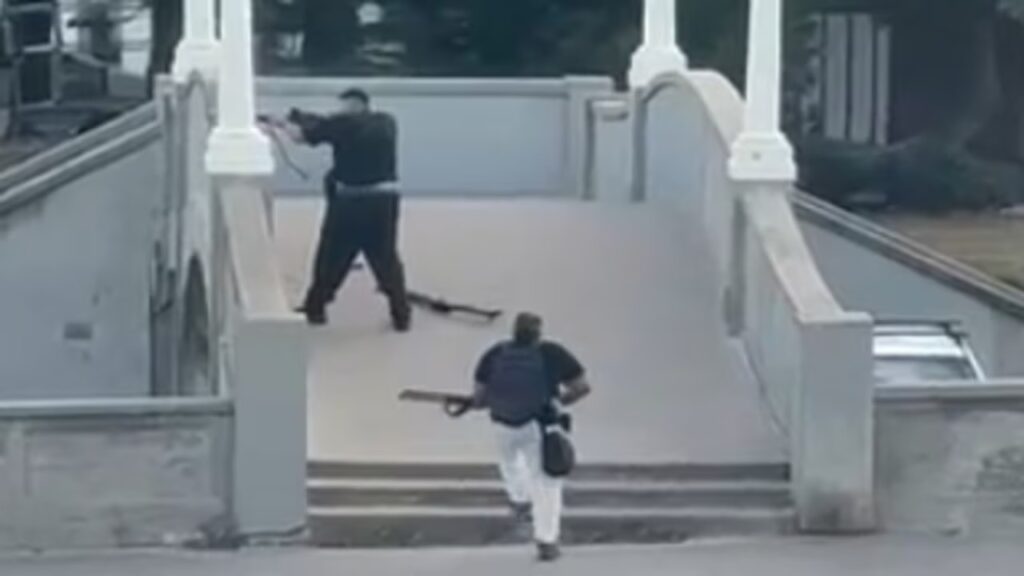
The terrorists tell us this themselves. According to a police report after the Bondi massacre, Naveed and Sajid Akram, the perpetrators of that terrible attack, attempted to justify the mass slaughter of Jews on a beach in Sydney by condemning “the acts of ‘Zionists’.” Mohamed Sabry Soliman, who used a makeshift flamethrower and Molotov cocktails to attack a hostage vigil in Boulder, Colorado, in June last year, killing 82-year-old Karen Diamond and injuring 11 others, said he did it because he wanted to “end Zionists” who, he said, were killing children. The previous month, Elias Rodriguez shot dead Sarah Milgrim and Yaron Lischinsky, two Israeli Embassy staffers leaving an American Jewish Committee event at the Jewish Museum at Washington DC, and then shouted, “Free Palestine” and, “There is only one solution, Intifada Revolution,” after the shooting.
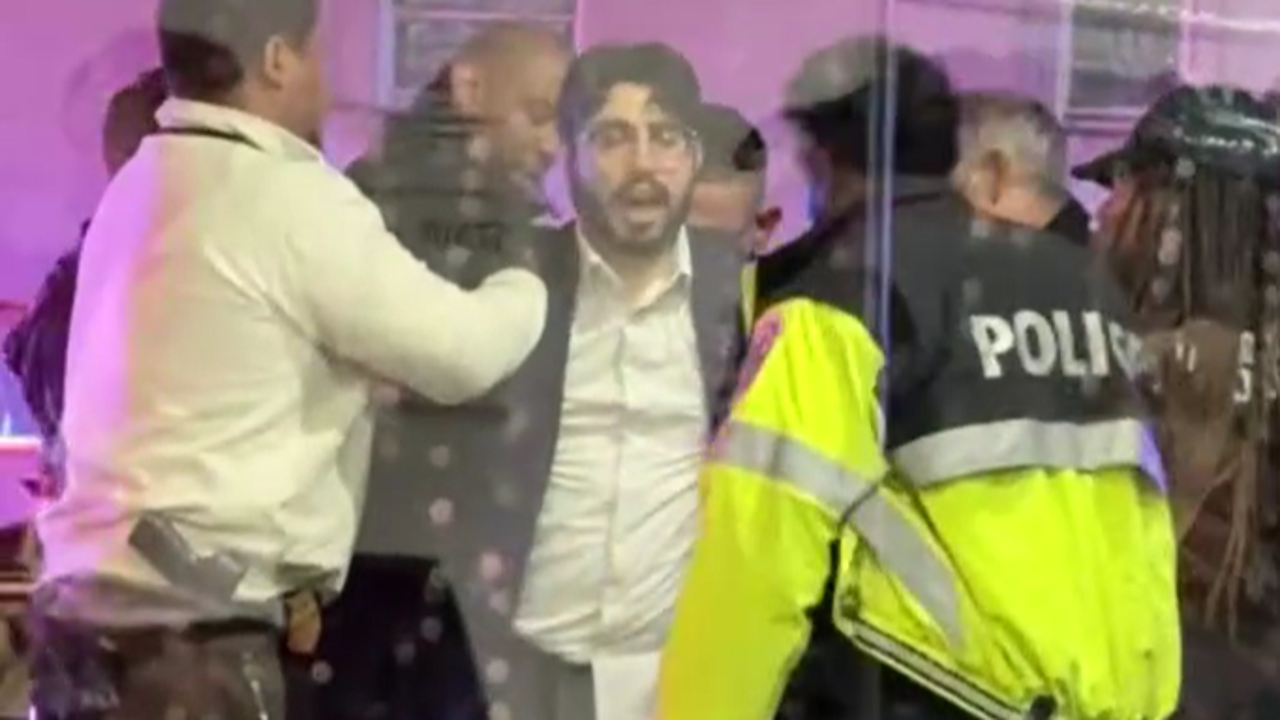
Elias Rodriguez shouted “Free Palestine” after shooting two Israeli Embassy staffers in Washington DC (Image: X/ screenshot)
And when Jihad al-Shamie was trying to batter down the doors of Heaton Park Synagogue in Manchester, having already killed Melvin Cravitz and injured others, he was heard to shout: “This is what you get for killing our children.”
Four terror attacks, three different continents, all targeting Jews and, significantly, all using similar language to justify their actions. It’s so striking. Protesting against Israel is legitimate, and many people would say it is necessary. But the most extreme end of anti-Israel activism – not all of it, perhaps not even most of it, but definitely part of it – now includes murdering Jews because they are Jewish. I know this may be hard to hear. It certainly complicates things. If we only had to worry about antisemitism by neo-Nazis, if the people attacking and harassing Jews always wore swastikas rather than keffiyehs, I think a lot of people would find it much easier to recognise and to talk about. But this is the reality of the lethal danger that Jewish communities face today. And the language that these anti-Jewish terrorists use is the same language that is used by peaceful, democratic protestors.
What can we do?
Like I said, it’s complicated. But we have to act. So what can we do?
The first point, I think, is to recognise hateful language when we hear it. I’m not talking about people campaigning for peace and for Palestinian rights. There is an obvious difference between calling on a government to change its policies and its military actions, and endorsing death and violence. Last June, a relatively unknown band called ‘Bob Vylan’ went on stage at the Glastonbury Festival in Somerset, deep in the English countryside, and invented a new chant: “Death, death to the IDF.” A week later, a mob stormed an Israeli-owned restaurant in Melbourne, chanting exactly the same slogan.
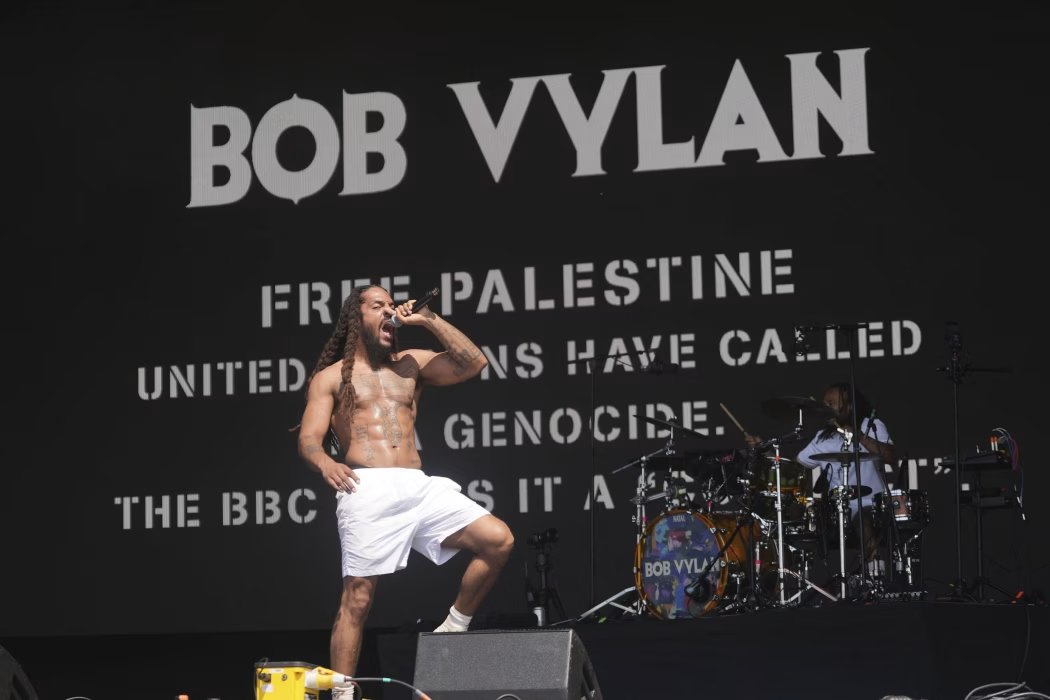
Bob Vylan at the Glastonbury Festival, June 2025 (Image: X)
There is a conceptual link, and an emotional one, between calling for Israel, the Jewish state, to be killed off, and thinking it is acceptable to kill Jews in Australia in pursuit of that goal. Once death and violence are firmly embedded as part of the rhetoric, nobody should be surprised when they become reality.
This point was made in an important speech after the attack on the Heaton Park Synagogue in Manchester, by Jonathan Hall KC, a senior lawyer who is the UK’s Independent Reviewer of Terrorism Legislation and Independent Reviewer of State Threats Legislation. In this speech, delivered just a few weeks ago, he addressed the dangers of failing to act against violent rhetoric, saying: “If the law fails to intervene when protestors openly call for death, if strong and regular and violent hatred becomes the norm, then violence, terrorist violence, even genocidal violence (as in Rwanda and Myanmar) is a plausible consequence. Hatred is distinct from terrorism,” he said, “but it raises the risk. It invites a state of psychological extremism in which conspiracies make sense and violence seems the only solution.”
He was talking about the need for police intervention and prosecutions. But policing can only tackle the symptom: it can’t address the wider reasons why antisemitism happens in the first place. That’s where we come in. Hatred, prejudice, conspiracy theories, dehumanising language – it isn’t too hard to find all of that amongst younger age groups. Schools are settings where young people are forming their ideas about the world, and about the people they share their world with. They are at an age when they are increasingly exposed to a much wider range of influences and information – much of it false or misleading – than used to be the case in the days before smartphones and social media.
Extremists have long been early adopters of every new technology, using it to spread their propaganda and lure in new recruits to their cause before anyone catches up with what they are doing. And in recent years, social media has been not just an arena for the encouragement of antisemitism, but a key engine in propelling it forwards. Algorithms that reward engagement, combined with a psychological understanding that outrage keeps people scrolling and posting more than agreement or ambivalence, has generated an online environment in which antisemitism is rewarded and encouraged, branching across networks quicker than any fact-checker or moderator can keep up with.
Educated to hate
This is also a form of education: but in this case it is antisemites doing the educating, using a stock of anti-Jewish ideas and motifs built up over centuries and deployed by some of our best-known and most-loved cultural creators.
This is not an exaggeration, by the way. Some of the greatest works of English literature include startling expressions of antisemitism, and are still loved and celebrated by millions. Geoffrey Chaucer’s Canterbury Tales, generally seen as the foundational work of English literature, contains a straightforward blood libel tale – that old medieval myth that Jews habitually murdered Christian children at Easter. The most famous Jewish figure in all English literature is Shylock – the cruel, bloodthirsty, merciless Jewish moneylender at the heart of Shakespeare’s Merchant of Venice. And today, some of the most popular podcasters around – Tucker Carlson, Candace Owens, Joe Rogan, and others – either spread anti-Jewish libels themselves, or give space to guests who do the same. I’m not suggesting that they are on a par with Shakespeare. But you don’t need to search out the wildest fringes of our society to find the most potent and dangerous anti-Jewish myths. It’s all there, in plain sight, and has been for centuries. Social media is just the latest vehicle for these ideas: old wine in digital bottles.

Tucker Carlson – pictured with white nationalist Nick Fuentes – and Candace Owens: Two highly popular podcasters spreading anti-Jewish libels and helping a growing online ecosystem of antisemitic hate (Images: X; YouTube screenshot)
When people come to hate Jews, or even try to kill them, they aren’t just influenced by the latest social media reel they’ve seen on their phones. They are following in a long tradition of antisemitism that has built over generations, with the same set of anti-Jewish ideas and bigoted beliefs replicating and adapting to fit each social and political moment. This isn’t always violent – in fact, most antisemitism isn’t violent at all – but there are common themes that run through all types of antisemitism, whether they seek to spill Jewish blood or merely to cause Jewish fear and shame. It is the idea that, as the slogan of Nazi propaganda put it, “The Jews are our misfortune.” That Jews cannot be trusted; they are always up to something, conspiring and plotting behind the scenes. That they are cruel and bloodthirsty, the enemy of morality, seeking only chaos and harm, standing between humanity and a more peaceful, just world.
This body of ideas is taught. I can’t stress that enough. Extremists are using the most modern technology and compelling content to teach people to hate Jews and to want to kill them, or not to care if they are killed by others. Sometimes, the message is to kill “Zionists”, or not to care when they are killed – and nobody bothers too much about how to define “Zionists”. The danger is not in the exact words but in the emotional language. It’s in the sentiments that are being taught. A constant diet of calls for death, killing, ending, eradicating; it numbs people to the reality of what this looks like, until it happens, red and raw and right in front of us, and then it’s too late.
Australia’s ban on social media use for under-16s is hopefully a positive step forward in this respect, and we’ll have to wait to see what impact it has. But we cannot only be reactive. We have to be proactive in what we teach, and in trying to shape not just knowledge but also values. Because if we are to properly understand what we face, we need to recognise that antisemitism goes deeper than hatred.
Antisemitism as a set of ideas
It isn’t – or isn’t only – blind fury. It’s a compelling and simplifying set of ideas, a way of viewing the world that always frames the Jews as an enemy. That’s the belief that drives all antisemitism. It’s the belief that justifies shooting ordinary people dead on a beach in Sydney, stabbing them to death at a synagogue in Manchester, or burning them in a park in Colorado: and also justifies shouting “baby killers” at random Jewish people in the street, or daubing it on a synagogue wall.
The emotional side of this is very important. Antisemitism is one of the most successful ideas in history, able to take root in all different societies, no matter the social, political, economic or religious context, and repeatedly able to persuade people that it remains relevant to their lives. It appeals to wealthy and successful people as well as to life’s losers.
It’s also politically useful sometimes, because it has such deep roots. When Russia sent people to daub antisemitic graffiti onto Jewish homes in France after October 7, it wasn’t because Putin is personally antisemitic: it was because Russian intelligence has long understood that antisemitism has the power to inflame emotions and divide Western societies. This all means that tackling antisemitism is not only a challenge of communicating facts. It is about understanding and addressing the emotional appeal of antisemitism; about countering the stories that antisemites and demagogues tell with positive stories of our own to embed and reinforce the positive values that we want to shape our societies.
If it was simply a matter of education, on its own, then there wouldn’t be so much antisemitism in universities. What we teach, how the message is framed, and who the messengers are, are all part of the package. And we need to be more compelling and persuasive than the extremists who are teaching our young people the negative values of division and the suspicion of difference.
This is the challenge that you all face. I know how shocked everyone in Australia was on December 14 last year, as news spread about the horrors on Bondi Beach. It seemed to be, not just an unimaginable crime against the Jewish community, but an affront to the Australian way of life. I must tell you, it struck hard in the UK too. Pretty much everyone who has ever visited Sydney has been to Bondi Beach, and Bondi Beach represents everything that hateful extremism is not. It stands as a symbol of exactly what we are fighting for.
So it is absolutely appropriate that this conference is happening now, and I am grateful to be a part of it. As I understand it, this educational program will be bespoke for Australia but will also be an example for other countries in the world. I hope that the United Kingdom learns from your example in the way we roll out our own education on this subject, because education, done in an effective, sustained and smart way, must be at the heart of our response.
In the short term, we will build bigger walls and fences to protect our Jewish communities, but ultimately, that is no sort of life. We need to find ways to reduce the flow of antisemitism, and to ensure that our values of dignity and respect win out in the struggle against those of division and hatred. This is why taking on this work is not just a necessary responsibility, but also a momentous opportunity. I thank you for joining this fight, and wish you success in all your efforts, because all Australians, Jewish or not, will benefit from it.
Dr DAVE RICH is one of the UK’s leading authorities on antisemitism. He has worked for almost 30 years for the Community Security Trust, a Jewish charity that protects the UK Jewish community and advises the police, the Crown Prosecution Service, football clubs, the Labour Party and many other organisations on how to tackle antisemitism. He appears regularly in the media to discuss antisemitism, and is the author of Everyday Hate: How antisemitism is built into our world and how you can change it (Biteback Publishing, July 2025).
Tags: Antisemitism, Australia, International Jewry, Israel
RELATED ARTICLES