Australia/Israel Review
Biblio File: The “X” Factor
Dec 19, 2025 | Allon Lee

Fine writing and trite sloganeering in service of a terrible cause
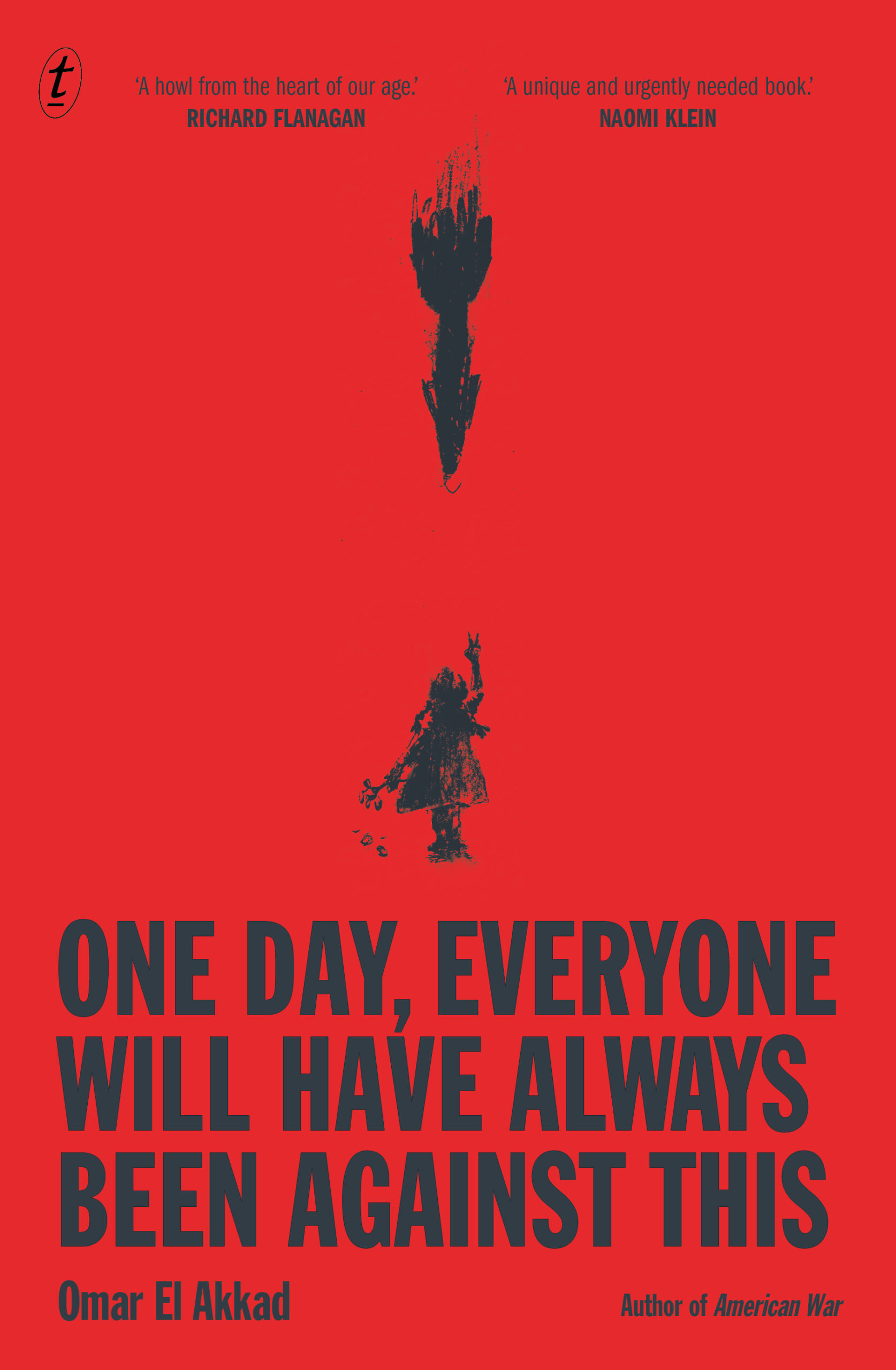 One Day, Everyone Will Have Always Been Against This
Omar El Akkad
Text Publishing, 2025, 208 pp. $32.99
When dawn broke on October 7, 2023, not one person in Israel knew that, by day’s end, thousands of Hamas terrorists would cruelly massacre, rape and torture 1,200 men, women and children in southern Israel, and abduct a further 251 back into Gaza.
Their villainy was broadcast to the world in real time, not only by GoPro-wearing terrorists screaming “Allahu Akbar”, but even by journalists employed by Al Jazeera and embedded with Hamas.
Hamas officials later boasted of their terrible deeds and promised to repeat them “again and again” until Israel is destroyed.
The very next day, in solidarity with Hamas, Iran’s Lebanese proxy Hezbollah started firing rockets into Israel.
Soon after, Yemen’s Houthi rebels, another Iranian-backed terror group, began firing missiles at Israel and at ships in the Red Sea belonging to countries deemed supportive of Israel. Eventually, Israel would be fighting a multifront war, including directly against Iran, spanning the Persian Gulf to the Mediterranean Sea.
By any stretch of the imagination, it has cost the Jewish state huge amounts of blood and treasure.
Despite what the armchair critics have said, it is a war that Israel has fought with as much honour as war, always a horrible business made worse by an urban environment, allows.
Leading urban warfare experts, including West Point Academy’s Major (ret.) John Spencer and former commander of British forces in Afghanistan Colonel (ret.) Richard Kemp, neither of whom have skin in the game, have described the Israeli Defence Forces’ (IDF) efforts to minimise civilian casualties in Gaza as “unprecedented”.
But you would never know any of this from reading One Day, Everyone Will Have Always Been Against This by Egyptian-Canadian journalist-turned-novelist Omar El Akkad.
Despite El Akkad’s skills as a writer, One Day is a nasty, brutish but thankfully shortish screed, stuffed with the usual anti-Israel and anti-Western half-baked slogans and self-righteous posturing, all of which wilts under minimal scrutiny.
The book’s genesis – or at least its title – starts on October 25, 2023, when El Akkad uploaded to his X account a short video showing a camera’s POV roving down a smashed-up street in Gaza with the caption: “One day, when it’s safe… everyone will have always been against this.” The post went viral.
In summary, the book argues that the Israeli-Palestinian conflict is a simple case of the coloniser versus the colonised, and the West has no right to support Israel at all, and certainly not its response to October 7.
El Akkad ‘explores’ – and rages – at what he considers the immoral complicity of Western governments and media in maintaining the status quo.
In a classic case of inversion, El Akkad first introduces October 7 this way:
“Beginning in October of that year, the Israeli military… enacted a campaign of active genocide against the Palestinian people, one of the most openly, wantonly vicious campaigns in the near-century-long occupation, and easily the most well documented.”
Only then does he turn to October 7 itself, using anodyne language that provides an impersonal summary of what happened.

Omar El Akkad: Selective outrage that fails to grapple with realities
As with so many pro-Palestinian activists, the genocide accusation is thus not an analytical conclusion but a frame – a pre-emptive moral verdict – that allows him to invert victim and aggressor from the outset.
Instead of describing October 7 and its aftermath for what it is – a multifront war against Israel by Iran’s “Axis of Resistance” – he weaponises it, arguing that the whole conflict is only the latest instalment of Western-backed aggression against the region’s indigenous peoples.
The tone of the book grows ever shriller, blaming everyone and anyone but those most responsible for dragging Palestinians into the fire: Hamas.
Ignoring Israeli offers for peace that were rejected by Palestinian leaders and standing offers to negotiate peace, he attempts to contextualise October 7 by saying it was “orchestrated by exactly the kind of entity that thrives in the absence of anything resembling a future.”
In El Akkad’s moral universe, Palestinians are entirely without agency. What’s worse, he places no responsibility on Hamas for any Palestinian deaths.
He disregards the fact that Hamas spent nearly two decades and billions of dollars building a vast subterranean tunnel network under Gaza’s civilian neighbourhoods, openly acknowledging it was only designed to protect its fighters and military hardware, not Palestinian civilians.
He expresses outrage over the deaths of Palestinian journalists in Gaza, who he says bravely reported during the conflict, but never addresses evidence that many worked for Hamas. He seems oblivious to the fact that Palestinian reporters virtually never filed stories or footage showing Hamas fighters or their military activity during the war.
He is outraged by Western media language that, in his view, dehumanises Palestinians, but casually labels Israelis living in sovereign Israel as “settlers”. This, along with his assertion that Palestinians have suffered a century of occupation, strongly suggests that he views all of Israel as illegitimate and all Israelis as illegal occupiers.
This helps explain why he dismisses the Oslo Peace Process and Israeli offers to create a Palestinian state – offers Palestinian leaders rejected – as a mere footnote. He derides attempts by leaders such as former US President Bill Clinton to portray the Palestinians’ rejection of peace offers as a “failure of imagination”, calling it an example of a racist Western mentality “that certain people are incapable of responding to their mistreatment with grace.”
The accusation that Israel’s operations were geared toward implementing a predetermined policy of genocide is a calculated obscenity. First, because genocide requires intent, which Israel’s actions – issuing advance warnings, setting up safe zones and letting in aid – prove it did not have. Second, because it is a deliberate attempt to whitewash Hamas’ culpability for the death and destruction in Gaza.
Betraying his professional responsibilities, El Akkad writes that the International Court of Justice in January 2024 “rules that Israel must stand trial for genocide.” Contrary to his insinuation, the Court made no determination on the substance of the allegation – only that South Africa had a plausible right to bring the case, and Palestinians a right to be protected from genocide.
Interestingly, amid all his anti-Western ranting and talk of genocide, he has nothing to say about the decade-long internecine savagery of the Syrian civil war and its estimated 650,000 deaths.
What, then, is El Akkad’s solution to the Israeli-Palestinian conflict? Love, apparently… especially the wonderful “love” of the Palestinian people. He writes: “Palestinians do respond overwhelmingly with love… Just as the Black communities in much of the United States… responded overwhelmingly with love… Today I watched footage of a man kissing his son’s foot as he buried the body so torn apart by the missiles that the foot was one of the only pieces the father could find. Tell me this man doesn’t know love… Except it is a love that cannot be acknowledged by the empire.”
The “if only we show them love” argument might work if there were a genuine desire for conciliation. But this falls flat in the face of the ideology, rhetoric and behaviour of the mainstream Palestinian parties – Hamas and Fatah.
Of the former, October 7 surely shatters any delusion that it can ever be a viable peace partner.
Then there is Fatah, which runs the Palestinian Authority. In the 32 years since it recognised Israel, it has proven itself no more committed to genuinely ending the conflict through dialogue and compromise than it was upon its founding in 1959. It has resorted to terror, rewarded it since the Oslo Accords and rejected numerous peace plans that met its publicly stated desire for a two-state resolution. Moreover, since October 7, numerous PA representatives have insisted Hamas is an indivisible part of the Palestinian polity and its future, and praised October 7. This hardly engenders optimism that Palestinian “love” is the answer.
Backtracking to El Akkad’s X posts – before the Oct. 25 one, his first reference to the massacre was a retweet on Oct. 11 that cast doubt on media reporting of atrocities. There were certainly no posts condemning October 7.
This lack of “love” for Jewish victims echoes a concern Edward Said raised in 2000 about the potential consequences if Palestinians achieved maximal political aims: “The question of what is going to be the fate of the Jews is very difficult for me. I really don’t know. It worries me.” El Akkad’s selective outrage and failure to grapple with realities further illustrates the book’s lack of seriousness in considering the ethical and real-world consequences of rejecting any Jewish right to self-determination and leaving Israel’s 8 million Jews to the “love” and mercy of the likes of Hamas.
Some readers may be dazzled by El Akkad’s self-righteous anger. Yet the irony of a book written to expose misinformation ending up reproducing many examples that support his own ideology makes it just another entry in the ever-growing catalogue of factually-challenged political polemics.
RELATED ARTICLES