Australia/Israel Review
Is the Lebanon-Israel ceasefire deal doomed?
Dec 19, 2025 | Oved Lobel
Disarmament falters as Hezbollah rebuilds
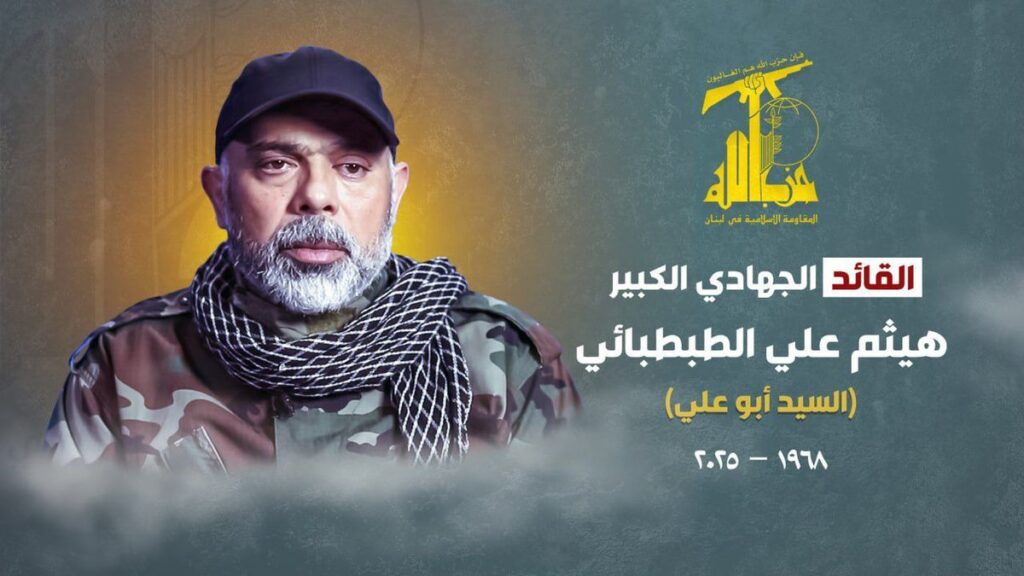
On November 23, Israel assassinated Hezbollah’s new military chief Haytham Ali Tabataba’i in the group’s stronghold of Dahiyeh in Beirut.
Tabataba’i, appointed Hezbollah’s Chief of General Staff following the November 2024 ceasefire, was a first-generation Hezbollah operative from the 1980s. He commanded its Intervention Force, which was merged with Hezbollah’s special forces and eponymously renamed the Radwan force in 2008 after the nom de guerre of Imad Mughniyeh, Hezbollah’s first military chief and the force’s founder. Mughniyeh was assassinated that year in Damascus in a joint CIA-Mossad operation.
Previously, Tabataba’i, sanctioned by the US since late 2016 with a US$5 million bounty on his head, oversaw Hezbollah’s special forces in both Yemen and Syria, where he was unsuccessfully targeted in January 2015 in a strike that killed Mughniyeh’s son.
Tabataba’i’s assassination represents a serious escalation, and caps off a year of near-daily, progressively intensifying Israeli strikes against Hezbollah operatives and infrastructure, which have reportedly killed more than 370 Hezbollah members, including senior commanders, in 2025.
The Israeli daily Yedioth Ahronoth reported that, in addition to airstrikes, there have been approximately 1,200 ground raids by the IDF this year – an average of three to five per day.
The assassination also follows at least a month of warnings from both the US and Israel that, should the Lebanese Armed Forces (LAF) and Lebanese Government fail to uphold the ceasefire deal’s requirements to disarm Hezbollah, Israel would act, with US support.
The LAF and Lebanese Government duly failed to take any significant action against Hezbollah, prompting ever more expansive Israeli operations, culminating in the assassination of the fourth Hezbollah military chief in just over a year. Tabataba’i’s predecessors, Fuad Shukr, Ibrahim Aqil and Ali Karaki, were successively eliminated in the span of three months in late 2024.
This will not have any noticeable operational impact on Hezbollah or its rehabilitation. However, the group is extremely unlikely to retaliate, at least in any significant manner, instead focusing on rearming, recruiting and shoring up domestic legitimacy.
Hezbollah is succeeding on all these fronts, according to Western and Israeli intelligence officials, with the latter telling the Knesset’s Foreign Affairs and Defence Committee in a classified briefing that Hezbollah is rearming faster than Israel can bomb it as well as increasing its domestic legitimacy.
An August poll by Hezbollah’s think tank, the Consultative Centre for Documentation and Studies, showed 96% of Shi’ites, 50% of Sunnis, nearly 50% of Druze and about a third of Christians reject the disarmament of Hezbollah “without a defensive strategy” against Israel.
Foreign intelligence officials reportedly believe that, despite the interdiction efforts of the new Syrian Government, Iran’s smuggling routes to Hezbollah have been partially reestablished. Weapons are also allegedly streaming in via seaports or being manufactured locally, while the US Treasury Department claims that Iran has succeeded in transferring more than US$1 billion to Hezbollah since January.
However, it still doesn’t have the strength to retaliate against Israel and prefers not to risk substantial disruption to its rebuilding efforts. In addition, the mass destruction and displacement that would occur across Lebanon should the battle once again escalate would not endear Hezbollah to its supporters, much less other Lebanese, many of whom have yet to rebuild their lives after the 2024 escalation.
Finally, the Tabataba’i strike, along with the relentless targeting of hundreds of other operatives and military infrastructure, demonstrates that Hezbollah has remained unsuccessful in addressing its comprehensive penetration by Israeli intelligence.
A year of disarmament theatre
The inexorable failure of Lebanon to disarm Hezbollah was built into the 2024 ceasefire agreement.
On Nov. 13, 2024, I warned of the infeasibility of any deal predicated on UN Security Council Resolution 1701, which ended the 2006 Israel-Hezbollah war and called, inter alia, for the disarmament of Hezbollah:
Like the government it is meant to serve, the LAF is closer to a cripplingly sectarian fiction than an independent entity… The LAF cannot and will not disarm Hezbollah or even obstruct its activities… Any proposed diplomatic solution to the current war based on the fatally flawed formula of 1701 is doomed to fail.
Notwithstanding this reality – which no serious observer could question – the ceasefire deal eventually signed in late November 2024 revolved entirely around 1701.
Since its inception, the LAF has been a “neutral army”. This is because, being a microcosm of Lebanon itself, if it ever tried to take any significant action, it would shatter along confessional lines, as it did during Lebanon’s decades-long civil war, which only ended in 1990.
From that time onward, the highest priority of the LAF and Lebanese Governments, which haven’t been genuinely independent since the 1950s – moving from Egyptian to Syrian to Iranian suzerainty – has been to prevent renewed civil war. No Israeli action or US sanctions will ever outweigh that catastrophic risk, as a result of which neither the US nor Israel have the ability to pressure the Lebanese to implement their disingenuous commitments to disarm Hezbollah.
This would be true even if Hezbollah’s Shi’ite support base didn’t comprise a substantial part of the LAF and the organisation and its allies weren’t represented in the current Government.
This is why it took Lebanon nine months from the November 2024 ceasefire deal to even officially order the LAF to come up with a plan for implementing it, which it only did under heavy US pressure, and another month before such a plan was presented. Hezbollah obviously rejected the plan.
The “plan” was kept secret, as were the monthly progress reports it mandated. This is unsurprising, given no such plan can be implemented, and therefore no progress can be publicly reported, despite claims by some Lebanese sources to the contrary. Rather, this has all been highly choreographed pageantry by the LAF, Lebanese Government and Hezbollah to ward off US pressure and play for time while Hezbollah reconstitutes.
The LAF has extremely limited capabilities, as even Lebanese Information Minister Paul Morcos said when announcing the plan. The LAF is also logistically dependent on UNIFIL, the ineffective and hostile international force that has helped enable the vast entrenchment of terrorist infrastructure along Israel’s northern border since the 1970s. It’s not clear how the LAF will continue to exist once UNIFIL begins withdrawing in January 2027.
Morcos and LAF Commander Rodolphe Haykal also blamed Israel’s ongoing presence in Lebanon and attacks on Hezbollah for the delay in implementation. A scheduled visit by Haykal to the US to discuss aid for the LAF in late November was cancelled when the LAF released a statement saying “the Israeli enemy” was the main problem.
Meanwhile, Hezbollah Secretary-General Naim Qassem praised the LAF’s “balanced” approach “on the issue of weapons,” while Lebanese President Joseph Aoun has repeatedly said since April that the LAF will never confront Hezbollah militarily. He reiterated this at the UN in late September, saying, “Resorting to force… is out of the question under any circumstances, and cannot take place at present.”
He further asserted, echoing Morcos and Haykal, that the “main obstacle” for Lebanon was “the continued Israeli occupation of the eight hills it has seized, as well as other Lebanese territories.”
The LAF rejected the recent Israeli demand to search for Hezbollah weapons in private homes, which is where most are stored, and despite Israel publicly revealing sweeping Hezbollah rehabilitation efforts in the south, no action has been taken. Israel has also indirectly passed intelligence on Hezbollah facilities and activities to the LAF, to no avail. There are even reports of the LAF warning Hezbollah to evacuate equipment before Israeli strikes.
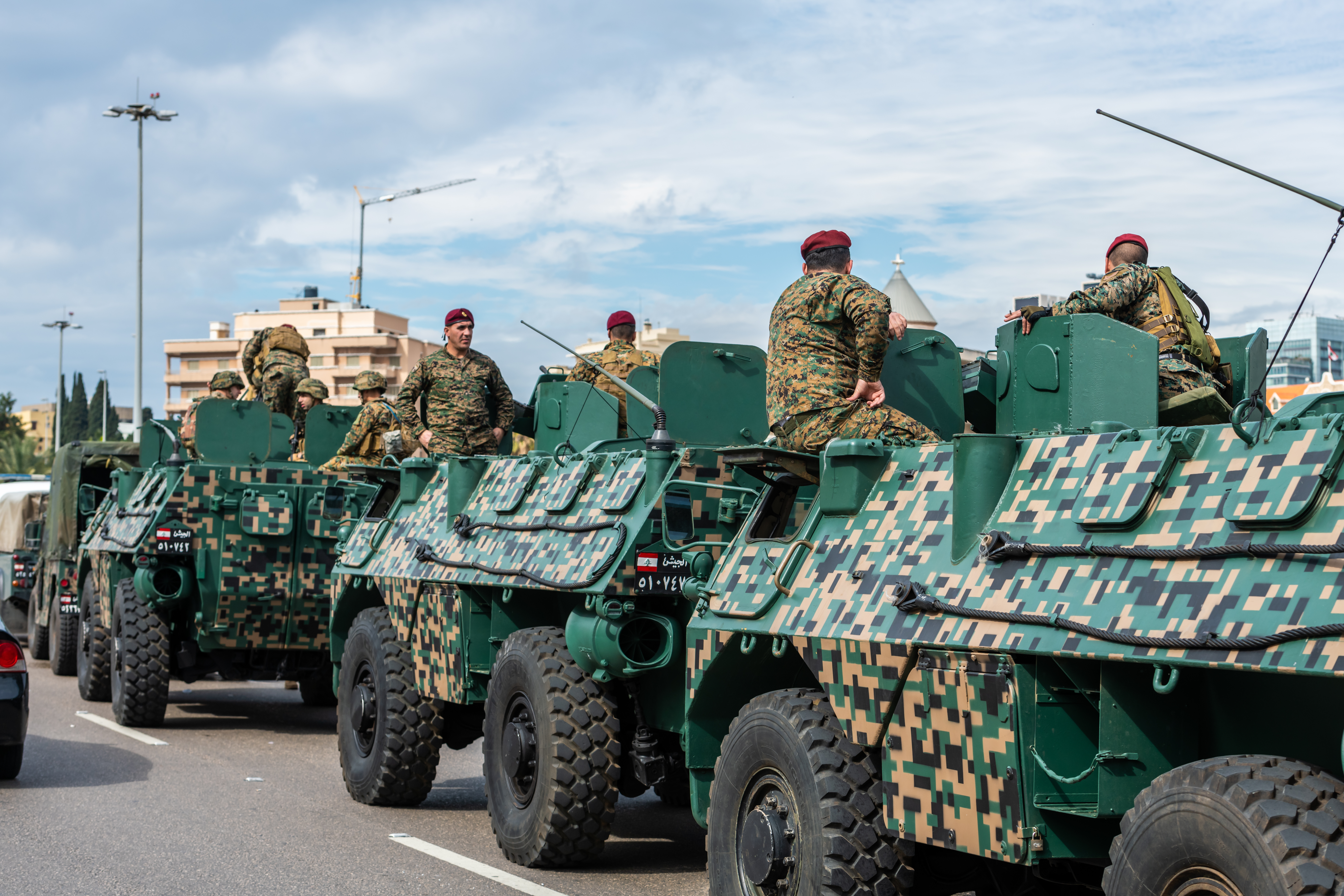
The Lebanese Armed Forces on the streets of Beirut (Image: Paul Saad/ Shutterstock)
Hamas’ helping hand
The Lebanon-Hezbollah pantomime also includes Hamas. Despite the LAF pretending to disarm some factions in the Palestinian refugee camps with token arms collections, Hamas and Palestinian Islamic Jihad (PIJ) were not covered by the operation.
Growing Hamas activity in Lebanon led to an Israeli strike on a Hamas recruitment centre in the Ein El Hilweh camp near Sidon on Nov. 18, killing more than a dozen operatives. Hamas had publicly advertised these locations during a recruitment drive in December 2023 for the “Vanguard of the Al-Aqsa Flood” Hamas scouts.
While Hamas has always had an extensive presence in Lebanon, there are now Israeli reports that hundreds of Hamas fighters are being seconded to Hezbollah’s Radwan force as part of its rebuilding efforts.
The past year should have illustrated, as if further proof were needed, that 1701-based attempts to address Hezbollah’s arms are futile. Any approach that hinges upon the LAF and the Lebanese Government, more ornamental than functional institutions, will always fail, something only belatedly recognised by US envoy and Ambassador to Turkey Tom Barrack in November.
The outcome of the Lebanese parliamentary elections, scheduled for May 2026, could possibly change things, assuming they actually take place and that Hezbollah does not win in the areas it needs to as resoundingly as it has in the past. And that Hezbollah respects the results, which Iran’s Islamic Revolutionary Guard Corps (IRGC) organs do not have a history of doing in the region.
For now, barring a collapse of the Iranian regime, the only practical Israeli policy for the foreseeable future remains threat management by way of constant strikes and raids, punctuated by larger escalations.
RELATED ARTICLES