Australia/Israel Review
Scribblings: Aid will never be enough
Dec 19, 2025 | Tzvi Fleischer
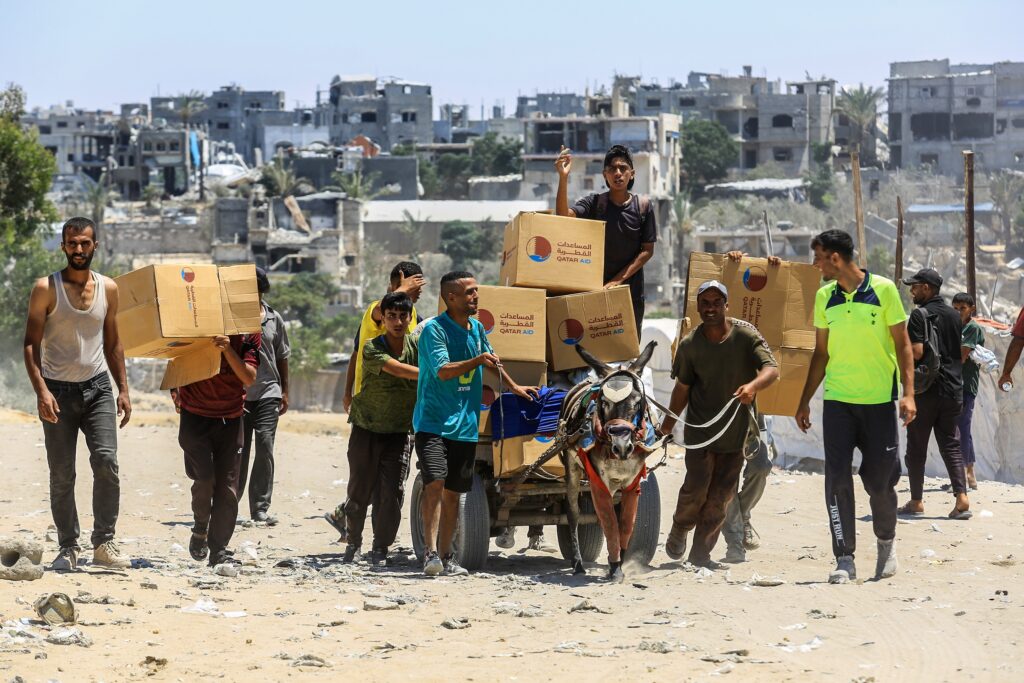
UN agencies continue to complain that not enough aid is going into Gaza. For instance, UNICEF spokesperson Tess Ingram gave a media conference on December 8 to say there were still many children suffering malnutrition in Gaza, blaming insufficient aid access. She admitted things have improved since the ceasefire, but complained obstacles remain, citing delays and denials of cargo at crossings, route closures and ongoing security challenges. “We have seen some improvement, but we continue to call for all of the available crossings into the Gaza Strip to be open,” she said.
But here’s the thing. According to the US-led body now coordinating aid entry into Gaza, the Civil-Military Coordination Center (CMCC), an average of 800 aid trucks a day have been entering Gaza since the ceasefire started on Oct. 10. That’s well beyond the 500-600 trucks that UN agencies previously demanded enter. What’s more, as this column documented last edition, even that demand was absurd because before the Gaza war, in 2022, only about 293 trucks entered Gaza a day, of which an average of just 73 carried food.
What’s more, during the ceasefire in January and February of 2025, more than 600 trucks were entering daily – and this led to a massive stockpile of excess food aid being built up in Gaza warehouses, enough to supply the whole Gaza population for several months. So 600 trucks daily was clearly more than enough to prevent any hunger, but now the UN says the 800 trucks entering daily are still not enough.
The lesson is: whatever the situation on the ground in Gaza, UN agencies will always scream that the aid is not enough – and blame supposed Israeli policies. That’s what they do, both to try to get more donations by creating a sense of urgency and to deflect blame from their own inability to get aid to those who most need it. And because extreme anti-Israel bias has been baked into all UN institutions for decades.
Confirmed: NGOs were co-opted by Hamas
Many commentators have ignored – or even dismissed – Israeli claims that supposedly humanitarian NGOs working in Gaza were cooperating with Hamas and facilitating its goals. There is now concrete proof that this was indeed the case.
NGO Monitor has just published a report based on Hamas’ own internal documents, detailing its elaborate and largely successful scheme for controlling the actions of all NGOs operating in Gaza.
The documents cover the years 2018-2022 and originate with the Hamas Interior Security Mechanism (ISM), a unit within the Hamas Ministry of Interior and National Security (MoINS).
And they show that Hamas demanded all NGOs in Gaza have a “guarantor”, a local Gazan, approved by MoINS, to serve as the point of contact between Hamas authorities and NGOs. Hamas required that such “guarantors” hold senior administrative positions within the NGO, such as director, deputy director, or board chair, ensuring access to the highest levels of the NGO’s local branches and operations.
Many of these “guarantors” who served as senior NGO officials were Hamas members or supporters, or employed by Hamas-affiliated authorities. Among the NGOs listed in Hamas ISM internal documents as having such a Hamas-controlled guarantor are MAP-UK, Human Appeal, CIVITAS, the International Medical Corps, the Norwegian Refugee Council and Handicap International.
What’s more, Hamas’ ISM used these “guarantors” as intelligence assets to report on everything the NGO was doing, describing controlling them as “an outstanding security-intelligence accomplishment.” Hamas also demanded scrutiny of all NGO finances, presumably to make sure they directed money and work to Hamas-approved companies and individuals. The documents also mention at least one case where an OXFAM irrigation project was made to conform with Hamas’ military preparations in the area.
Yet no NGO seems to have blown the whistle about these arrangements for cooperating with Hamas at the time, even though they must have been aware of them. And they continue to deny their reality today, despite the Hamas documents proving the opposite.
More good news on minority relations in Israel
Readers of the AIR are probably aware that one piece of good news coming out of two years of war in Gaza is that the Abraham Accords emerged from it intact. Israeli economic, security and cultural relationships with the UAE, Bahrain and Morocco not only continued during the conflict, but look likely to grow further in the near future.
But another increasingly positive relationship that does not seem to have been adversely affected by the conflict is the improving relationship between Israel’s Arab minority and the nation as a whole.
A poll of Arab Israelis undertaken from Nov. 13 to 18 by the Konrad Adenauer Program for Jewish-Arab Cooperation at Tel Aviv University shows that fully 75% of them want the predominantly Arab political parties to seek to join the governing coalition after Israel’s next election. This is amazing because, until the Islamist Ra’am party joined the Bennett Government in 2021, no Arab party had previously done so, and the idea was largely taboo among Israeli Arab politicians. Now, more Israeli Arabs want them to join than before the Gaza War – in May 2023, the percentage who wanted Arab parties to be part of Israel’s governing coalition was 63%.
And what’s the key political issue for the Israeli Arabs polled? It’s not the plight of Gaza, nor the need for Palestinian self-determination. A large majority, 74%, said the most important political issue for them was improving law and order (Israeli Arab towns have suffered badly from violence and disorder caused by organised crime gangs in recent years). Only 7.6% said it was resolving the Palestinian issue.
One more interesting statistic from that poll – 73.4% of respondents said their personal economic situation is either “quite good” or “very good”.
Meanwhile, the IDF has also reported some good news regarding the minority section of Israel’s population in the form of increased enlistment.
More than 85% of Israeli Druze males are drafted into IDF, which is not that surprising as Druze males are, like Israeli Jews, subject to compulsory conscription. But that’s an increase from pre-war conscription levels of 80%.
But more impressively, some 60% of Bedouin Arab youths (again, meaning males, females almost never serve) – overwhelmingly Muslim – are serving in the IDF. And Bedouin are not subject to conscription, so these are volunteers. And there has also been a sharp rise in Arab Israeli Christians volunteering for the IDF, with a threefold increase in just the last year.
Tags: Arab Israelis, Gaza, Hamas, IDF, Israel, NGOs, United Nations
RELATED ARTICLES