Australia/Israel Review
Washington Heights: How to understand Donald Trump’s foreign policy
Mar 18, 2026 | Danielle Pletka
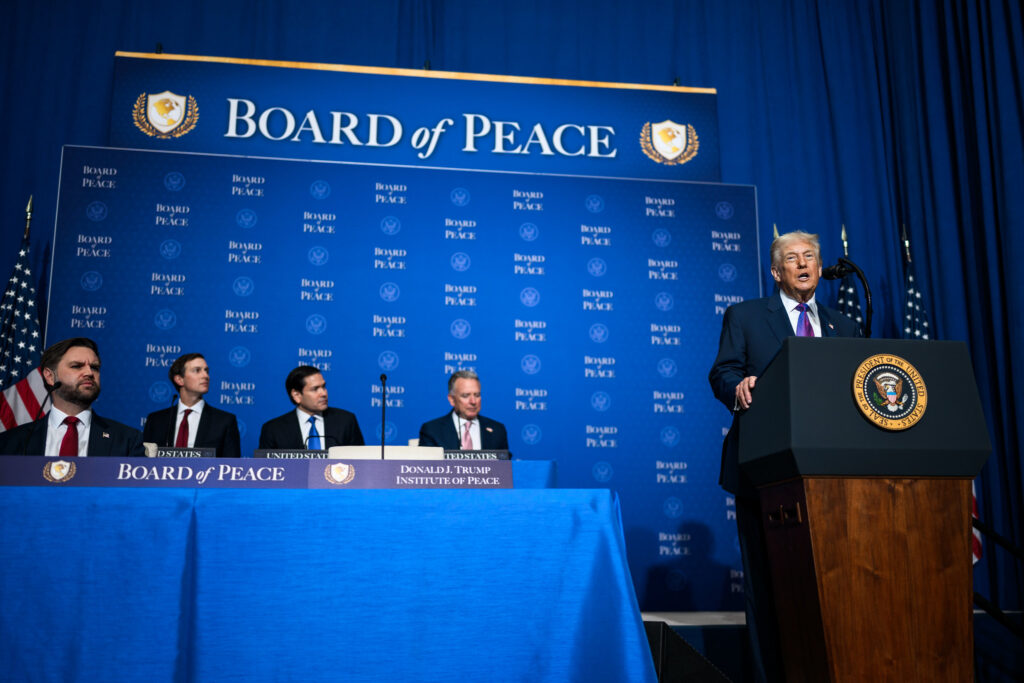
The question of what makes US President Donald Trump tick is an object of shared fascination the world over. Indeed, there is little agreement in Washington DC about the President’s guiding principles, his “vision”, or the nature or existence of a “Trump doctrine”. In truth, however, it’s not that complicated. Sui generis, for certain, but not that complicated. Here’s a primer.
The first Trump Administration, 2017–2021, was, in many ways, more conventional than his second. The President hired established Washington figures like former CENTCOM (the US military’s MidEast region command) Commander James Mattis to be Secretary of Defense; former Exxon-Mobil CEO Rex Tillerson to be Secretary of State; former South Carolina Governor Nikki Haley to be Ambassador to the United Nations; and (after a quick flameout by the erratic Gen. Michael Flynn), General H.R. McMaster, the hero of Fallujah, to be National Security Advisor.
While Trump’s relationship with these officials was decidedly different from his predecessors’ – few of whom tweeted their views of their cabinet – the group was well within the bounds of American political convention.
Trump’s cautious adherence to convention in his first term reflected his own political novice status, and the relative newness of his M[ake] A[merica] G[reat] A[gain] movement. Among the Washington chattering classes, many believed that MAGA was a flash in the pan, and that traditional Republicans would again assert themselves once Trump began floundering. How wrong that was.
Looking back at Trump’s first term, the foreign policy highlights included, in no specific order, an innovative approach to the Middle East that resulted in the Abraham Accords; a deep scepticism of international institutions like the United Nations and NATO; a hostility towards agreements – like the Iran nuclear deal (JCPOA) and the North American Free Trade Agreement (NAFTA) – inked by Trump’s predecessors; and suspicion of the People’s Republic of China on both the national security and trade fronts. Underlying it all was a healthy contempt for the salon society of America’s capital and a heretofore unseen willingness to ignore almost entirely the counsel of Washington’s self-labelled “best minds”, and act on instinct.
As Trump settled into his new role, he found increasingly that he did not like many of those he was advised to hire for his cabinet. Firings – including over Twitter, poor Rex Tillerson – became a regular event. Nonetheless, the first Trump term looked more like other presidencies than not.
Thus, Trump’s efforts at renegotiating the JCPOA were reasonably conventional, though they ended, as so much does, with Trump throwing up his hands at his negotiators and tearing up the agreement.
Ditto the underpinnings of a fresh approach to the Middle East, which included the traditional obsession with bringing the Palestinians along for a two-state solution. Ultimately, when the Palestinians proved incapable or unwilling to play ball with the new team, Trump dumped them unceremoniously and moved on.
Now consider Syria and Iran: Many had hoped that Trump would be more robust in the face of the Assad murder machine that had taken hundreds of thousands of lives. Whereas Barack Obama had labelled the abandonment of Syria as a bold rejection of Washington’s “conventional wisdom”, Trump was reportedly horrified about the Syrian Government’s mass murder and bombed it twice. In addition, he gave standing authorisation to the US troops stationed there to support Syrian Democratic Forces to take military action to defend US (and therefore SDF) positions. Over February 7–8, 2018, US forces killed several hundred pro-Assad forces, including at least 200 Wagner Group fighters serving the Russian military.
The Qassem Soleimani assassination is even more instructive: An Iranian-backed Iraqi terrorist group, Kata’ib Hezbollah (KH), attacked an airbase in northern Iraq, killing an American contractor, and wounding several US and Iraqi troops. The US retaliated with air strikes on five KH camps in Syria and Iraq, killing roughly two dozen terrorists. Following the funeral, Iranians and Iranian-backed Iraqis attacked the US embassy in Baghdad. Four days later, presented with a range of options, Trump decided to eliminate the infamous Quds Force commander, Qassem Soleimani.
Analysts have become distracted by the intervening events of Jan. 6, 2021 and Trump’s own obsession with election fraud. As a result, they have ignored his growing confidence in his own judgement and the evolution of something that could be called a Trump Doctrine and a Trump “court” (in the royal, not legal sense).
In his second term, the President did not name any traditional types to high office, excepting perhaps Rep. Mike Waltz to the United Nations and former Senator Marco Rubio to the dual role of National Security Advisor and Secretary of State. Certainly, Iraq war veteran and ex-Fox News host Pete Hegseth is not a traditional choice for Secretary of Defense (now ‘War’). Nor was ex-Democratic congresswoman and avid Assad-lover Tulsi Gabbard for Director of National Intelligence.
However, for the most part, Trump pays little attention to his advisers outside the White House. On Gaza, Ukraine and Iran, Trump has relied on his close personal friend Steve Witkoff, now supplemented by Trump’s son-in-law Jared Kushner. All of these figures are advisers; Donald Trump is the decider. And the way he calculates American priorities and action looks a lot like some of the first term decisions. On Iran, the question ultimately was whether the regime would agree to curbs on its missile and nuclear programs. It would not, and was clearly just trying to string Trump along. He lost patience, and bang.
Similarly on Venezuela, the White House engaged in several months of outreach, seeking to change Venezuelan behaviour on everything from drug trafficking to support for terrorism and close ties with Iran. No dice, and the President lost patience; now Maduro is in a New York prison awaiting trial.
Why, allies ask, is Trump not better on Ukraine? Why doesn’t he follow through on Gaza? Again, these questions are eminently answerable. Trump wants a deal to end the Russian war on Ukraine, but has turned personally on Volodymr Zelensky because of last year’s confrontation in the Oval Office. In the President’s view, he was partnering with Ukraine in a way that would set Kyiv on a path to economic security and solid ties with Washington. And Zelensky upended that calculus completely.
On Gaza, again, we see the President using his own negotiating skill to help cement an end to the war, and then a loss of interest in the details of implementation. This is characteristic.
For those still desperately searching for a traditional White House or a conventional president, they will not find one in the Trump Administration. But Donald Trump is neither incomprehensible nor mysterious. He is abundantly clear about his priorities, his timelines, and his likes and dislikes. It’s not that complicated.
Tags: Donald Trump, Middle East, United States
RELATED ARTICLES