Australia/Israel Review
The UN’s untouchables
Mar 18, 2026 | Anne Hertzberg
Why won’t the UN Human Rights Council fire Francesca Albanese?
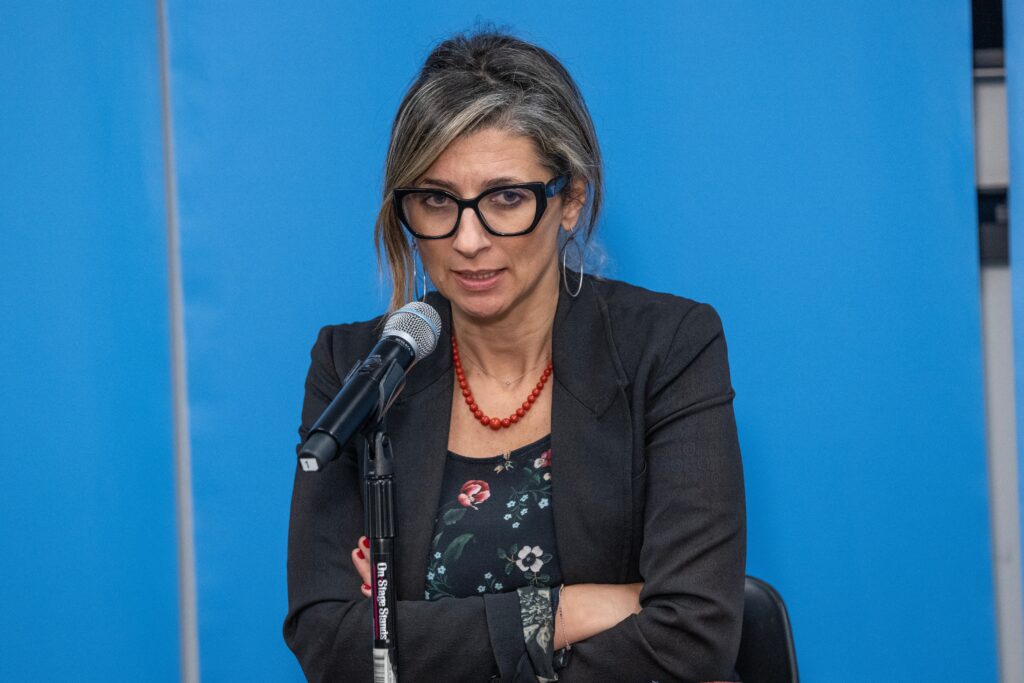
On February 7, 2026, UN Human Rights Council (UNHRC) Special Rapporteur Francesca Albanese appeared at a conference sponsored by Al Jazeera that included participation from Hamas leader Khaled Meshal and Iranian Foreign Minister Abbas Araghchi. In her remarks, Albanese invoked tropes of Jewish conspiracy and control in relation to Israel, while branding Western support for the country as the “common enemy of humanity.”
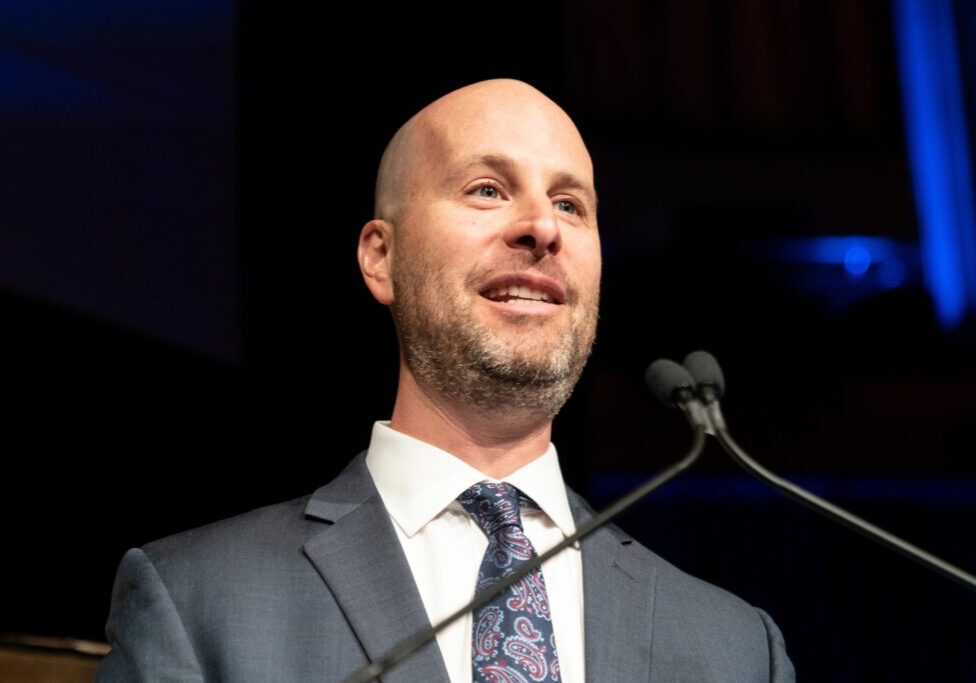
Also in February, another UNHRC figure generated significant controversy in advance of Israeli President Isaac Herzog’s state visit to Australia. Although Herzog was travelling to Australia primarily to comfort members of the Jewish community still reeling from the Bondi Beach massacre, Chris Sidoti, an Australian member of the UNHRC’s permanent Commission of Inquiry on Israel, was widely featured in the media opposing the visit, and insisting Herzog was guilty of incitement to genocide (see Allon Lee’s column on media coverage of the Herzog visit for more details). In his interviews, Sidoti called Herzog, the former leader of the Israeli left Labor Party, “one of the most divisive figures in the world.” He called it “nuts” to bring Herzog to Australia, and claimed that aside from a 1966 visit by then-US President Lyndon Johnson, Herzog’s visit was “probably the most divisive state visit to Australia.”
Antisemitic or hostile and extreme remarks regarding Israel made within the confines of UNHRC proceedings are certainly not new. People like Albanese and Sidoti are selected by the UNHRC precisely because of their pre-existing records regarding the Jewish state. In recent years, however, such public statements by UNHRC “experts” have become increasingly common and more brazen. Their reach has also expanded far beyond the confines of fringe conferences and obscure UN reports and meetings. Yet there is little ability for the UN to sanction or fire those who violate UN rules or engage in unprofessional conduct.
This is particularly the case for individuals, like Albanese and Sidoti, who are working under the auspices of the UNHRC’s Special Procedures. Special Procedures covers the mandates of UNHRC rapporteurs and members of fact-finding missions and commissions of inquiry. Known as “independent experts”, these rapporteurs and commissioners are not UN employees, nor are they UN officials. They are unpaid, though their expenses are covered by the UN and they are provided logistical, research, and office support by the UN Office of the High Commissioner for Human Rights. Perhaps far more valuable to them is that, due to their position, they are given prominence, UN legitimacy, and a UN platform from which they can disseminate and amplify their personal views. While mandate holders are bound by a Code of Conduct, there is no clear mechanism to enforce it.
As a result, Special Procedures mandate holders operate in a zone of impunity where they are rarely held to account for activities and statements that cross the line. This is all the more true when those activities and statements promote antisemitism or are extreme comments regarding Israel.
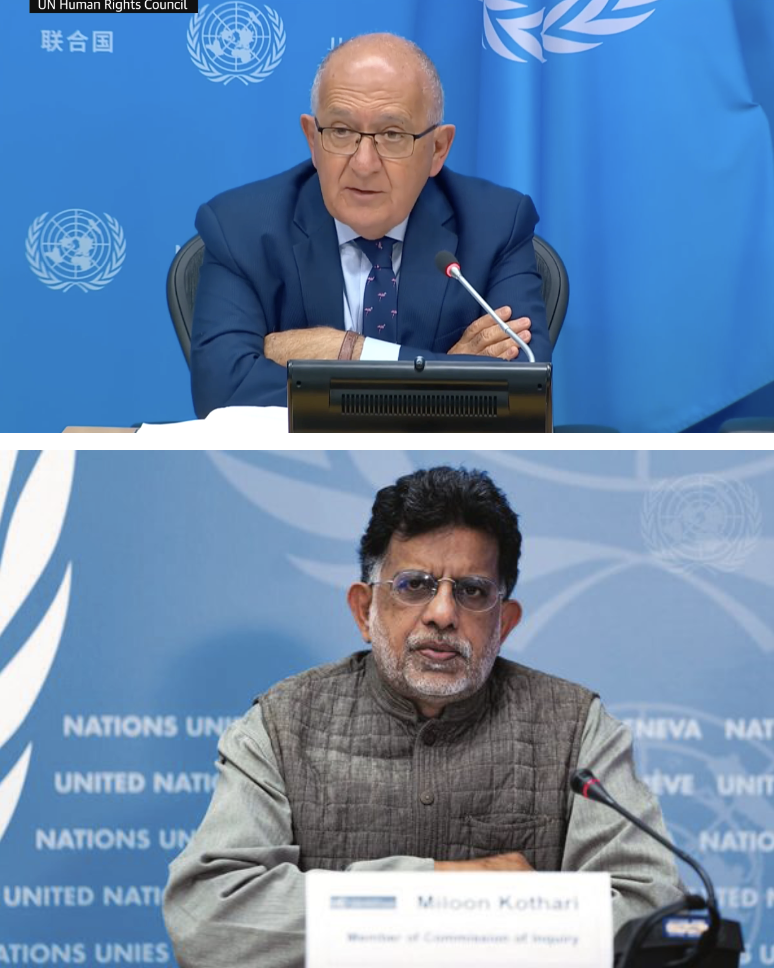
From top: Chris Sidoti, Miloon Kothari (Images: X)
There are many examples of UNHRC special rapporteurs abusing their platforms, but few have achieved the notoriety of Francesca Albanese, an Italian national and former UNRWA employee. Since taking up the post of the Special Rapporteur on “the situation of human rights in the Palestinian Territory occupied since 1967” in 2022, and thanks to the perks of the position, Albanese has become a superstar in anti-Israel circles for her shameless comments. At a 2022 conference organised by a former Hamas leader and including members of Hamas and Palestinian Islamic Jihad, Albanese reportedly told attendees they had a “right to resist”. In media appearances since October 7, she claimed, “the motives [of October 7] were not antisemitic – because the attack was against Israel and Israelis… because they are occupiers.” She denied October 7 atrocities stating that, “there were fabrications attached to it, like the mass rape and other horror stories,” and “what’s the need to talk about mass rapes? There is no evidence of rape.”
Albanese’s conduct has sparked multiple condemnations from many countries. The French Foreign Minister called her February remarks “outrageous and reprehensible”, noting further that “she presents herself as a UN independent expert, yet she is neither an expert nor independent – she is a political activist who stirs up hate.”
Germany, Austria, Italy and Czechia, among others have joined France in demanding her dismissal. In July 2025, the US Government sanctioned her, objecting to her “biased and malicious activities… that have long made her unfit for service as a Special Rapporteur.” It noted she “spewed unabashed antisemitism, expressed support for terrorism, and open contempt for the United States, Israel, and the West.”
Sidoti’s swipes at Herzog were also not an aberration and similarly extreme and offensive comments have plagued other members of the UNHRC COI of which he is a part. In June 2022, following the COI’s presentation of its first report to the UNHRC, Sidoti denigrated the IHRA international consensus working definition on antisemitism (adopted by the government of Australia in 2021) as being “promoted by the government of Israel, and its GONGOS [governmental non-governmental organisations].” He also derisively contended that “accusations of antisemitism are thrown around like rice at a wedding.”
In July 2022, Sidoti’s then-fellow Commissioner Miloon Kothari claimed on a podcast that the “Jewish lobby” controls social media and questioned whether Israel should have UN membership. The third commissioner in the COI trio, former UN High Commissioner for Human Rights Navi Pillay, refused to condemn Kothari’s remarks, stating his comments “have deliberately been taken out of context… [and] deliberately misquoted” – even though Kothari himself admitted making them.
Kothari’s remarks were widely condemned by many countries, including Albania, Bulgaria, Czechia, the Federated States of Micronesia, Germany, Guatemala, Hungary, Liberia, the Marshall Islands, Palau, Republic of Nauru and the US. Many of these countries also denounced the failure of the UNHRC to repudiate these statements or remove him from his position. Nevertheless, no punitive action was taken. Reportedly fearing US sanctions, in August 2025, Pillay and Kothari resigned. Sidoti remains on the COI.
Under published UNHRC guidelines, Special Procedures mandate holders are expected to “do no harm” and act with “objectivity” and “professionalism”. As mentioned, they are bound by a Code of Conduct. Passed in June 2007 under Resolution 5/2, Article 3 of the Code obligates mandate holders, among other duties, to “uphold the highest standards of efficiency, competence and integrity, meaning, in particular, though not exclusively, probity, impartiality, equity, honesty and good faith” and to “adopt a conduct that is consistent with their status at all times.” Under Article 12, they must “ensure that their personal political opinions are without prejudice to the execution of their mission,” and “show restraint, moderation and discretion so as not to undermine the recognition of the independent nature of their mandate.”
Yet, despite these obligations, the Code is not legally binding and is almost purely self-enforcing. A Coordination Committee for Special Procedures was established in 2005, ostensibly to serve as an oversight body. The role of the Committee, however, is relatively limited. There is a complaint function under which the Committee can review the conduct of a mandate holder and submit its findings to the President of the UNHRC, but these procedures are generally non-transparent and have no binding import. Oftentimes, moreover, the Committee has acted to protect the interests of the rapporteurs rather than serve as a real check on behaviour. Indeed, in relation to Albanese’s remarks last month, the Committee actually “condemned” the criticism of her as “vicious attacks, rooted in disinformation” and declared those states which criticised her were “on the wrong side of history” and “contributing to lawlessness and world disorder.”
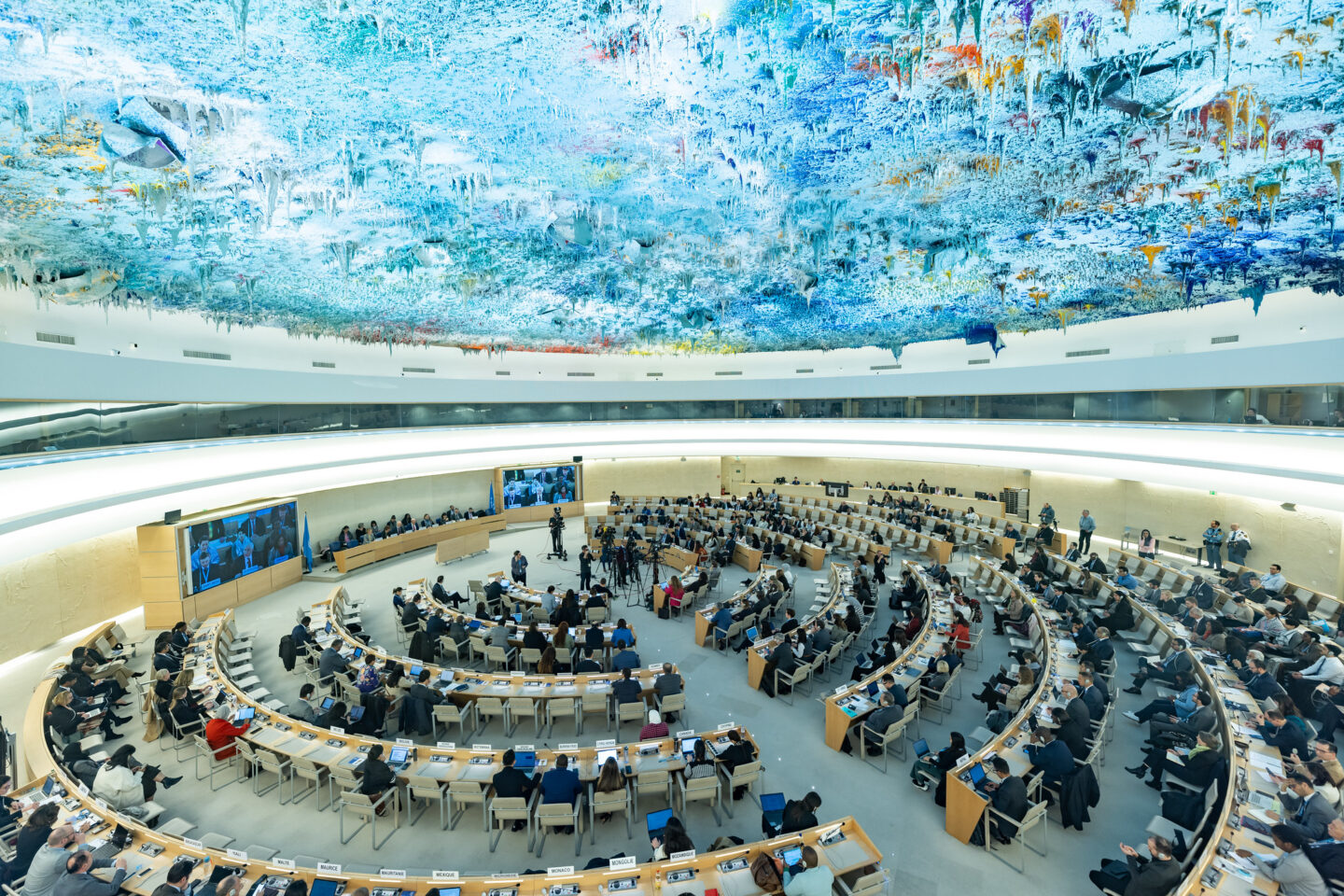
A refuge for extremists?: The UN Human Rights Council chamber in Geneva (Image: Jean-Marc Ferré/ UN Photo)
Given the lack of enforcement measures under the UNHRC Code of Conduct, what else can be done? Under UNHRC rules, the UNHRC President can exercise their power to convene an interactive dialogue of the UNHRC to review a mandate. The President can express their opinions and make recommendations to member states relating to issues of misconduct, but there is no means to remove or sanction mandate holders. The UNHRC (or alternatively, as the parent UN body, the UN General Assembly) could propose a resolution, ordering a rapporteur’s removal and/or cancelling the mandate. However, given the overwhelming control of both the General Assembly and the UNHRC by countries hostile to Israel, it would likely be impossible to pass such a decision.
While anti-Israel activists may remain smug that an Albanese or Sidoti cannot be forced to resign, they ignore the real consequences of this impunity. First, their tenure provides yet further evidence for the view that the UNHRC is a farce – hopelessly biased and discredited. Second, the UN is currently undergoing a severe liquidity crisis. Many countries, most notably the US, have not paid their dues, and the activities of Albanese and the COI are a significant reason why not. They are also the reason the US withdrew from the Council in February 2025. It is also one reason the Trump Administration has formed a Board of Peace to lead Gaza reconstruction efforts rather than entrusting it to the UN.
Importantly, due to the long-standing failures of UNRWA, and its unwillingness to implement real reforms, it is now being blocked from having a role in Gaza going forward. The expansion of US sanctions is also a significant possibility and could expand to the Special Procedures unit as a whole or even the entire Office of the High Commissioner for Human Rights.
In the meantime, the primary recourse available remains to continue to vociferously name and shame these actors, exposing their bias and unprofessional conduct. Individual countries can impose their own sanctions or, at the very least, refuse all cooperation with Albanese and others who violate their professional codes. They can exclude rapporteur reports as source material for government activities or bar reliance on information using such reports. They can also be blocked from appearing at official events or engaging in activities receiving governmental funding. Countries could also withhold funding to the UNHRC and OHCHR overall until such individuals resign or are removed from their positions.
In the long term, the UNHRC must be pressed to enact reforms which would include the adoption of a removal mechanism. The UN is currently undergoing the UN80 (in honor of the UN’s 80th anniversary) reform process, and this must be included as part of this initiative.
The UN already has a major credibility problem. The longer individuals like Albanese are allowed to remain in their positions, the more the UN will haemorrhage funding and influence. Albanese and Sidoti will likely continue to benefit from their elevated profiles and the notoriety gained through their UN platforms long after their mandates have ended. However, it is not these individuals, but the UN, that will have to live with the consequences for failing to root out those who bring that institution into disrepute.
ANNE HERTZBERG is the Legal Advisor and UN Representative for NGO Monitor, a Jerusalem-based research institution.
Tags: Israel, UNHRC, United Nations
RELATED ARTICLES