Australia/Israel Review
Biblio File: Life after…
Mar 18, 2026 | Rebecca Davis
Resilience and defiance amidst anger, grief and fear post-October 7
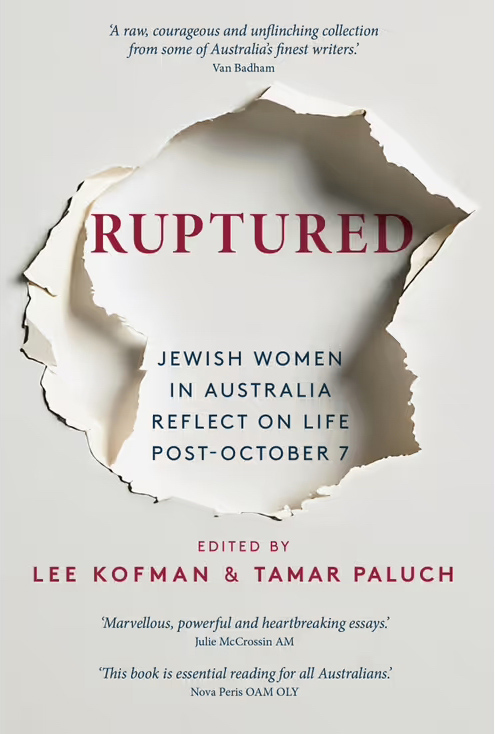 Ruptured: Jewish Women in Australia Reflect on Life Post-October 7
Edited by Lee Kofman and Tamar Paluch
Lamm Jewish Library of Australia, 2025, 252 pp. $34.95
“I had to remember what life was like before October 7 and that’s hard to do. It is like trying to remember a faded romance or the texture of life when I was at high school.”
With these words, writer Julie Szego captures the profound fracture experienced by many Jews worldwide following October 7 – and the emotional terrain explored in Ruptured: Jewish Women in Australia Reflect on Life Post-October 7.
Edited by Lee Kofman and Tamar Paluch, the anthology brings together 36 essays by Jewish women across Australia reflecting on how the Hamas atrocities of October 7, 2023 – and the global response that followed – reshaped their lives and sense of belonging.
For many Jewish Australians, that rupture was not only geopolitical; it was personal, social and psychological. Something fundamental shifted in how Jewish identity was experienced in public life, professional environments and even private relationships. Assumptions about belonging – long taken for granted in multicultural Australia – suddenly felt far less certain.
Ruptured seeks to record that moment.
The collection captures how a distant war reverberated across the Australian Jewish diaspora, reshaping the lives, identities and sense of security of Jewish women. The result is a work that functions simultaneously as personal testimony, communal record and social document.
The contributors span an extraordinary breadth of backgrounds and experience: millennials and octogenarians; queer women; women living in regional Australia; migrants from the former Soviet Union and Israel; Mizrahi women and women of mixed heritage; descendants of Holocaust survivors and those whose families have lived in Australia for generations.
Some are prominent public voices – including Ramona Koval, Dani Valent, Kylie Moore-Gilbert, Deborah Conway, Kerri Sackville, Lisa Goldberg and Rachelle Unreich. Yet equally compelling are the lesser-known voices: first-time writers whose reflections bring a rawness to the collection.
What emerges across the essays is not a single story, but a chorus of dislocation, grief, anger and rediscovery.
Yet despite the diversity of backgrounds and viewpoints, several themes emerge with striking consistency.
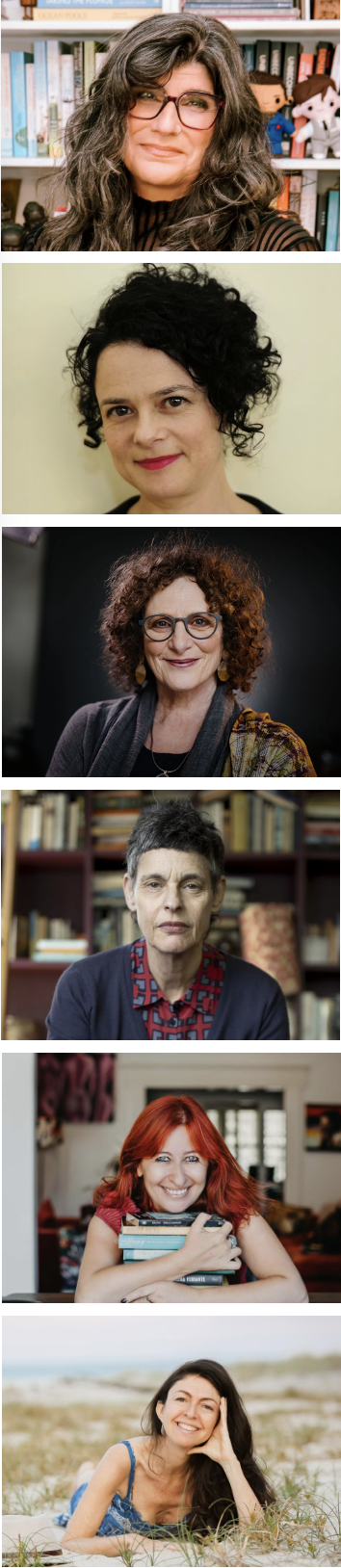
The voices of Jewish women (from top): Joanne Fedler, Julie Szego, Ramona Koval, Deborah Conway, Lee Kofman, Sharon Sztar
The Abandonment by the Feminist Movement
One of the most jarring aspects of the aftermath described in the essays is the absence of solidarity from many feminist and progressive circles.
Writer Sharon Sztar gives voice to a sentiment that recurs throughout the book:
“Where were the strong feminist voices? Why weren’t they demanding our girls to be released from captivity? Where was the outrage about the desecrated bodies of the Nova festival’s young partygoers?”
The question hangs over the anthology. Contributors describe waiting for solidarity that never came.
The Betrayal by the Left
Author Joanne Fedler reflects on the ideological dislocation she experienced within progressive politics.
“I began to see the toxic fascism in parts of the left, my once political home,” she writes. “Its performative selective outrage masquerading as ‘anti-Zionist pacifism’; the Jew-hate, finally aired.”
Fedler recounts the moment her rage overtook her fear, describing the painful process of “unfriending” and blocking people on social media.
“It was self-care. I had to arrest the thousand daily assaults on my nervous system as I just couldn’t take another smug, ill-informed post about the Israel-Hamas war.”
“My idealism about ‘peace’ is gone,” she writes. “It died with Vivian Silver and those young dancers at the Nova festival.”
The LGBTQI+ Experience
For student Noa Gomberg, the rupture manifested in a fracture between communities.
“I had to choose: the Jewish community or the queer community.”
Her essay describes the anger and isolation she felt watching LGBTQI+ influencers accuse Israel of “pinkwashing”, all while brainwashing her generation that being queer must mean being anti-Zionist.
“How dare someone say I – a queer woman – don’t belong at a Pride parade because of the Star of David around my neck?”
When Hatred Appears on Your Doorstep
Writer and performer Elise Esther Hearst describes how the events of October 7 reverberated into everyday life in Australia.
“Soon after that hellish day I caught the first few whiffs of anti-Jewish racism in Australia,” she writes. Her children’s Jewish school advised parents not to send students in uniform. A casual clothes day became a week, then another.
Each morning on the way to school, her children witnessed posters of Israeli hostages being torn down from light poles, replaced and ripped down again.
“The child hostages, Kfir and Ariel Bibas, looked eerily similar to my son, all redheads,” she writes.
Hearst captures the emotional dissonance many Jewish Australians felt: “In a distant land, a death toll was rising, and here in my backyard hatred was mounting.”
To Conceal or to Reveal
This theme of conflicting realities is further expressed by Olympic race walker Jemima Montag.
“This duality of fear and pride dominated my year,” she writes.
As Montag prepared to represent Australia at the 2024 Paris Olympics, she wrestled with whether to conceal her Jewish identity.
“I stood in front of microphones, on start lines and in airports, hyper-aware of my safety as a Jewish athlete,” she writes.
The approaching Games reminded her of the 1972 Munich massacre, when 11 Israeli athletes were murdered by terrorists.
“I was set to compete in the 20-kilometre race-walk and the mixed marathon race-walk relay, both in open public spaces with unprotected exposure.”
Montag wears a bracelet that once belonged to her grandmother, a Holocaust survivor. In past interviews she spoke proudly about its meaning. But now, she stays silent.
“In some ways, the choice to conceal my Jewish identity this year has made me feel disappointed in myself,” she admits. “I hope that I can feel safe enough to speak about Nana’s bracelet again soon.”
Yet for some contributors, October 7 sparked a personal awakening.
Grief and trauma counsellor Irena Zilberman recounts listening to American commentator Ben Shapiro declare simply: “I am a Jew.”
“There is grief in his voice, but also a deep rage,” she writes. “Tears start streaming down my face, tears of relief at finally having this emotional mess inside me reflected back.
“For the first time in my life I can feel it in my body – a spark of my Jewish identity.”
Zilberman’s story carries an added tragedy: her uncle Serzhik and aunt Vicka were shot dead in their Ofakim home on October 7.
Trauma in the Body
Psychoanalyst and artist Julia Meyerowitz-Katz introduces another dimension to the rupture: the physiological toll of collective trauma.
“My acupuncturist tells me that, as with all her Jewish patients, my nervous system is in a frenzy,” she writes. A physiotherapist makes a similar observation – Jewish bodies, she says, appear to be “in trauma mode”.
After October 7, Meyerowitz-Katz herself was diagnosed with two rare illnesses. A health insurance broker tells her that serious diagnoses among his Jewish clients have surged.
“Trauma has affected us biologically, making us ill. This is how epigenetic changes occur.”
But the sense of threat is not confined to the body. It permeates the everyday.
“I find I am hyper-aware of being Jewish. Wherever I go, I wonder if it is safe. Will I be accepted as a Jew? Should I reveal that I am a Jew?”
That unease becomes painfully real when a fellow resident artist tells her that “Jews have all the power.”
“That relationship has never recovered,” she writes. “Now even my studio feels unsafe.”
Echoes of History
Writer and broadcaster Ramona Koval contributed one of the anthology’s most reflective essays, drawing historical parallels that are both sobering and unsettling.
“The time has come for us – Jews, non-Jews, all of us who love this country – to open our eyes to the truth of history,” she writes. “To the bloody, bestial, vicious, murderous truth of what can happen when we wilfully ignore the parallels between what is now and what was then.”
Koval warns against complacency. The lesson of Jewish history, she argues, is that divisions between Jews never protect anyone.
“It would be a mistake to think that the Nazis distinguished between good Jews and bad Jews, sophisticated ones and shtetl ones, Zionists or anti-Zionists. In the end, all the hair was shaved, the gold teeth were pulled and the bodies were burned.”
But Koval’s essay is also about resilience and responsibility.
“Since October 7, like many of us, I am strengthened in my Jewishness,” she writes.
“After all, there is no hiding place now. We must not bury our manuscripts in metal boxes and milk pails. We must continue to challenge and speak up and write openly. Courage is what I was bequeathed by those who survived. I didn’t know it when they were alive, but now I do.”
Hineni – We are here
Taken together, the essays in Ruptured form more than a collection of personal reflections. They are a testimony of a moment when Jewish Australians felt the ground shift beneath them.
There is grief in these pages. Anger. Disillusionment. Fear.
But there is also resilience – and defiant strength.
If the anthology has a unifying message, it is captured in a single Hebrew word that echoes throughout Jewish history: Hineni – “I am here”.
Despite rupture, despite abandonment, despite hatred, Jewish life continues. And the women of Ruptured will not be silenced.
To order the book, or learn more, go to ruptured.com.au.
RELATED ARTICLES