Australia/Israel Review
Biblio File: Haunting parallels
Mar 18, 2026 | Allon Lee
From 1929 to October 7
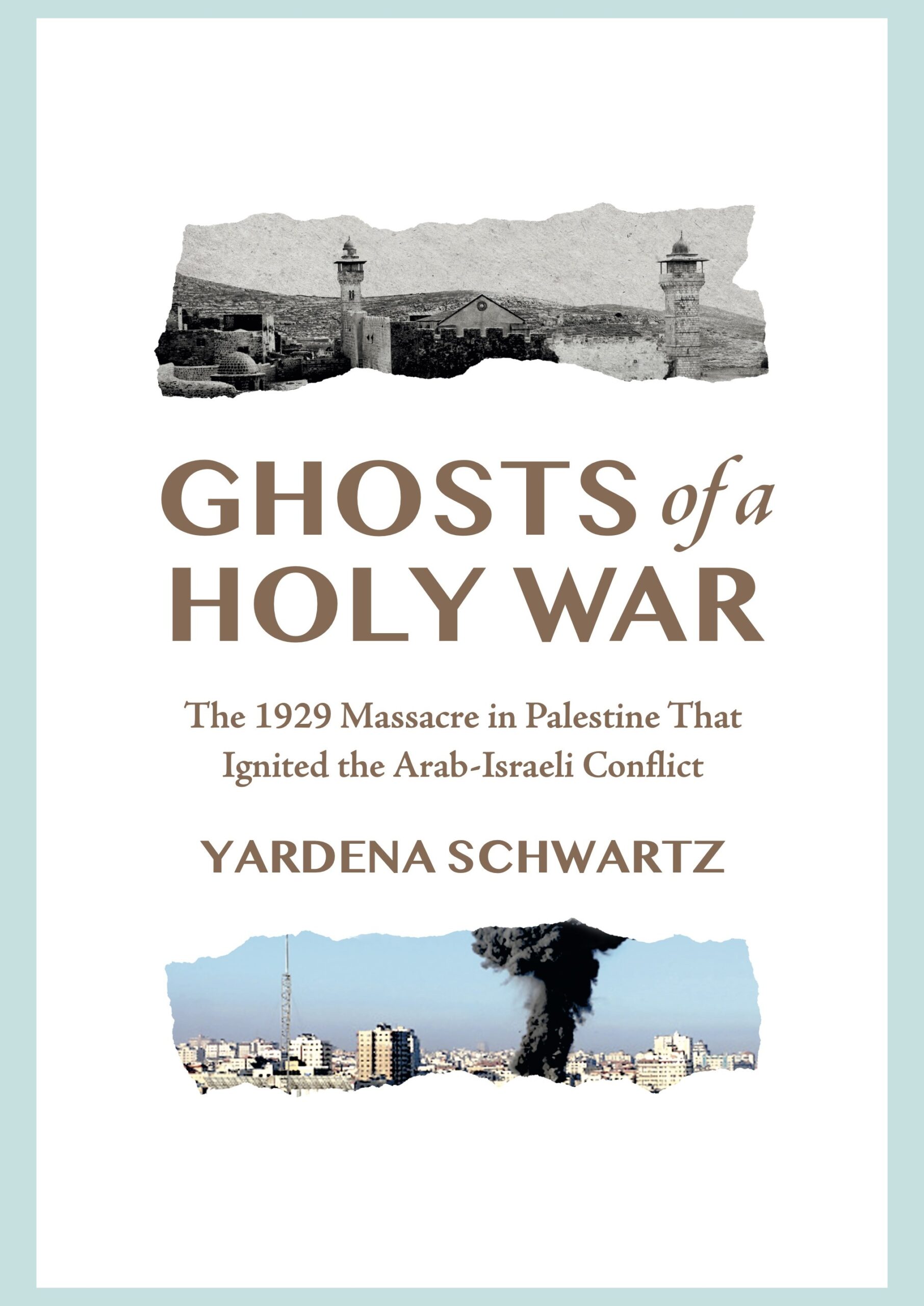 Ghosts of a Holy War: The 1929 Massacre in Palestine That Ignited the Arab-Israeli Conflict
Yardena Schwartz
Hearst, 2025, 336 pp, A$54.95 [purchase here]
A refusal to accept the Jewish people’s legitimate and historic right to their own state anywhere in the territory encompassing contemporary Israel, Gaza and the West Bank lies at the heart of the century-old Israeli-Palestinian conflict.
Several books have explored this theme in recent years, particularly after the October 7 massacre. American journalist Yardena Schwartz’s Ghosts of a Holy War is an example whose starting point is the massacre of the ancient Jewish community of Hebron on Aug. 24, 1929. Schwartz argues that this event deserves to be seen as a defining moment in the Arab-Israeli conflict – what she calls its “ground zero”. Her book traces the massacre’s legacy right up to the present day.
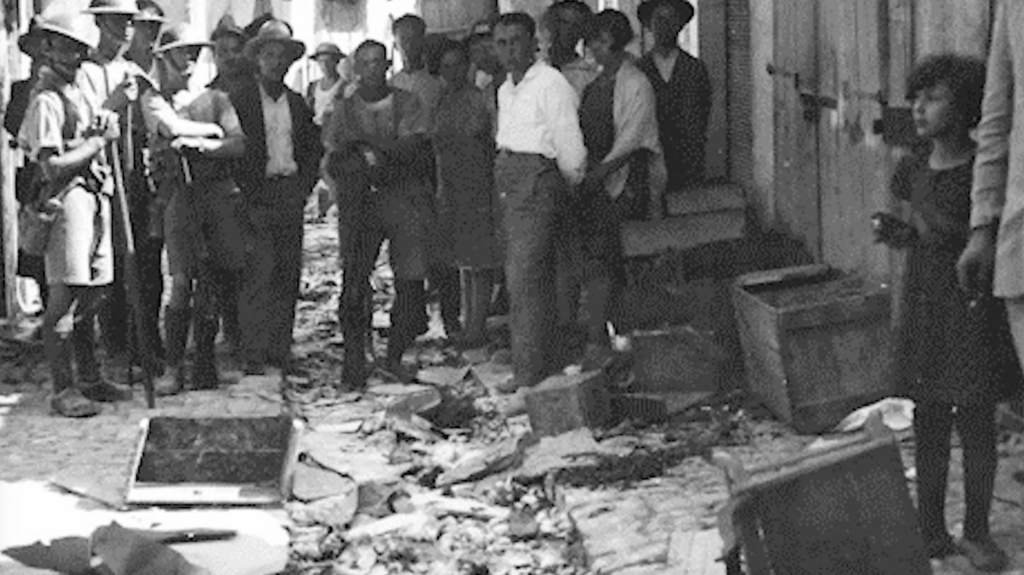
Roughly 3,000 men armed with swords, axes and daggers descended on Hebron’s Jewish quarter, where they murdered, raped and mutilated men, women and children. By the time the violence ended, 67 Jews had been murdered and hundreds more wounded. The violence was not confined to Hebron; across British Mandatory Palestine a total of 133 Jews were killed in various riots.
The aftermath marked a profound historical shift. British authorities forcibly evacuated the survivors, ending a Jewish presence in Hebron that had been sustained for hundreds of years. The savagery also reshaped Jewish political thinking in Palestine. Zionist leaders concluded that coexistence without organised self-defence was no longer viable and accelerated efforts to build professional security forces.
What made the violence particularly shocking was that Hebron’s Jews were not Zionists, yet were still targeted.
For many of the older non-Zionist Jewish communities in Mandatory Palestine, the events of 1929 made it clear that their survival depended on aligning with the Zionist movement. Hebron was particularly vulnerable because of the absence of any organised Jewish defenders. Indeed, the city’s Jewish leaders had rejected offers from the Zionist leadership to provide security assistance.
Schwartz’s interest in the massacre began after she was given access to a cache of correspondence written by David Shainberg, a young American Jew from Memphis. At the age of 22, he moved to Hebron in 1928 to study at a yeshiva (religious school) there. Like most of Hebron’s Jews, he did not support Zionism. Shainberg was among the massacre’s victims.
At the time, Hebron was home to about 700 Jews, most of Sephardic (Middle Eastern and North African) origin. They lived among a much larger Arab population in what appeared to be relatively stable coexistence, although they certainly had to know their place – a distinctly subordinate place – in the social pecking order. Jews were barred from entering the Tomb of the Patriarchs, where tradition holds that Abraham – the founder of the Jewish faith and people – and other biblical patriarchs are buried.
Few members of this community could have imagined that their neighbours – including members of the city’s police force – would one day turn against them so savagely.
The massacre, however, did not erupt spontaneously. It was fuelled by the incitement of Haj Amin al-Husseini, the Grand Mufti of Jerusalem, who spread a conspiracy theory claiming that Jews were plotting to destroy the al-Aqsa Mosque and replace it with a third temple.
Although the 1929 massacre marked a turning point, it was not the first outbreak of organised mass violence against Jews in Mandatory Palestine. That grim distinction belongs to the Nebi Musa riots of April 1920, which were also fuelled by false claims about alleged Jewish designs on al-Aqsa Mosque. Al-Husseini played a role in that earlier outbreak of violence as well. His role and legacy are a key focus of Ghosts of a Holy War.
Despite the horror of the massacre, the author finds hope in the story of the 22 Arab families that risked their lives to shelter Jewish neighbours during the 1929 pogrom in Hebron.
Yet, dispiritingly, when the author visited the descendants of these rescuers in 2019, many refused to speak with her, fearful of being labelled collaborators.
By contrast, when she visited the small Jewish community now living in Hebron, she discovered that the settlers there maintain a museum of Hebron’s Jewish history that acknowledges the Muslims who saved Jewish lives.
Given the reputation of Hebron’s current Jewish residents as settler extremists, “the space that was given to the Muslim heroes of Hebron took me by surprise,” she writes.
She wonders how different life might be if Palestinians could learn to honour their own suffering without erasing the Jewish historical connection to the land.
An alternate subtitle of the book might well have been “No Good Deed Goes Unpunished.” In one section of the book, Schwartz notes how Israeli prisoner exchanges have repeatedly produced unintended consequences. In 1985, Israel released Sheikh Ahmed Yassin in a swap; three years later he founded Hamas.
A similar pattern followed the 2011 prisoner exchange for kidnapped Israeli soldier Gilad Shalit, which included Yahya Sinwar – the Hamas leader who would later mastermind the October 7 massacre, dubbed “Operation al-Aqsa Flood” – again invoking false claims about plans to destroy the mosque as a justification and catalyst for bloody violence.
The author argues that there are many parallels between 1929 and October 7 beyond the libel accusing Jews of seeking to tear down the al-Aqsa Mosque and the sickening brutality inflicted on civilians.
Looming large over the narrative is the pattern of Palestinian leaders rewriting history and weaponising Islam to both justify terrorism and further their own personal political objectives. So too is the repeated willingness of Western governments to placate Palestinian extremists, whose goal is not to reach a settlement to end the conflict but to perpetuate it.
In response to the 1929 pogrom, London established the Shaw Commission. Although its report placed responsibility for the violence on the Arab side, it was the Jews who ultimately paid the price, with the complete destruction of the ancient Hebron community, and gradual British moves away from support for creating a “Jewish national home” – the explicit purpose of the British Mandate for Palestine.
Likewise, she notes how, after Hamas’ October 7 massacre, Western governments moved to recognise a Palestinian state, reinforcing the perception that terrorism yields political rewards.
In this respect, Schwartz is clearly right – the ghosts of 1929 do indeed still haunt the present.
Tags: Israel, Palestinians
RELATED ARTICLES