Australia/Israel Review
From New Delhi with love
Mar 18, 2026 | Ilan Evyatar
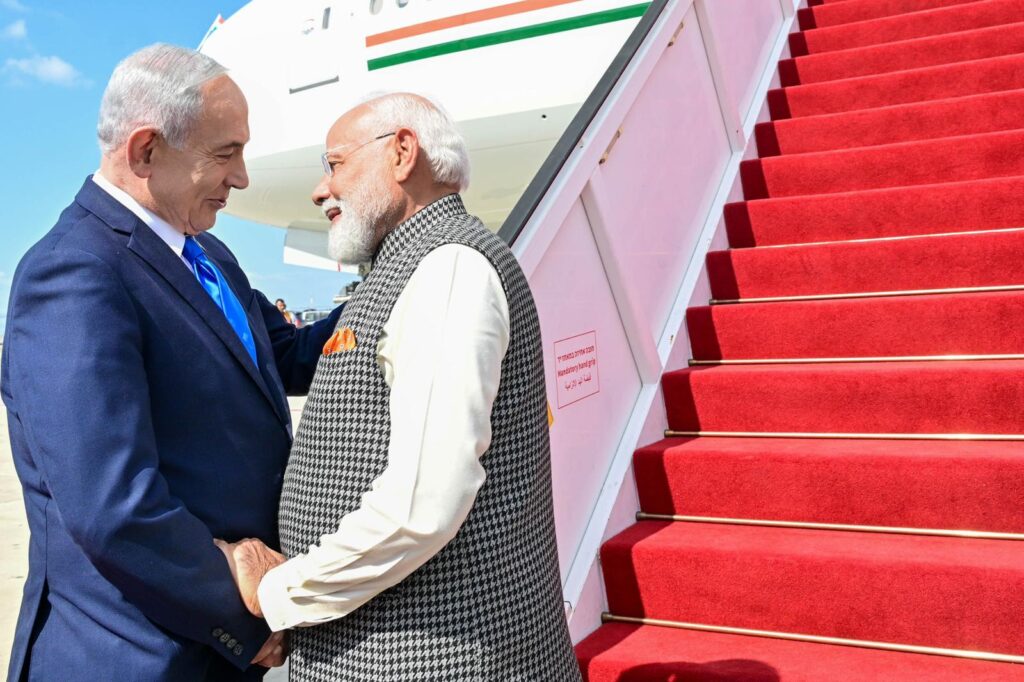
War fails to overshadow deepening Israel-India “romance”
In early March, standing amidst the destroyed remains of a synagogue in Beit Shemesh where an Iranian missile strike had killed nine people, Israeli PM Binyamin Netanyahu told an Indian TV crew that he had just spoken with “our great friend, Prime Minister Narendra Modi.”
This statement came only days after Modi had stood beside Netanyahu in the Knesset during a landmark visit to Israel, his first in nine years. In retrospect, it meant that the leader of the world’s most populous nation was in Israel on the eve of the joint United States-Israeli strike on Iran and the assassination of its Supreme Leader, Ayatollah Ali Khamenei. This timing exposed Modi to harsh criticism from his country’s opposition, which accused him of a “betrayal of India’s values, principles, concerns, and interests.”
The possibility of a US-Israeli attack on Iran had been widely discussed for months, yet Modi decided to proceed with the visit regardless, knowing the risks.
Dr Oshrit Birvadker, an India expert and senior fellow at the Jerusalem Institute for Strategy and Security, said the decision reflected Modi’s leadership style.
“He makes bold decisions that go against the hesitation we often associate with traditional Indian policy. And that is true not only in foreign policy, but in many other areas as well,” Birvadker said.
Birvadker also emphasised the broader symbolism of the visit. India, she noted, is the world’s largest democracy and an influential voice in the Global South. It maintains strong relations with the Muslim world, the Gulf states and major global powers.
“For such a country to embrace Israel and upgrade relations to a level reserved for only a handful of countries – such as the United States and Germany – is a very significant statement, especially at a time like this.”
During the visit, the two countries elevated their existing relationship from a “strategic partnership” to what they described as a “special strategic partnership”, reflecting the rapid expansion of ties between Jerusalem and New Delhi.
Defence cooperation – which Birvadker described as “the core of India–Israel relations” – continues to dominate the partnership, with the two countries recently signing defence deals worth billions of dollars.
What’s more, new mechanisms are also expected to facilitate discussions on cooperation in areas such as air-defence systems and emerging technologies, including the integration of Indian capabilities with Israel’s Iron Beam laser interception system.
At the same time, Birvadker stressed, “both countries are now seeking to diversify the relationship and deepen cooperation beyond the defence sphere.”
Reflecting this shift, 17 memoranda of understanding and 11 joint initiatives were signed during the Modi visit, spanning fields from critical and emerging technologies to agricultural innovation, cultural cooperation, and research and development. Among the most significant steps taken during the visit was the agreement to establish a special committee with high-level ministerial engagement focusing on defence co-production, cyber defense, artificial intelligence, and quantum technologies.
The visit also carried a strong political message. Addressing the Knesset, Modi expressed his “deepest condolences” for the Israeli lives lost in Hamas’ October 7 attack and declared that “India stands with Israel firmly, with full conviction, in this moment and beyond.”
Taken together, the visit underscored the accelerating strategic convergence between Israel and India – a partnership increasingly embedded in wider regional frameworks linking the Indo-Pacific with the Middle East.
A changing regional architecture
India has been gradually repositioning itself within a new regional architecture that includes Israel, the United States, and key Gulf states, at the same time as its once valued relationship with Iran has receded in importance.
New multilateral initiatives are central to this shift. Among the most prominent is the I2U2 grouping, which brings together India, Israel, the United Arab Emirates and the United States. Initially focused on economic cooperation and food security, the framework has increasingly been viewed as a platform for broader technological and strategic collaboration.
Similarly, the proposed India–Middle East Corridor (IMC) aims to connect India with Europe through a network of ports, railways and digital infrastructure linking the Persian Gulf and Israel. Announced at the G20 summit hosted by India in New Delhi in September 2023, the project is widely seen as a potential counterweight to China’s Belt and Road Initiative.
Birvadker argues that such frameworks align well with India’s strategic preferences.
“When we talk about formats such as the economic corridor or I2U2, India has a great deal to gain. These are essentially positive platforms focused on trade, food security, and energy – areas that India has no difficulty promoting.”
She noted that the corridor plan’s original launch was quickly overshadowed by the regional upheaval triggered by the October 7 attacks and the war that followed.
“Despite the attention the announcement generated, and the geopolitical weight such a project could have for global trade, only a few weeks later the events of October 7 occurred, followed by a prolonged regional war. These important plans were therefore delayed.”
Nevertheless, she believes the project remains strategically important for the future of the region.
“Now that we may be approaching a new Middle East, it would be worthwhile to move these projects forward. They could provide a strong foundation for building cooperation – a platform that might later evolve into something political, although for India that will take time.”
“This is precisely the kind of project that embeds the regional integration that Israel has sought since the early days of its establishment.”
The “Hexagon” and India’s strategic limits
Not all emerging frameworks, however, fit comfortably within India’s strategic outlook.
Netanyahu has recently spoken of a broader strategic “Hexagon” linking Israel, India, the United States, and other regional partners in what he described as “an alliance of countries that stand together against the radical axis” – presumably meaning primarily Iran and its proxies and partners.
Birvadker believes India is unlikely to embrace such a concept too quickly.
“I find it difficult to believe that India would formally join such an alliance for the simple reason that, in general, India does not favour alliances or binding agreements,” she said.
“When it does join such platforms, they are usually ones with a positive agenda rather than those explicitly defined against a specific country.”
She cautioned that joining a framework framed explicitly against specific states could limit India’s diplomatic flexibility, but noted that it is still too early to make a decisive assessment.
“We need to see where this idea goes. India will need to understand what joining such an alliance would actually give it. Ultimately, India maintains good relations with all sides, and joining such a framework would reduce India’s room for manoeuvre – which is a cornerstone of Indian foreign policy and of its broader strategic outlook.”
Strategic autonomy in a new Middle East
The outbreak of open confrontation between Israel, the United States and Iran has only sharpened the dilemmas facing Indian policymakers.
India maintains ties with all sides in the region – including Iran, the Gulf states and Israel – and has historically sought to balance these relationships under a doctrine known as strategic autonomy.
“I think we should not flatten the analysis of this relationship into black-and-white categories of being ‘on our side’ or not,” Birvadker said.
“For India, the situation is much more complex.”
India’s approach, she explained, reflects a broader worldview shaped by the emergence of a more multipolar international order.
“We are moving toward a multipolar world in which American hegemony is weakening. In such a world we see different poles of independent power interacting with one another. India is one such pole.”
New Delhi is unlikely to align itself fully with any single bloc, even as it deepens partnerships with a range of countries.
“India is not willing to submit to external dictates or entangle itself in wars that are not its own,” Birvadker said. “But it is interested in cooperating with everyone, developing partnerships, and strengthening its resilience against the uncertainties of a changing world.”
The future of the partnership
Despite these constraints, the trajectory of Israel–India relations over the past two decades suggests that the partnership will continue to deepen across multiple domains.
Defence cooperation may remain the backbone, but collaboration in technology, infrastructure and trade is steadily transforming it into a broader strategic relationship.
For Israel, closer ties with India offer access to one of the world’s largest and fastest-growing economies. For India, cooperation with Israel provides technological capabilities and strategic connections that support its ambitions as a rising global power.
Modi’s February visit underscored how far the relationship has evolved. What was once a discreet security partnership has become an increasingly visible strategic alignment linking the Indo-Pacific and the Middle East.
“In the past,” says Birvadker, “analysts used to call the relationship between Delhi and Jerusalem a ‘romance’, others called it a ‘long-term relationship’, and many viewed Modi’s historic 2017 visit as the ‘wedding’.” Today, she concludes, “We are in the stage of ‘Strategic Intimacy’.”
RELATED ARTICLES