Australia/Israel Review
Asia Watch: An emerging divide
Dec 19, 2025 | Michael Shannon
Malaysia’s multi-ethnic communal mix has long been a key driver of its politics. At over 30% of the population, the minority ethnic Chinese and Indian communities are large – and successful – enough to make the majority Malay population cling evermore ferociously to the consolations of identity politics, claiming special entitlements as bumiputera – “sons of the soil.”
The underlying resentment of many Malay Muslims towards the minority Chinese (and to a lesser extent, the minority Indians as well), who are generally more urbanised and economically dominant, creates a clear incentive for politicians to play to Malay sensibilities, especially via expressions of solidarity with their global Muslim brethren and denunciations of an agreed-upon bogeyman – the Jewish nation-state of Israel.
Over recent months, Malaysian outrage over the human toll in Gaza has spilled into domestic politics in new ways — sharpening ethnic and religious divides, inflaming anxieties among non-Muslims and strengthening the hand of political Islam.
Nowhere was this more visible than in the escalating rhetoric of Parti Islam Se-Malaysia (PAS), which intensified its portrayal of the Gaza war as a religious obligation for Muslims. At several rallies, PAS leaders described the conflict in theological terms, insisting that Malaysians had a “duty as Muslims” to stand with Palestinians.
At a February gathering in Kedah, a PAS state leader declared, “Defending Palestine is defending Islam. If we abandon them, we abandon our faith.” The line drew thunderous applause, but also immediate criticism from civil-society groups, who said the message implied that non-Muslims were less welcome in national expressions of solidarity.
A more direct flashpoint emerged in July, when PAS Youth deputy chief Hafez Sabri, protesting the Government’s proposed Urban Renewal Act (URA) – a plan that seeks to redevelop ageing urban buildings, with guarantees of a “one-for-one” replacement for affected residents – likened potential Malay displacement to Palestinian expulsions: “When land is taken from Malays, it is the same as when Palestinians lose their homes. This is modern colonisation.” His remarks alarmed Chinese and Indian community groups, who accused him of weaponising the Palestinian crisis to inflame ethnic fears.
Yet, thousands of PAS activists attached their cause to a pro-Palestinian rally in Kuala Lumpur in October, claiming that the country would fall to “DAP control” (the Chinese-dominated Democratic Action Party) if the “Urban Robbery Act” were passed, while marching with placards equating the proposed law with “stolen Palestinian land”.
A senior member of a Chinese civic organisation commented, “Every issue is being Islamised now. Even housing policy is compared to Gaza. It sends a message that Malay-Muslim grievances are supreme, and everyone else is peripheral.”
And yet the trend has continued. PAS MP Ahmad Marzuk Shaary’s Facebook post on October 19 titled “Learning from Palestinian History: Let us not Repeat the Same Mistakes” claimed that Malaysia’s Muslims have been “exiled from their own homeland” by non-Muslims.
Rewriting history, Marzuk claimed that Jewish immigrants (pendatang) had initially gone to Palestine as visitors and were accepted on humanitarian grounds by the noble-hearted Palestinians. Eventually, they “controlled the economy, seized strategic cities, seized important lands, and finally dominated politics.” Consequently, the Palestinians became “refugees in their own land,” and “signs are already beginning to appear” that this history is repeating itself in Malaysia.
From Marzuk’s perspective — and that of his fellow party members — Malay-Muslims no longer have control over major resources, chiefly land and properties. The pendatang to whom they have lost these resources are the non-Malays (specifically the Chinese). A possible motive behind this rhetoric is to influence the urban Malay vote, where PAS has far less traction compared to rural or semi-rural areas, but his remarks have been criticised as “extreme and unacceptable”, even from within the wider opposition coalition.
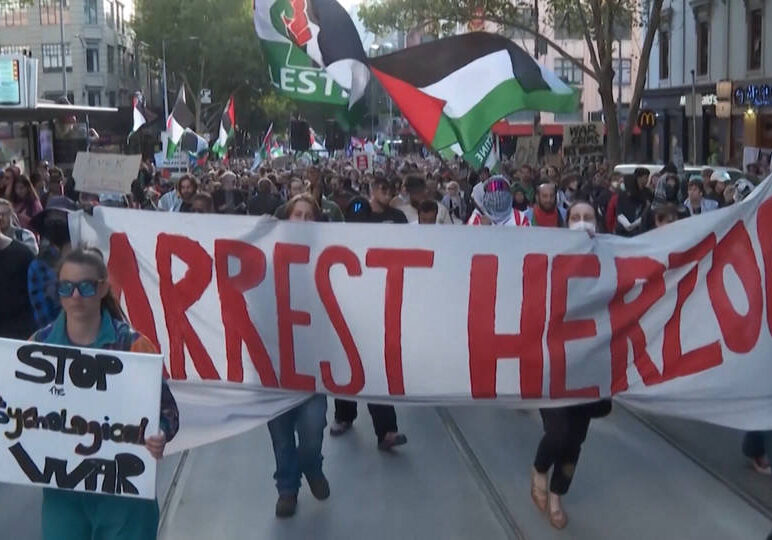
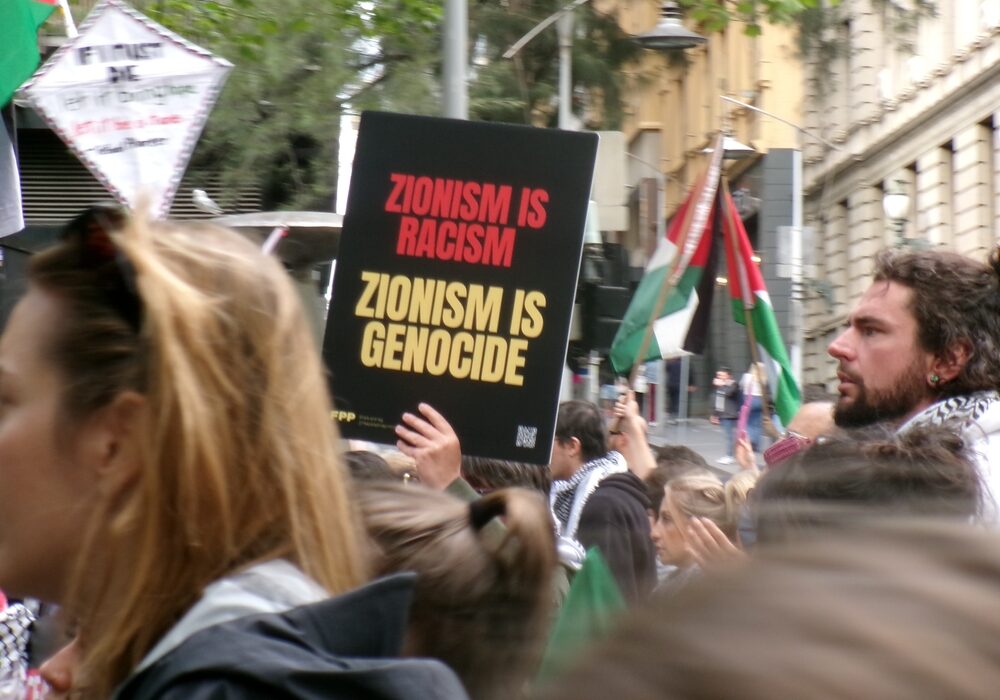
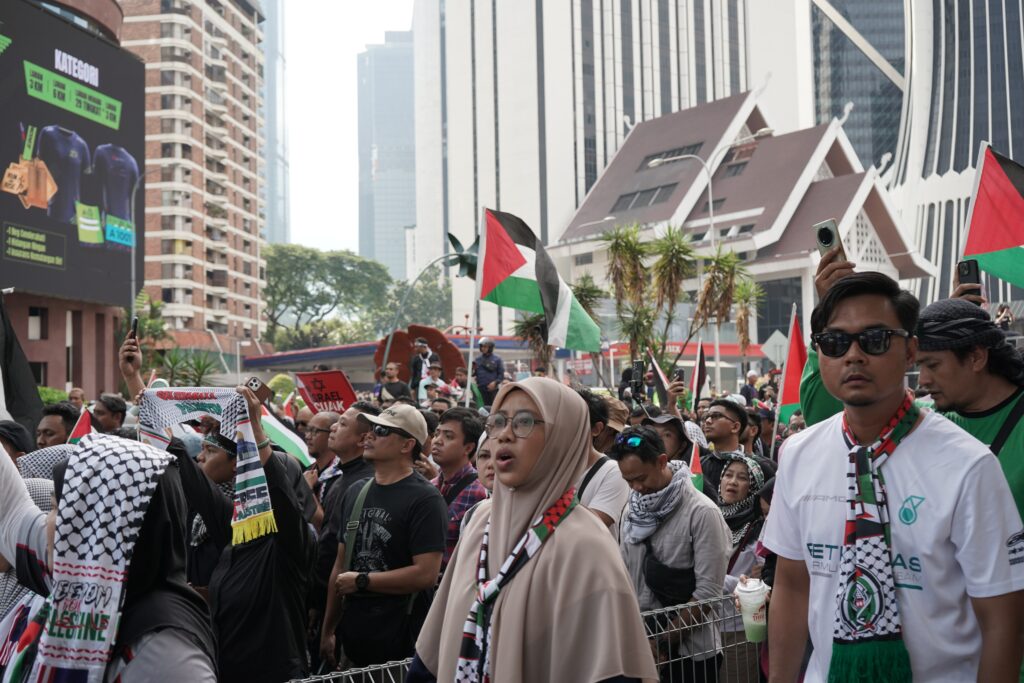
Meanwhile, pro-Palestinian rallies have continued to attract Malaysians of all backgrounds, but the tone and symbolism have been shifting. Large protests — often led by PAS, Muslim NGOs and hardline religious movements — increasingly feature Islamic chants and banners equating Gaza with a universal Muslim struggle.
At the massive “Solidarity Bersama Gaza” rally in October, organised in solidarity with the Global Sumud Flotilla activists, some Malay-Muslims felt it was a spiritual moment – one 21-year-old attendee told a reporter: “This is our ummah. Palestinians are our brothers. Their suffering is our suffering.”
But non-Muslim attendees described a different experience. A Hindu university student who joined for humanitarian reasons said she felt “out of place”, adding: “We support Palestine too. But when every speech is about Muslims and the ummah, you feel like you are not part of the narrative.”
Some non-Muslims’ attendance at the rallies fell away through the year, not out of disagreement with the cause, but discomfort with the increasingly religious tone and PAS’s prominent role.
Prime Minister Anwar Ibrahim’s Government has tried to project a unifying message, reiterating Malaysia’s long-standing position: strident opposition to Israel’s conduct, humanitarian support for Gaza and diplomatic backing for a two-state solution.
But the Government faced pressure from all directions. Islamist groups accused Anwar of being too cautious; non-Muslims complained the Government’s rhetoric increasingly leaned toward religious symbolism; while moderates in the governing Pakatan Harapan coalition privately worried that PAS was framing itself as “the true defender of Palestine” — a potent narrative for Malay voters.
When Anwar announced a major new aid package for Gaza in August, he urged Malaysians to maintain unity, saying: “Our compassion must not divide us. This is a humanitarian crisis, not an excuse for communal politics.”
But PAS leaders, including its influential clerics, quickly pushed back. One senior PAS figure responded: “This is not only humanitarian. This is jihad of the heart. Muslims must stand firm.”
For now, Malaysia remains broadly united in sympathy for the Palestinians. But beneath the flags, chants and speeches, two visions of solidarity are emerging — one civil, and one religious. The contest between them may shape Malaysia’s communal cohesion in the years to come.
Tags: Gaza, Islamic Extremism, Israel, Malaysia
RELATED ARTICLES