Australia/Israel Review
The scene of the crime
Dec 19, 2025 | Ahron Shapiro
A return to the decimated Gaza border communities
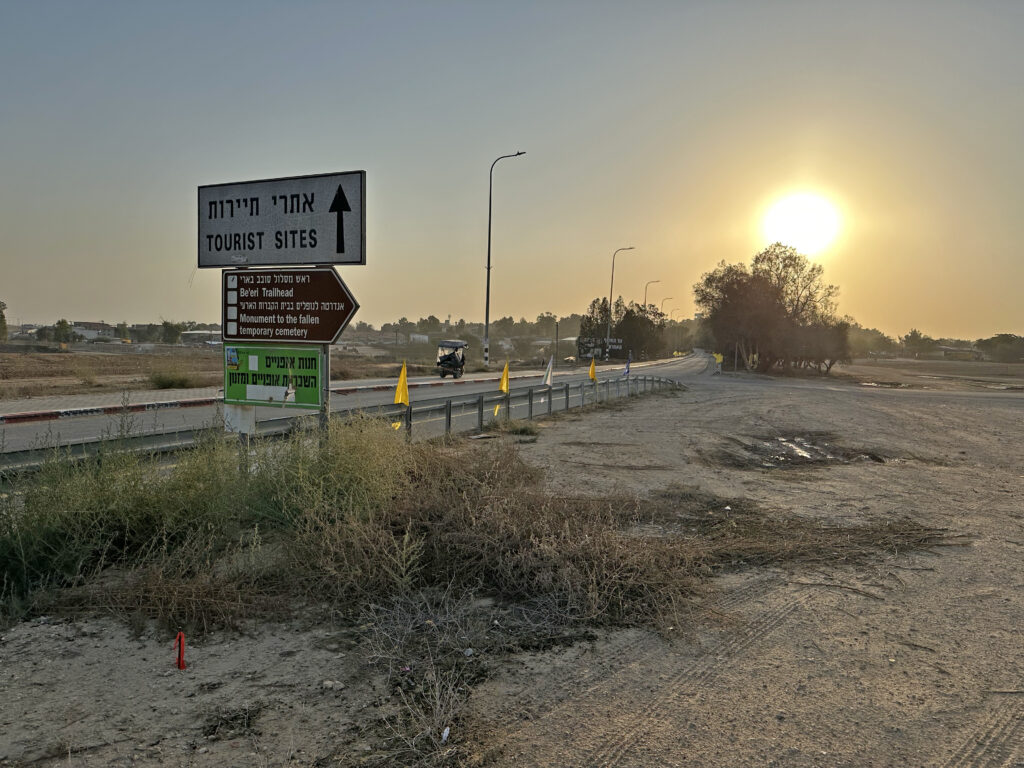
Stepping down from the bus at the junction for Kibbutz Be’eri along Israel’s Route 232 near the Gaza border, two things greet you: The first is the bus stop’s bomb shelter, which has been turned into a makeshift shrine for the people who had fled from the nearby Nova festival on October 7 and were murdered by Hamas inside. The second, across the road and off to the right, is a whimsical metal sculpture.
To be precise, it’s a giant bicycle several metres high, complete with a rider and tractor tyres for wheels. Its weathered red paint and motif tell me it was placed there before, when Be’eri was known as Israel’s mountain biking mecca. Before Hamas murdered 101 residents, before 30 hostages were taken from the area. Simply before.
Yet these days – for the first time since that cursed morning – this kibbutz and other hard-hit Gaza border communities are experiencing the stirrings of the day after.
A degree of closure arrived with the sudden, almost surreal return of the last 20 living hostages during the US-brokered ceasefire and prisoner release agreement in October 2025, followed by the gradual recovery of all but one of the 28 deceased hostages.
With the return of Dror Or and his burial in late November, the last murdered member of Kibbutz Be’eri was finally laid to rest in its cemetery. However, the circle has not yet been entirely closed. As of press time, the remains of Ran Gvili, an Israeli police counter-terror officer killed defending Kibbutz Alumim, are still held in Gaza.
Meanwhile, the IDF’s withdrawal to an agreed-upon “yellow line” as part of the deal left Hamas in control of about half of the Gaza Strip, and the chances of it disarming are low. This means the threats posed by Hamas against the country’s south post-war, while unquestionably reduced, are not completely different from they were before the war. Renewed Hamas attacks in the form of rockets, mortars, tunnel warfare, incendiary kites, drones and hostage-taking attempts can’t be ruled out – especially in the mid-to-long term.
What do the Gaza border communities think about rebuilding even as Hamas reestablishes itself in Gaza? For the answer to this question and many others, I arranged to meet Kibbutz Be’eri member Danny Majzner, brother of Galit Carbone – the only Australian citizen murdered on October 7.
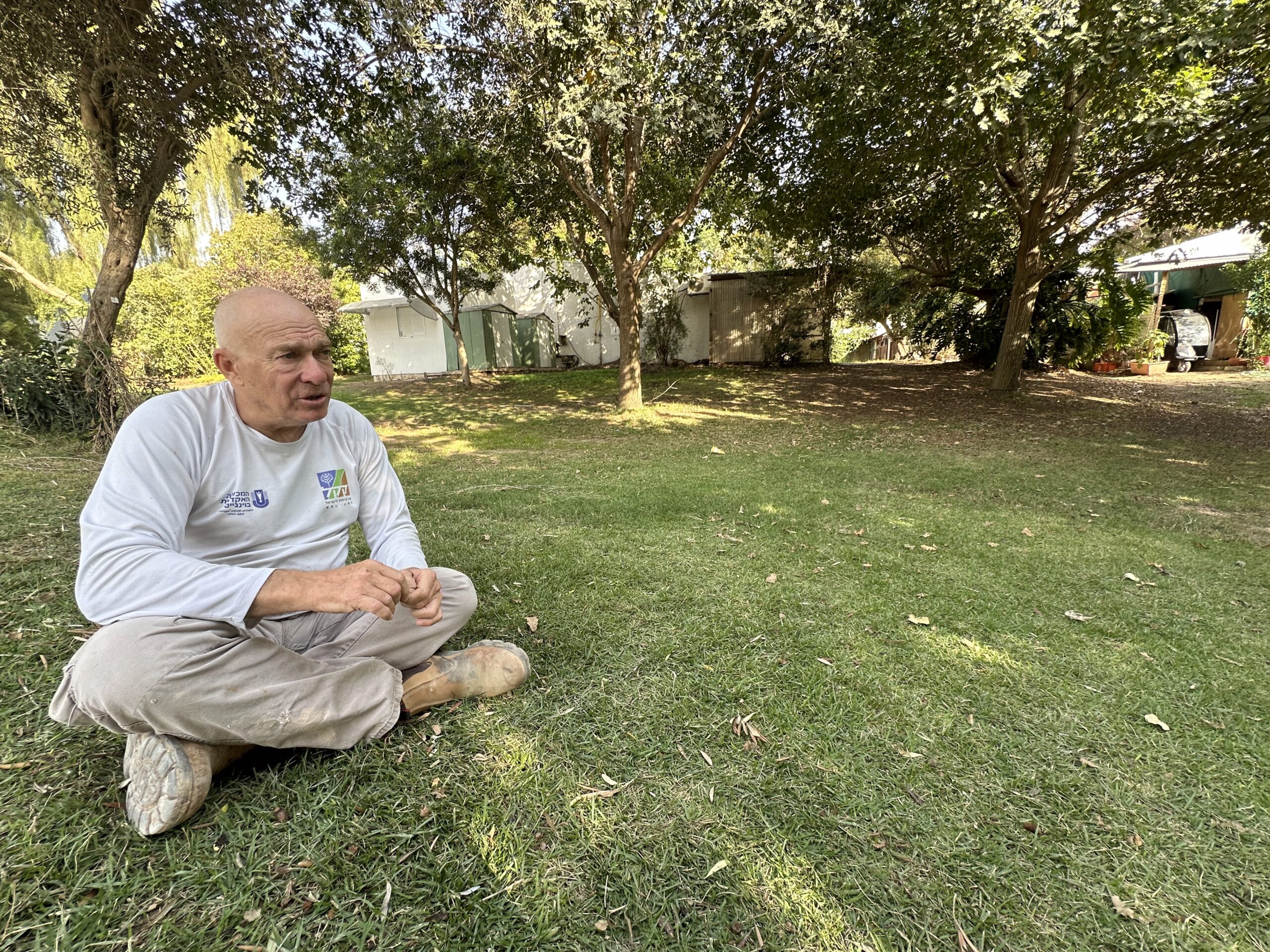
Kibbutz Be’eri resident Danny Majzner (Image: Ahron Shapiro)
The Return
In the immediate aftermath of October 7, the Israeli Government created the Tkuma (resurrection) Administration to handle the immediate and long-term needs of the evacuated residents. At first, it was most involved in the immediate need to arrange hotel and temporary housing solutions. The horizon of returning to life on the Gaza border was distant.
Today, its activities have a great deal to do with reviving and expanding the kibbutzim and making the entire region, including the city of Sderot, once again a special place to live, which creates dilemmas in terms of balancing the need to memorialise the victims of October 7 while giving the residents and newcomers a future that isn’t defined by the massacre.
After October 7, Israel evacuated all towns and cities within seven kilometres of the Gaza border. By the end of November 2023, it narrowed that mandatory evacuation zone to 4 km. However, it wasn’t until June 2025 that the IDF declared it was safe to return to all areas.
Whether people themselves were keen on living so close to the front was another story. Until the ceasefire, the jarring sounds of nearby artillery guns and other explosive blasts remained inescapable.
Nonetheless, more than 90% of the Gaza envelope’s 64,000-strong population had moved back by September 2025. Yet Kibbutz Nahal Oz has only just begun its return, while Be’eri, Kfar Aza, Kissufim and Holit aren’t expected to be repopulated until next year. Nir Oz, which had one-quarter of its residents killed or taken hostage and almost all of its homes severely damaged or destroyed, will only be ready to reopen in 2027.

The bus stop bomb shelter outside Be’eri in which 16 people fleeing the nearby Nova music festival were massacred – now a makeshift monument (Image: Ahron Shapiro)
Nova’s Makeshift Memorial
Surprisingly, Tkuma has not been involved with developing the poignant memorial at the Nova festival site. That arose from a grassroots level. Grieving families and friends started coming and leaving photos and makeshift obituaries there. Seeing a need, artist Amir Chodorov is credited for helping design the space, unifying the elements and weatherproofing them. The NGO KKL-JNF, on whose parkland the site sits, invested millions in developing infrastructure like a paved access road, parking lot and semi-circular seating areas off to the side where guides – often Nova survivors themselves – today tell their stories to visiting groups.
Meir Zohar, the father of a Nova victim and representative for the families, who was heavily involved in the site’s development, told Ynet in March that when he first brought his daughter’s picture to the site, a KKL-JNF manager he met empathised about the lack of a proper dignified memorial.
“[He told me] ‘Forget about [government] decisions, forget about bureaucracy, let’s do this together.’” And so it was. “My dream is that there will be a museum here, like [Israel’s Holocaust museum] Yad Vashem,” he continued, “that the burnt cars [the 1,500 Hamas incinerated] which are on display [currently at nearby Moshav Tekuma] will come here and even the [bus] shelters [where people were murdered].”
Since the Nova memorial has officially become the most visited site in Israel – more than even Masada or Caesarea – one can see some logic to unifying October 7 memorials into one central location along the highway that connects all the massacre sites.
Danny Majzner, however, doesn’t agree.
Remembrance and Reconstruction
Danny, like most Be’eri members today, currently lives temporarily in Kibbutz Hazerim, 40 minutes away. But he visits Be’eri often.
Arriving early for our meeting at Be’eri, I stopped at the landmark La Medavesh (“For the Peddler”) bike shop and kiosk outside the gates and checked over my notes on my laptop.
When Danny arrived, he told me that Be’eri, like several other devastated kibbutzim, hasn’t made up its mind whether to preserve any of its own ravaged homes or start with a clean slate.
From his perspective, he believes that while the Nova memorial is important, it’s not the right place to tell the story of what happened at Be’eri.
“I hope that the kibbutz will be sensitive enough to leave one [ravaged] duplex up for the next generations. Otherwise, if we take everything down, there’s nothing to show to my grandkids what happened here.
“People say ‘we don’t want to walk in museums,’ and I can understand, yet something happened here, for goodness’ sake!” [Subsequent to this encounter, the members of Be’eri voted 196-146 to demolish and replace all but one of the homes heavily damaged on October 7- Ed.]
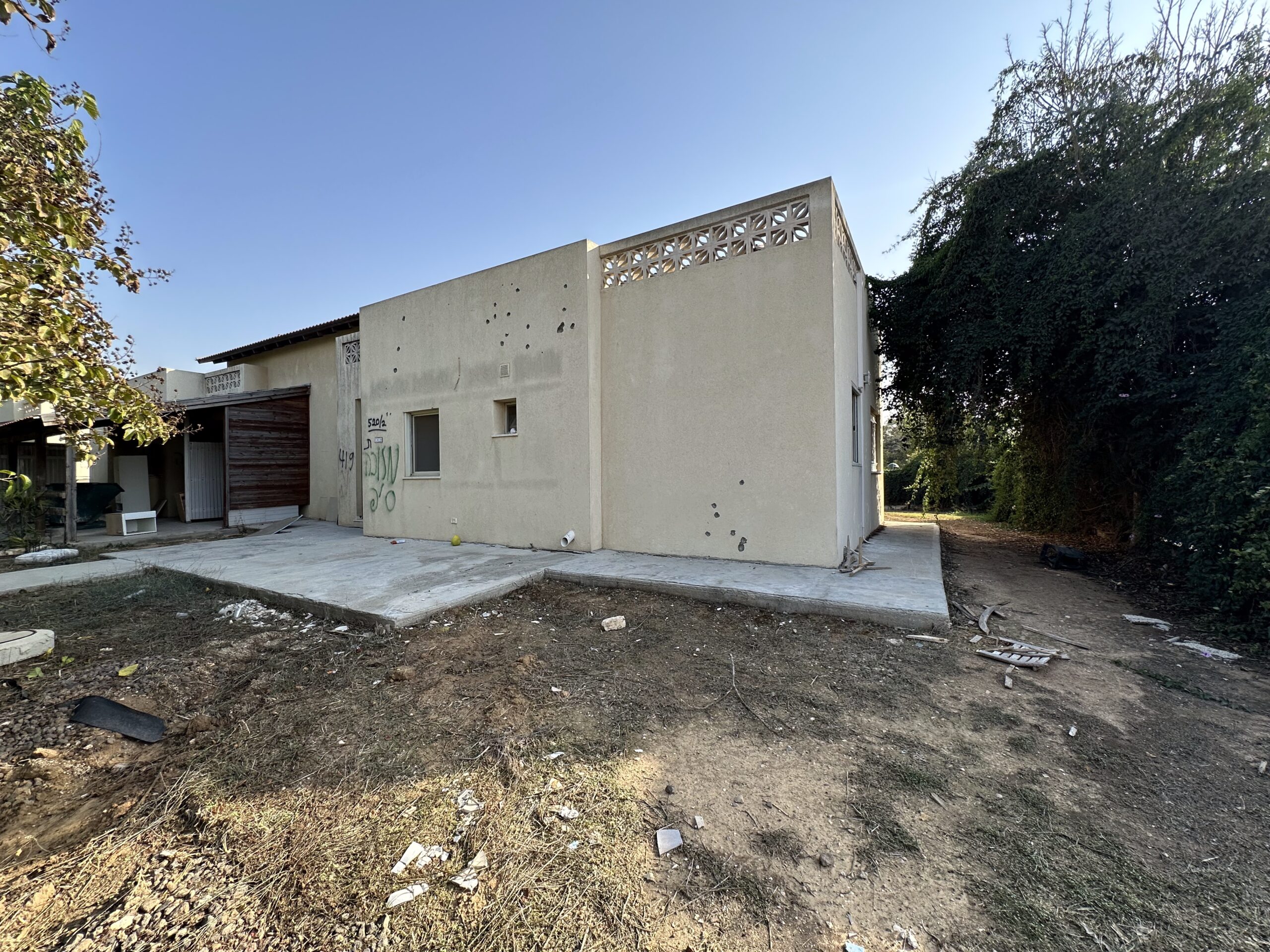
One of the 120 homes in Be’eri that were heavily damaged on October 7, and whose fate is now being decided by Kibbutz members (Image: Ahron Shapiro)
In any case, while about 120 of the worst damaged homes remain standing, some kibbutz members have made themselves available to take small, pre-organised groups to bear witness to the destruction and hear the stories of those who died from those who survived.
It should be emphasised, however, that visitors are not welcome to enter Be’eri or any other kibbutz affected by October 7 uninvited and unescorted.
Danny suggested that he, too, would show me a couple of homes of people killed, and tell me the stories behind them, and then we’d find a place to sit in the shade and talk some more.
I have to say, my first impression of Be’eri was that it’s really spacious and naturally beautiful. Danny tells me that before October 7, they liked to say that it was 90% heaven and 10% hell. The “hell”, of course, was when the rockets and mortars would come, sending kids running to the bomb shelter with 15 seconds’ notice. Yet nothing prepared them for the attack that was to come.
Initially, as we drive around, nothing seems amiss. It’s lovingly landscaped with lots of flowers and greenery, tall hedges and trees that mask the full extent of the damage from many vantage points.
It’s also buzzing with activity, which Danny explained was almost entirely day trippers who come down to handle kibbutz business, but return to Hazerim at night.
Soon we get to a road that splits two neighbourhoods, Kerem (“vineyard”) and Zeitim (“olives”). Here, we stop, and from the looks of it, every house in sight was besieged and destroyed. Danny tells me Hamas saw to it that practically everyone in this area was either murdered, kidnapped, or both.
He takes me to the homes of two victims. Either visit could be a feature story in its own right, but I’ll have to be concise and link to some longer stories (click through to see the stories of: Vivian Silver; Maayan & Yuval Bar; Sgt. Ariel Ohana; and Lt. Nave Lax).
The first home was that of Canadian-Israeli Vivian Silver, a peace activist who advocated for Gazans and took them for treatment in hospitals in Israel. I take a minute of silence in the safe room where her body was found, burnt beyond recognition.
Nearby, I enter the devastated home of Yuval and Mayan Bar, both killed on October 7. The following day, two IDF soldiers, Ariel Ohana and Naveh Lax, were themselves killed here in a battle trying to regain control of their house. The house has become a unique space for remembering both the victims of Be’eri and those who lost their lives trying to save them and reclaim their homes.
An old security idea revived
The relationship between the kibbutz and the army is destined to grow closer in the future.
One of the matters under discussion is a revival of Nahal “garinim” (seeds) – soldiers who will commit to live and work on border kibbutzim for a year, serving in a combat unit for 20 months, and then returning for another year. This program, which was active from the country’s independence until the 1990s, was thought to have become obsolete with the advent of modern warfare.
Post-October 7, these squads will bolster the kibbutz emergency response teams that were never designed to fend off a major infiltration. Some will surely remain and rejuvenate the kibbutz.
We rested on the shady grass, and here I saved the hardest question for last – the one that had been on my mind since I arrived. With the war apparently ending with Hamas remaining in its part of Gaza, how does a community that suffered so much return to live in a place where Hamas has vowed to attack again and again?
“It is a problem,” Danny sighed, “because my daughter, son-in-law and granddaughter [truly want] to come back here, yet, in this situation, where there are still 10,000 or 15,000 Hamas terrorists in Gaza, and they still rule Gaza, they have no intentions of coming back here. And it’s a problem because probably by mid-2027 we’ll [all] have to leave the temporary residence in Hazerim, and people will have to make decisions.”
Danny has already made his own. He’s coming back. Not to his old place, but perhaps sentimentally, to a damaged one that belonged to his friend Ziv Shopen. Ziv was in Tel Aviv on October 7 but rushed back to try to help save people in the kibbutz, and was tragically killed.
Danny showed it to me from the car.
“See it’s that one,” he pointed, “with the bullet [holes]. This is going to be my house. I’m waiting for the permits [to renovate].”
To which I said nothing. I found myself at a loss for words.
Our last stop was the new neighbourhood, where 70 homes are under construction. The idea is for the members who lost their homes to live in them first. Soon, though, the kibbutz will be accepting new members. While Danny estimates that 20% of the Be’eri survivors may ultimately choose not to return, from reports there is a waiting list, not just here, but for all the Gaza border kibbutzim, of people applying to join. The demand exceeds their absorption capacity, and the kibbutzim are now on track to come back larger, younger and stronger.
Forward…
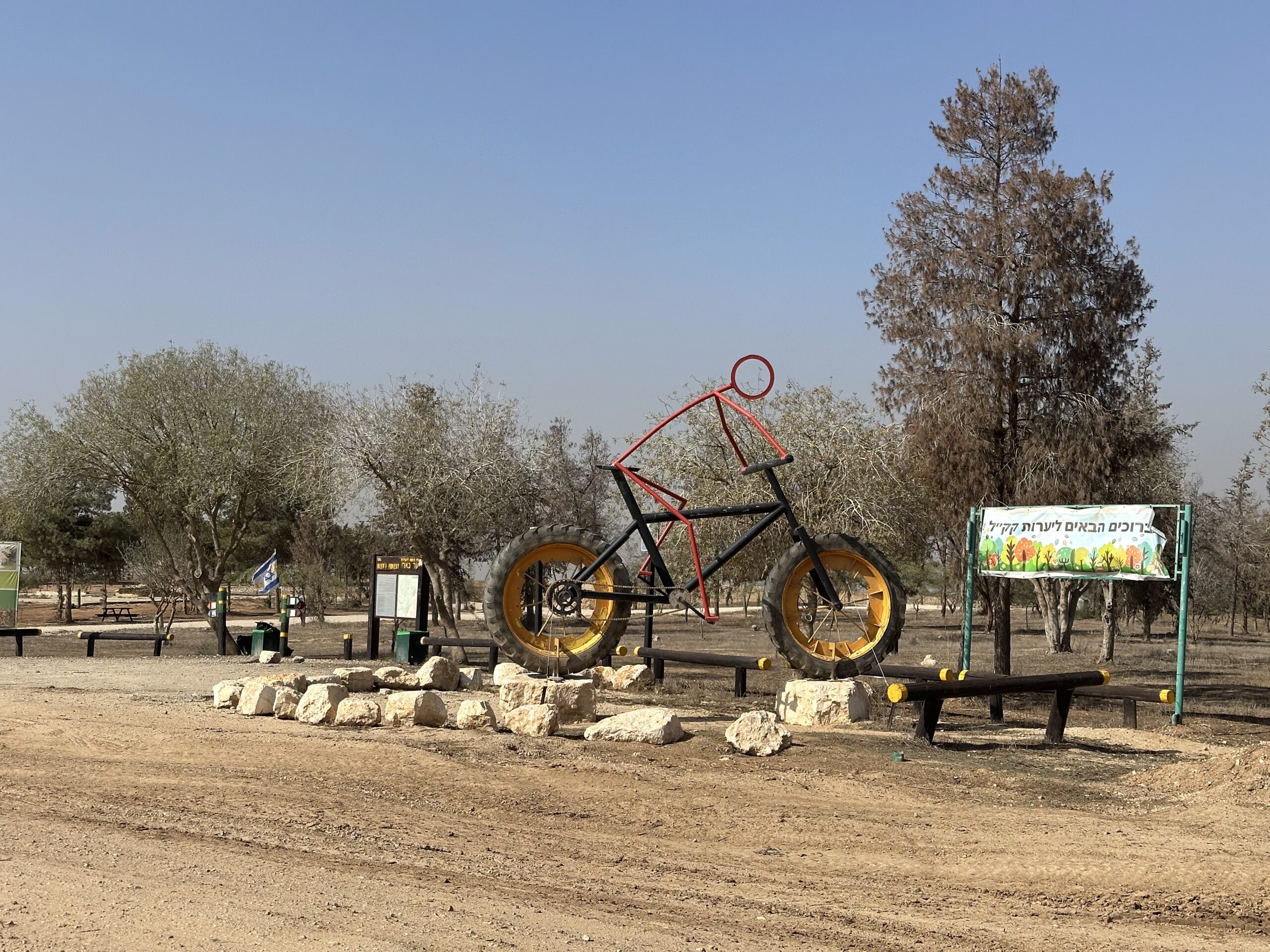
A monument from a happier time outside Kibbutz Be’eri, when the village was best known as a centre for mountain biking, instead of a massacre site (Image: Ahron Shapiro)
Despite the best intentions of Tkuma, according to reports, bureaucratic issues have sometimes held up payments, leaving the kibbutzim to raise money on their own to ensure reconstruction gets done on time and the way they need it to be.
Danny hinted this was true for Be’eri, as well. The kibbutz’s fundraising campaign can be found online at “rebuildbeeri.org”.
As I made my way back to the bus stop and then to the train station in Sderot, my mind swimming with emotion as I tried to make sense of what I had seen and heard, I found myself lingering again in front of that famous bicycle sculpture – which for some reason, looked very different.
When I arrived, the artwork looked like a heartbreaking relic of Be’eri’s past, when it was famous for mountain biking, not as a site of mass murder. Yet after all I had seen and heard, I felt like it spoke more to its promising future.
You see, one of the features of a mountain bicycle is that it can’t be ridden backward. Only forward.
RELATED ARTICLES